www.scheppach.com
44
|
GB
The device and its accessories are made of dierent
materials, such as metals and plastics.
Take defective components to special waste disposal
sites. Check with your specialist dealer or municipal
administration!
Old devices must not be disposed of with house-
hold waste!
This symbol indicates that this product must
not be disposed of together with domestic
waste in compliance with the Directive
(2012/19/EU) pertaining to waste electrical and
electronic equipment (WEEE).
This product must be disposed of at a designated col-
lection point.
This can occur, for example, by handing it in at an
authorised collecting point for the recycling of waste
electrical and electronic equipment. Improper han-
dling of waste equipment may have negative conse-
quences for the environment and human health due
to potentially hazardous substances that are often
contained in electrical and electronic equipment. By
properly disposing of this product, you are also con-
tributing to the eective use of natural resources. You
can obtain information on collection points for waste
equipment from your municipal administration, public
waste disposal authority, an authorised body for the
disposal of waste electrical and electronic equipment
or your waste disposal company.
Connections and repair work on the electrical equip-
ment may only be carried out by electricians.
If the power cord of this device is damaged, it must
be replaced by the manufacturer, their service depart-
ment or a similarly qualied person to avoid dangers.
17.2 AC motor
• The mains voltage must be 220–240 V~.
• Extension cables up to 25 m long must have a
cross-section of 1.5 mm².
• Extension cables over 25 m long must have a
cross-section of 2.5 mm².
Connections and repair work on the electrical equip-
ment may only be carried out by electricians.
Please provide the following information in the event
of any enquiries:
• Type of current for the motor
• Data of machine type plate
• Data of motor type plate
18. Disposal and recycling
The equipment is supplied in packaging to
prevent it from being damaged in transit.
This packaging is raw material and can thus
be used again or can be reintegrated into the
raw material cycle.
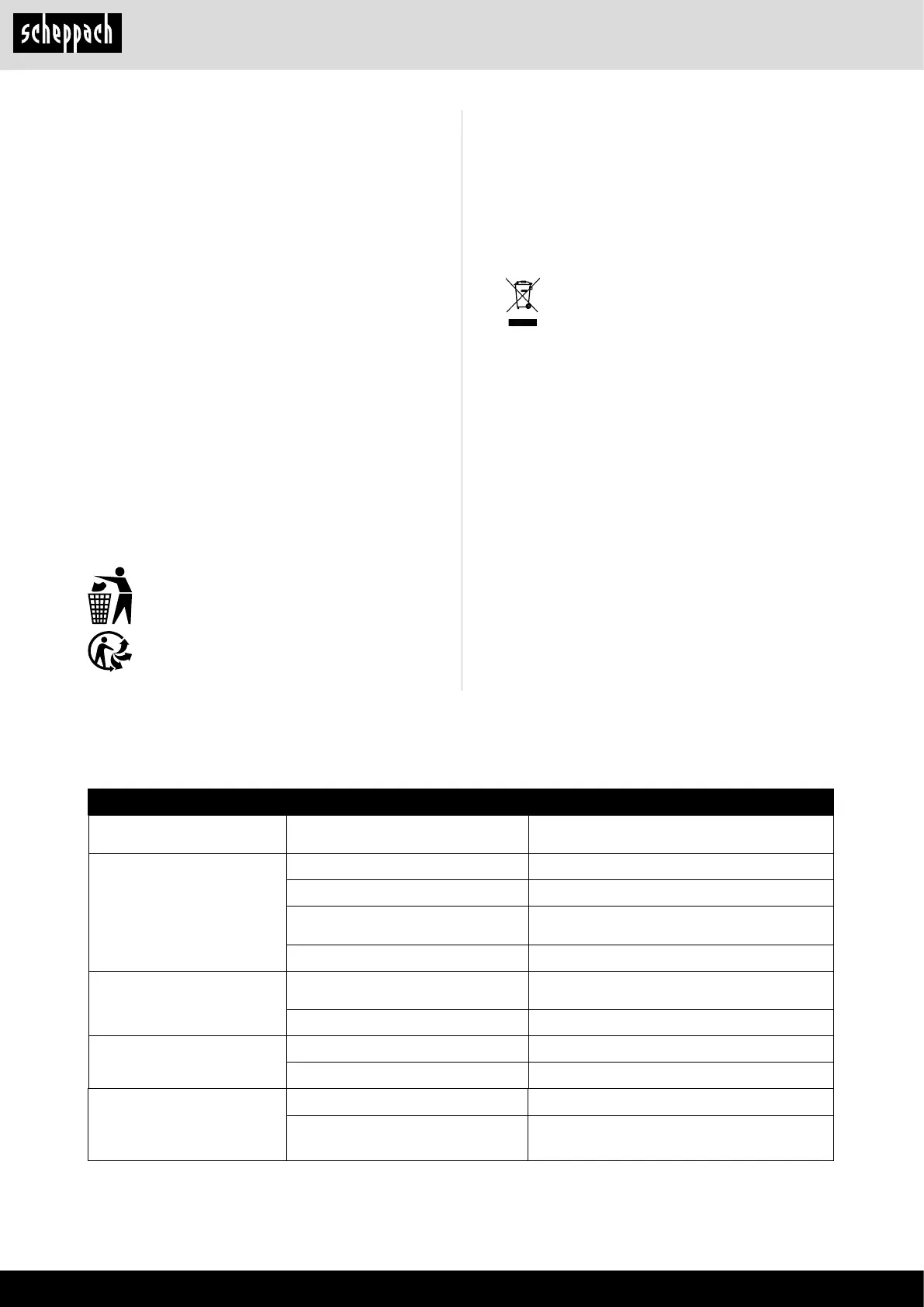
19. Troubleshooting
The following table shows fault symptoms and describes remedial measures in the event of your machine failing to work
properly. If you cannot localise and rectify the problem with this, please contact your service workshop.
Problem Possible cause Help
Saw blade gets loose after
turning o the motor
Fixing nut not tight enough Tighten xing nut with right-hand thread
Motor does not start Mains fuse blown Check the mains fuse
Extension cable defect Replace the extension cable
Connections to the motor or switch
not OK
Have it checked by an electrician
Motor or switch defective Have it checked by an electrician
Motor not supplying power,
fuse tripping
Cross section of the extension cable
insucient
See “Electrical Connection” in the operating
manual
Overload due to blunt saw blade Replace saw blade
Burn areas at the cutting
surface
Blunt saw blade Sharpen saw blade, replace
Wrong saw blade Replace saw blade
Motor turning sense incorrect Capacitor defective Commission check by an electrician
Incorrect connection Have an electrician transpose the wall plug
poles


 To Next Page
 Loading...