| Page 32 | SEABOB Operation Manual |
5
into the water. On models with the Accumulator Change
System (ACS), ensure that the accumulator box ACS has
been attached securely to the SEABOB housing so that
no water can leak in.
Always ensure that the sealing cap has been placed se
-
curely on the charging socket.
Never plug the charging plug into a moist or wet
charging socket for charging.
The charging socket is hermetically sealed to prevent wa
-
ter from leaking into the accumulator box. Water, in par
-
ticular salt water, on the contacts of the charging socket
or charging plug may result in strong chemical reactions
while charging, causing irreparable damage to the charg
-
ing socket contacts and the charging plug.
For this reason, you should always check to make sure
that the charging socket and charging plug are perfectly
clean and dry before plugging the charging plug into the
charging socket of the accumulator box. Always put the
sealing caps back on the charging socket and charging
plug immediately after charging is completed. Only open
the charging socket and charging plug for the charging
process.
Before charging, always dry the charging socket and
charging plug using a soft, clean cloth and / or cotton
swab, and blow the water out of the contacts. If neces
-
sary, first rinse off any salt deposits with clear water.
Before rinsing off components, ensure that the
mains plug has been disconnected from the mains
socket. Not doing so may result in electric shock!
Using auxiliary power units / electric generators:
Only electric generators with precise closed-loop
control suitable for connection to electronic de
-
vices are permissible. Asynchronous generators are not
suitable and can result in destruction of the chargers.
Furthermore, there is danger of injury in the event of
destruction. Use of electric generators with inverter tech
-
nology is preferred. The continuous power of the genera
-
tor must be greater than the input power of the charger
(see rating plate).
5.3 Installing the accumulator box ACS
(Accumulator Change System)
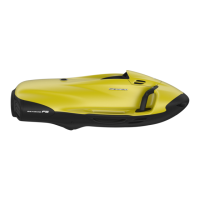
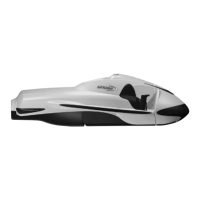
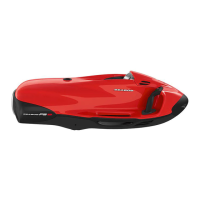
Note: The following description applies only to the
SEABOB CAYAGO VX2 and SEABOB CAYAGO F7 mod-
els with Accumulator Change System (ACS). These
are the only models on which the accumulator box
ACS can be detached from the SEABOB housing and
changed.
1. Place the accumulator box ACS on a dry and sturdy
surface that will not damage any components.
Prevent the sealing surfaces and contact surfaces
on the SEABOB ACS and accumulator box ACS
from getting dirty, particularly from blowing dust or sand.
Do not place the accumulator box on surfaces covered
with grass or similar. When connecting the accumulator
box and SEABOB housing, blades of grass may get in
between the sealing surfaces, reducing the effectiveness
of the seal.
Each time prior to activation of the accumulator box ACS,
always check the sealing surfaces and contact surfaces of
the SEABOB and accumulator box. If necessary, clean the
surfaces using a clean, damp, lint-free cloth.
Prevent the high-current contact plate of the ac-
cumulator box and the high-current connector
plate of the SEABOB from coming into direct contact
with water. These components are not sealed to pro
-
tect them from sprayed or pressurised water. Protection
from sprayed or pressurised water is provided solely by
the quad ring and spacer O-ring (sealing rings) on the
electronic system of the SEABOB motor, and only if the
accumulator box ACS has been securely connected to the
SEABOB and the SEABOB is ready for operation. Water
leaking into the motor‘s electronic system or the accu
-
mulator box may cause complete destruction of the elec
-
tronic system and motor or lead to discharge of flaming
gases from the accumulator cells, causing injury.
2. At the latest after changing the accumulator ten times,
you should wipe off the sealing surfaces and contact
surfaces on the high-current connecting plates of the
accumulator box ACS and SEABOB ACS using a soft,
clean, lint-free cloth, so that they are clean and dry. At



 To Next Page