handheld instruments. There are no service panels, viewing op-
tics or scanning elements; requirements for these objects are
thus not applicable. There shall be a mechanical attenua-
tor/beam stop available to make it possible to block the beam
from the nozzle temporarily. The stop is released with the instru-
ment enclosed Calibration Unit, which also makes double duty
as a dust cap. Class 3B is one of the most severe classes;
meaning that it is easy to permanently harm the eye when the
product is not used properly. A class 3B product is not suited as
a consumer product since the operator needs to be trained to
use proper procedures to avoid eye damage. A safety interlock
is needed to ensure that only trained operators use the instru-
ment. A software requirement solves this; the operator needs to
login with a PIN number to use the instrument. The software also
turns the instrument off when inactive and a new login with PIN
number is required. Ensure the beam is always terminated at a
suitable non-specular (i.e., non-mirror- like) surface. Do not di-
rect the beam at other people or into areas where other people
unconnected with the laser work may be present. Refer to the
International standard EN 60825-14 users’ guide for guidance
on identifying and controlling hazards associated with laser use.
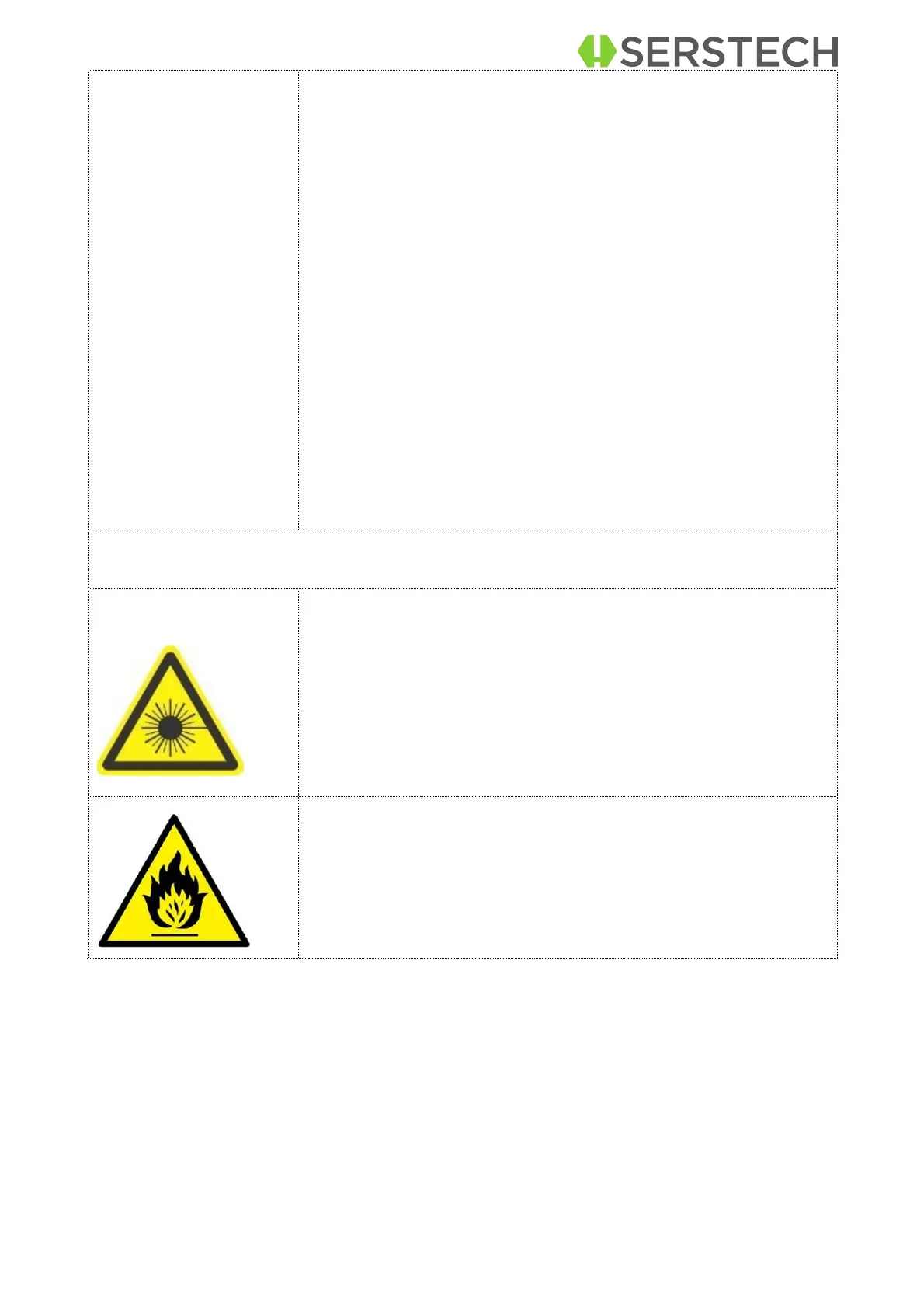
WARNING: Exposure to levels of invisible laser energy above
the MPE can be harmful to the eye. The minimum safety dis-
tance (Nominal Ocular Hazard Distance, NOHD) is 100 cm from
the invisible laser aperture to avoid exposure to levels above the
MPE. The output power is 300 mW at 785 nm. Always avoid
exposure to the beam. Use administrative controls, engineering
controls, and/ or laser safety glasses to avoid exposure to invis-
ible laser radiation within the 100 cm hazard zone. Use invisible
laser safety eyewear of an optical density (OD) greater than 3.
WARNING: Scanning a thermally sensitive material may cause
burning of the target. If the sample is contained in a tightly sealed
vessel (e.g., a capped vial), pressure may build up during the
scan, causing subsequent explosion of the vessel.


 To Next Page