Mower FA
- 29 -
8.4 CHECK AND REPLACING THE BLADES
To obtain optimal machine operation, frequently check (every 50 working hours)
that the mower blades are in good working order, sharp and completely secured
by the locking bolts.
CUTTING AND CRUSHING HAZARD!
Wear cut-resistant gloves and secure the mower on solid
supports.
Proceed as follows to replace the blades:
• Place the mower on solid supports;
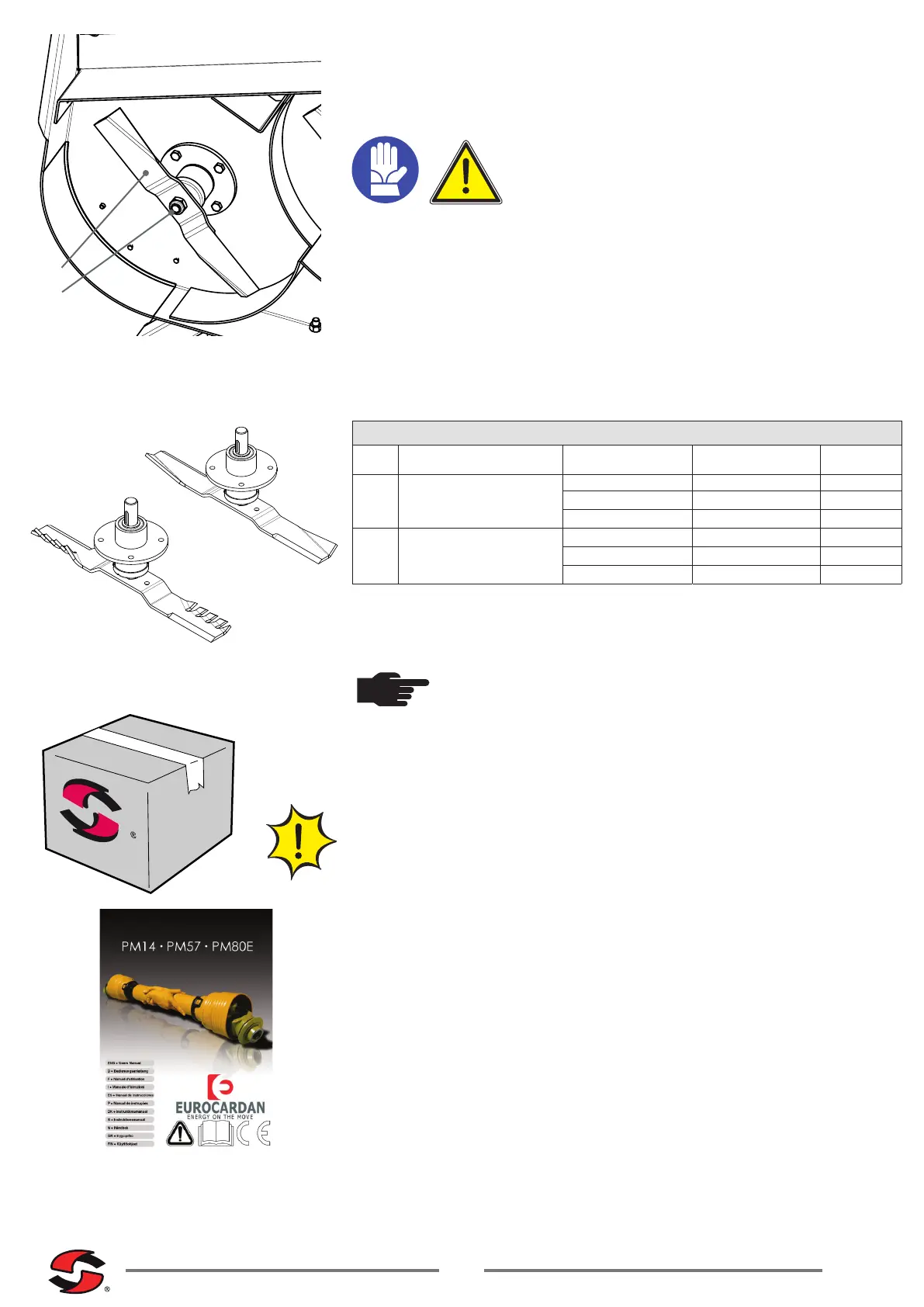
• Unscrew nuts “A” while keeping the blades “B” still;
• Remove the blades “B”;
• Replace the old blades with a new set;
• Reassemble the new blades in their original position;
• Tighten the self-locking nuts “A” thoroughly keeping the blades “B” stationary.
Refer to the table below to identify the correct blade code.
SPARE BLADES CODES
REF Description Mower Code Qt
C Standard blade
FA1200 5812701 3
FA1500 5812702 3
FA1800 5812703 3
D
MULCHING blades
(optional)
FA1200 5812712 3
FA1500 5812713 3
FA1800 5812714 3
When even a single blade is worn or damaged, replace the entire set of
blades. Failure to replace all blades will cause hazardous imbalances.
NOTE:
Whenever the blades are disassembled from their supports, the self-
locking securing nuts must be replaced with new equivalents.
Replace blades and their securing elements with original spare parts by contacting
your nearest dealer. Not mounting the original blades may result in abnormal
vibrations of the machine.
WARNING!
Sicma disclaims all liability from harm that may arise from non-compliance
with the requirements described above.
9. PTO DRIVE SHAFT
For both lubrication and maintenance of the PTO drive shaft supplied with the
mower, proceed as described in the corresponding use and maintenance manual.
10. SCRAPPING
In the event of scrapping, the machine must be disposed of in suitable waste
disposal sites, in compliance with the Law in force.
In Italy, prior to scrapping, plastic or rubber parts must be separated from metal
parts. Parts made up of only plastic, aluminium and steel materials can be
recycled, if collected by dedicated centres.
Recover any waste oils and dispose of them at relevant collection centres. Used oil
must be appropriately recovered and must not be dispersed in the environment as,
according to current regulations, it is classied as hazardous waste and as such
should be taken to the appropriate collection centres. For the collection of used oils
it is essential to contact the "Obliged Obligatory Consortium" (www.coou.it, green
number 800-863048);
For the other countries, refer to the relative anti-pollution regulations in force.
C
D
A
B



 To Next Page