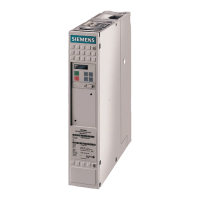
SIMOVERT P 6SE21 Series Inverters
English
Operating Instructions
Siemens plc 1995
G85139–A1615–U156–A
02.95
9
The output frequency of the inverter, and hence the speed of the motor, can be controlled by any of the following means
(see 5.3.2, parameter P04 and also Figure 3)
:
(1) Connection of 0–10 V control voltage (terminals X11.7/8).
(2) Connection of a 0–20 mA current loop control input (terminals X11.9/10).
(3) Connection of a 4–20 mA current loop control input (terminals X11.9/10).
(4) Connection of a 5 kΩ control potentiometer (terminals X11.6/7/8).
(5) By digital parameterisation via the push–buttons fitted to the inverter, or via equivalent external push–buttons
connected to terminals X11.17 and X11.18.
(6) Via the serial I/O connection.
1.3 Monitoring Facilities
The following monitoring facilities are available:
(1) Seven–segment display for output frequency, output current, fault indication or parameterisation. This is
viewed through a window in the cover.
(2) A 0–10 V analogue signal, proportional to output frequency or output current.
(3) A changeover relay, normally energised when the drive is connected to a suitable input supply. The relay is
de–energised when a fault is indicated
(see section 5.5)
.
(4) The drive may be interrogated via the serial I/O connection.
1.4 Motor Characteristics
The inverter can be adjusted to suit individual motor characteristics in the ways described in 1.4.1 and 1.4.2.
1.4.1 Voltage/Frequency Characteristic
Six voltage/frequency characteristic curves are available plus one programmable curve
(see
Figure 2)
. They are
intended for the following applications:
Curve 0: V
N/50 Hz (constant torque)
For standard 50 Hz induction motors with linear speed/torque characteristics.
Curve 1: V
N/60 Hz (constant torque)
For standard 60 Hz induction motors with linear speed/torque characteristics.
Curve 2: V
N/87 Hz (constant torque)
For delta–connection of standard induction motors designed for star–connection of 50 Hz input voltage.
This increases the speed range over which constant motor torque can be achieved.
Curve 3: V
N/120 Hz (constant torque)
For applications where a constant torque is required over the full operating speed range 0.1 to 120 Hz.
Curve 4*: V
N/50 Hz (torque proportional to speed
1.5
)
For operation of 50 Hz motors driving loads where torque is proportional to (speed)
1.5
. Typical examples
of such loads are fans and pumps.
Curve 5*: V
N/60 Hz (torque proportional to speed
1.5
)
For operation of 60 Hz motors driving loads where torque is proportional to (speed)
1.5
.
Curve 6*: Programmable
(not shown in Figure 2)
The curve type and corner frequency may be selected by the user.
* Curves 4 and 5 allow variable torque output current values (see section 2.1) to be loaded into parameter P17. Curve
6 may allow variable torque output currents depending on the user–defined curve specified.


 To Next Page
 Loading...