SYSTEM OPERATIONS-53
PROPULSION SYSTEM
Propulsion of your 34C is accomplished
by two inboard engines, located within
the engine compartment. Depending on
the option you chose upon purchase from
your Silverton dealer, the engines are ei-
ther fueled by gasoline or diesel fuel. Each
engine transmits its power to a separate
transmission, which rotates the attached
propeller shaft and the propeller, provid-
ing forward or reverse movement of your
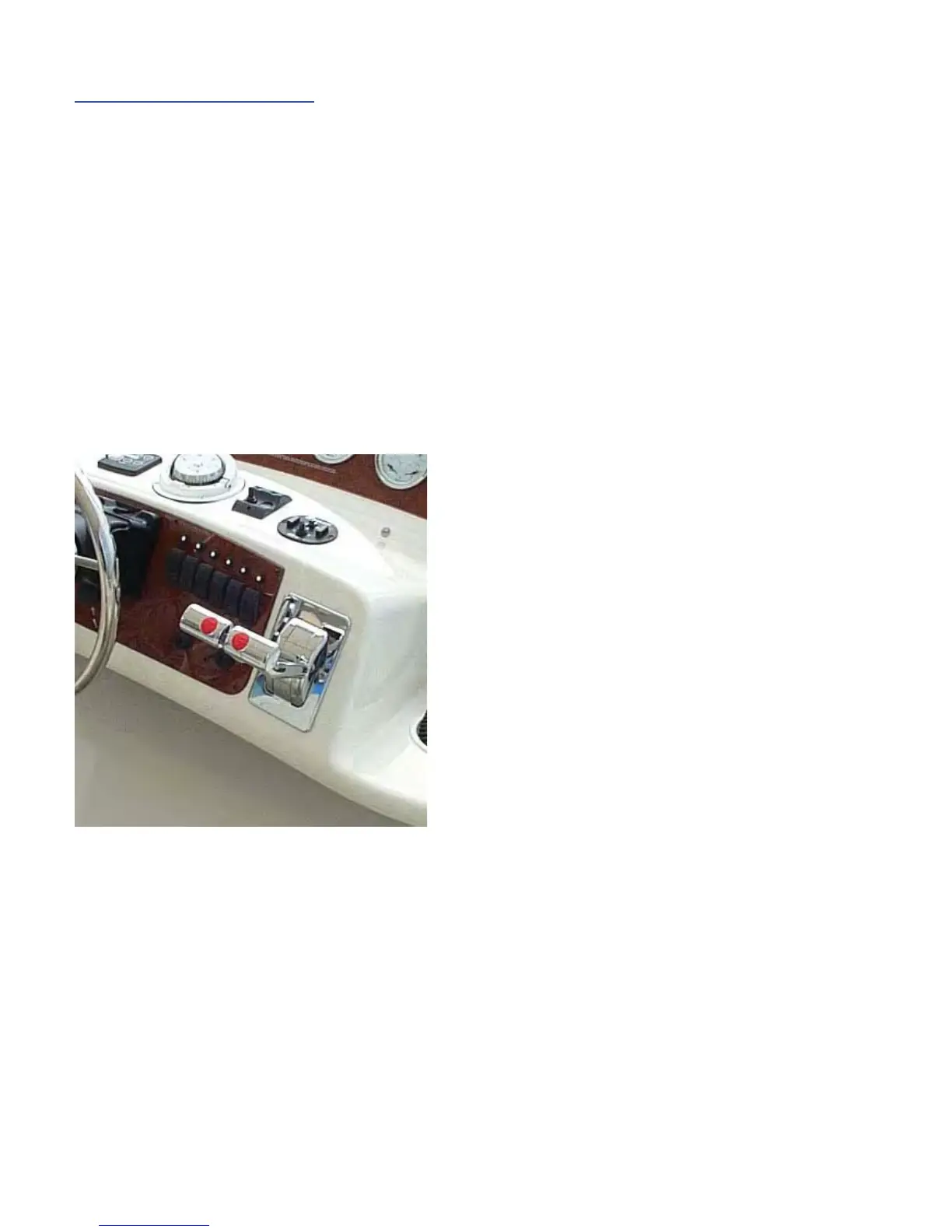
yacht as selected from the shift control
unit located on the Port side of the helm.
The photo below shows the Throttle and
Shift Control at the Helm.
The transmissions are counter-rotating.
This is defi ned as when in the forward
shift mode and viewing forward from aft,
the Port transmission rotates the Port pro-
peller counterclockwise and the Starboard
transmission rotates the Starboard propel-
ler clockwise.
The engine starting procedure is as fol-
lows:
Open and inspect the engine compart-
ment. Use your sense of smell to detect
the presence of fuel fumes. Access to the
engine compartment in your 34C is provid-
ed through the hatch located in the fl oor
of
the Salon.
Turn battery switch ON.
Operate the bilge blower motors for at
least fi
ve (5) minutes. Listen to make sure
blowers are on.
Check the bilge water level. If it appears
above normal, turn ON the bilge pump(s)
and remove the water. Determine the
source of the excess water and repair, if
necessary, before starting the engines.
Check the bilge for the presence of any
oil. Determine the source of the oil and
repair, if necessary, before starting the
engines.
Open both engine seawater intake
valves (location of these valves are shown
on the Mechanical Layout in the Schemat-
ics Section of this Owner’s Manual). The
valves are open when the handles are
parallel to the valve body (See photograph
below and the adjacent photograph, which
illustrates the open and closed positions of
the engine seawater intake valves).



 To Next Page