EasyManua.ls Logo

Simoniz S1700 - User Manual

Simoniz S1700
24 pages
Print Icon
To Next Page IconTo Next Page
Loading...
PLEASE KEEP THE ORIGINAL BOX, PACKAGING AND RECEIPT.
BEFORE OPERATING THIS UNIT, PLEASE READ THIS MANUAL THOROUGHLY AND
RETAIN IT FOR FUTURE REFERENCE.
39-8673-0
If you have any questions or comments,
please call our toll free hotline
1-866-4SIMONIZ (1-866-474-6664)
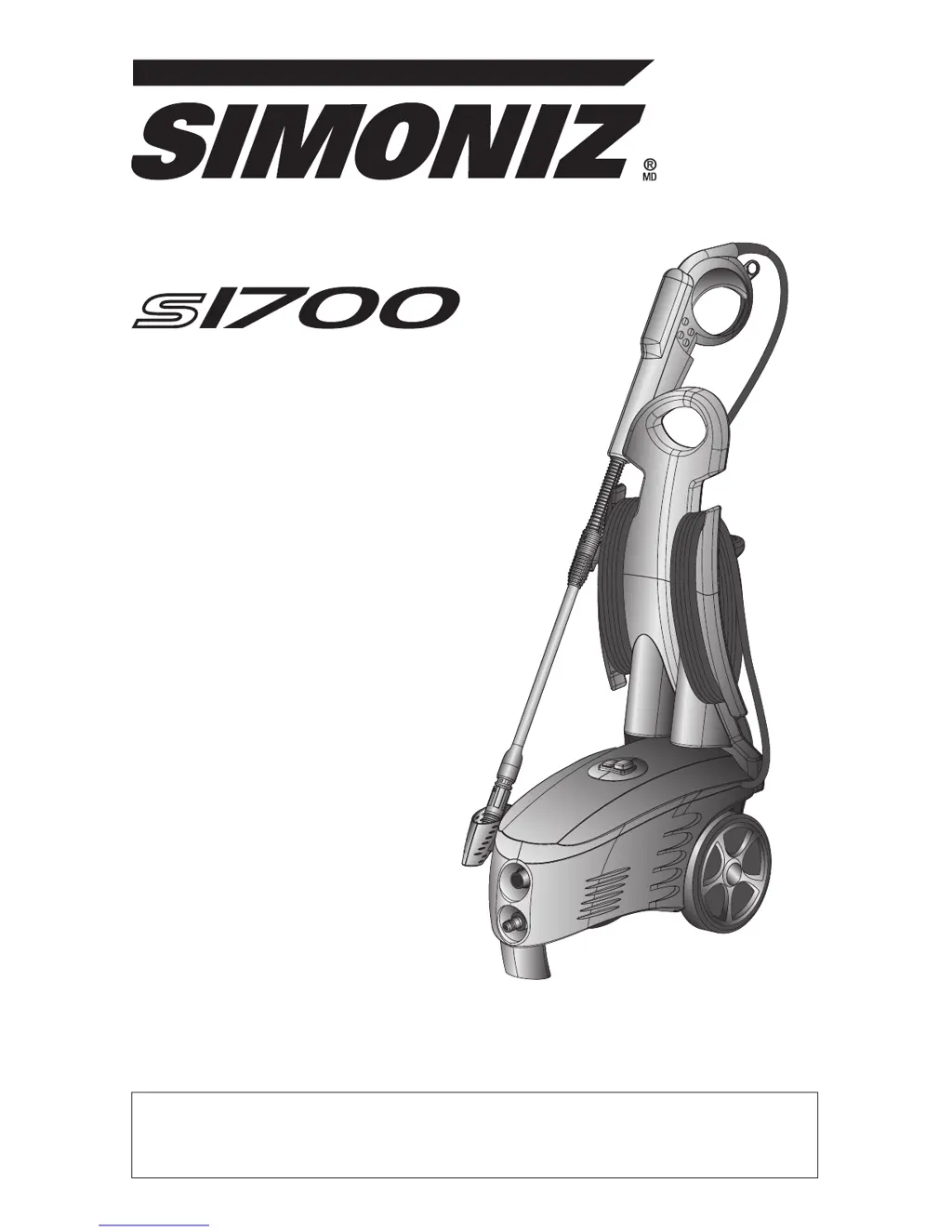
PRESSURE WASHER
Instruction Manual

Other manuals for Simoniz S1700

Questions and Answers

  • C
    Chad JonesJul 31, 2025
    Why won't my Simoniz S1700 Pressure Washer motor start?
    • V
      Veronica GilbertAug 1, 2025
      There are several reasons why your Simoniz Pressure Washer motor might not start. First, ensure the On/Off switch is in the “ON” ( | ) position. Check that the power cord is properly plugged in. If you're using an extension cord, make sure it's either a 25’ (7.6 m) 14/3 gauge cord or a 50’ (15 m) 14/3 gauge cord. Try a different electrical outlet to rule out power supply issues. Finally, the pressure washer's circuit breaker might have tripped; allow it to cool, and then restart the unit.
  • J
    Jessica CochranAug 11, 2025
    What to do if my Simoniz Pressure Washer doesn't reach high pressure?
    • S
      Sean BurkeAug 11, 2025
      If your Simoniz Pressure Washer isn't reaching high pressure, several factors could be the cause. First, ensure that you are using a 1” (25 mm) or 5/8” (16 mm) garden hose, as a smaller diameter hose can restrict water flow. Check the garden hose for any kinks, leaks, or blockages that might be restricting the water supply. Make sure the water source is fully open to provide enough inlet water. Clean the water inlet filter by removing it and rinsing it in warm water. Confirm that the power nozzle is in the high-pressure position. Lastly, check that hoses and fittings are airtight and purge any air from the pump by turning the machine off and squeezing the trigger gun until a steady stream of water emerges from the nozzle.
  • K
    Katelyn DavisAug 20, 2025
    Why does the output pressure of my Simoniz S1700 Pressure Washer vary high and low?
    • D
      dgardnerAug 20, 2025
      Inconsistent output pressure in your Simoniz Pressure Washer can stem from a few issues. Ensure that the water is turned on fully and inspect the garden hose for kinks, leaks, or blockages. Also, make sure that hoses and fittings are airtight, and purge the pump by turning the machine off and squeezing the trigger gun until a steady stream of water emerges through the nozzle. Another potential cause is a clogged water inlet filter; remove the filter and rinse it in warm water to resolve this.

Summary

Easy Assembly

First Time Use & Hose Connection

Initial setup, connecting the garden hose and quick-connect coupling.

High-Pressure Hose Attachment

Connecting the high-pressure hose to the unit securely.

Detergent Container Preparation

Filling the detergent container and attaching the suction tube.

Wand and Nozzle Attachment

Inserting and locking the desired spray wand into the gun.

Water Supply Connection

Connecting the garden hose to the water source and turning water on.

Electrical Power Connection

Plugging the pressure washer into a grounded electrical outlet.

Safety Trigger and Air Purge

Releasing the safety trigger and purging air from the system.

System Start-Up Procedure

Starting the pressure washer by engaging the trigger and power button.

Critical Operation Prohibitions

List of crucial safety rules to never violate during operation.

Warranty Information

Product Warranty Terms

Details on the limited warranty for parts, exchange, and repair.

14-Day Exchange Policy

Policy for exchanging units within 14 days of purchase.

Motor & Accessory Warranty

Warranty coverage for the motor (2-year) and accessories (3-month).

Important Safety Precautions

General Safety Warnings

Basic safety precautions to follow during product use.

Specific Hazard Warnings

Warnings about injection hazards, system pressure, and electrical safety.

Safety Features & Electrical Power

Product Safety Features

Information on the stop device and main power switch.

Grounding and Electrical Safety

Proper grounding and electrical connection safety guidelines.

Extension Cord Usage Guidelines

Recommended practices and warnings for using extension cords.

Parts Identification

Component Diagram and List

Visual diagram and list of all parts with their corresponding numbers.

Assembly and Operation

Water Supply Requirements

Specifications for water source, hose diameter, and flow rate.

Step 1: Handle Frame Assembly

Assembling the handle frame to the pressure washer unit.

Step 2: Gun Holder Attachment

Attaching the gun holder to the main unit.

Step 3: Initial Hose Connection

Connecting the garden hose using quick-connect fittings for first use.

Step 4: High-Pressure Hose Connection

Connecting the high-pressure hose to the unit's outlet.

Step 5: Detergent System Setup

Preparing the detergent container and suction tube for use.

Step 6: Spray Wand Insertion

Inserting and securing the spray wand into the spray gun.

Step 7: Water Source Connection

Connecting the garden hose to the water supply and turning water on.

Step 8: Electrical Plug-in

Plugging the unit into a properly grounded electrical outlet.

Step 9: Safety Trigger Release

Releasing the spray gun's safety trigger before operation.

Step 10: System Air Purging

Purging air from the system by running water through the gun.

Step 11: Starting the Unit

Starting the pressure washer using the ON button and trigger.

Cleaning Area Preparation

Inspecting and preparing the cleaning area for safety and efficiency.

Using Accessories

Adjustable Wand Operation

Controls for adjusting spray pressure and pattern.

High-Pressure vs. Low-Pressure Settings

How to select high-pressure for cleaning and low-pressure for detergent.

Adjusting the Spray Pattern

Adjusting the spray from a jet to a fan pattern.

Turbo Power Wand Usage

Proper use of the turbo nozzle for maximum cleaning effectiveness.

Working with Detergents

Detergent Application Principles

How detergent aids in soaking dirt for effective cleaning.

Step 1: Setting for Detergent Use

Setting the adjustable nozzle to low-pressure for detergent application.

Step 2: Detergent Bottle Setup

Connecting the detergent suction tube and bottle to the unit.

Step 3: Applying Detergent to Surface

Applying detergent to a dry surface from bottom to top.

Step 4: Detergent Dwell Time

Allowing detergent to soak without drying on the surface.

Step 5: Rinsing the Surface

Rinsing the cleaned surface with clean water under high-pressure.

Step 6: Flushing the Detergent System

Cleaning the detergent injection system with fresh water.

Prohibited Chemicals for Use

List of chemicals that should never be used with the pressure washer.

Shutting Down and Cleaning

Post-Use Detergent System Flush

Flushing the detergent system with fresh water after use.

Powering Off and Disconnecting

Turning off the unit, unplugging the power cord.

Releasing System Pressure

Pressing the trigger to release residual water pressure safely.

Disconnecting Hoses and Cord Storage

Detaching hoses and winding cords for storage.

Taking a Break Procedure

Steps to follow for short breaks during operation.

Winterizing and Storage

Optimum Winterizing Procedure

Using antifreeze to protect the unit from freezing and rust.

Quick Winterizing Procedure

Alternative steps to protect the unit from winter damage.

User Maintenance

Connections Lubrication and Cleaning

Maintaining hose and gun connections for smooth operation.

Adjustable Nozzle Cleaning

How to clean a clogged adjustable spray nozzle with a thin instrument.

Lubrication System Overview

Information on the unit's permanent lubrication system.

Water Filter Screen Maintenance

Cleaning the water inlet screen to protect the pump from debris.

Air Vent Cleaning

Keeping air vents clear to ensure proper motor cooling.

Cleaning Tips and Techniques

General Cleaning Recommendations

Testing spray, using caution on painted surfaces, and optimal angle.

Deck Cleaning Instructions

Techniques for cleaning decks with or without detergent.

House Siding Cleaning Guide

Techniques for cleaning house siding with or without detergent.

Cement Patios, Brick & Stone Cleaning

Techniques for cleaning hard surfaces with or without detergent.

Car, Boat, & Motorcycle Cleaning

Specific tips for cleaning vehicles with the pressure washer.

Grill & Outdoor Equipment Cleaning

Techniques for cleaning grills and other outdoor power equipment.

Patio Furniture Cleaning Guide

Techniques for cleaning wood patio and lawn furniture.

Technical Specifications

Troubleshooting

Motor Start Failures

Causes and solutions when the motor will not start.

Low or No High-Pressure Issues

Causes and solutions for the unit not reaching high pressure.

Variable Pressure Output

Causes and solutions for inconsistent pressure output.

Detergent Supply Problems

Causes and solutions for no detergent flow.

Garden Hose Leaks

Causes and solutions for leaks at the garden hose connection.

Spray Attachment Leaks

Causes and solutions for leaks from the spray wand, extension, or nozzle.

Noisy Pump Diagnosis

Causes and solutions for a noisy pump operation.

Pump Water Leakage

Causes and solutions for water leaks from the pump.

Oil Drip Causes

Causes and solutions for oil drips from the unit.

Motor Buzzing Without Running

Causes and solutions when the motor buzzes but fails to run.

Long-Term Storage Considerations

Specific issues and solutions for units not used for extended periods.

Simoniz S1700 Specifications

General IconGeneral
BrandSimoniz
ModelS1700
CategoryPressure Washer
LanguageEnglish

Related product manuals