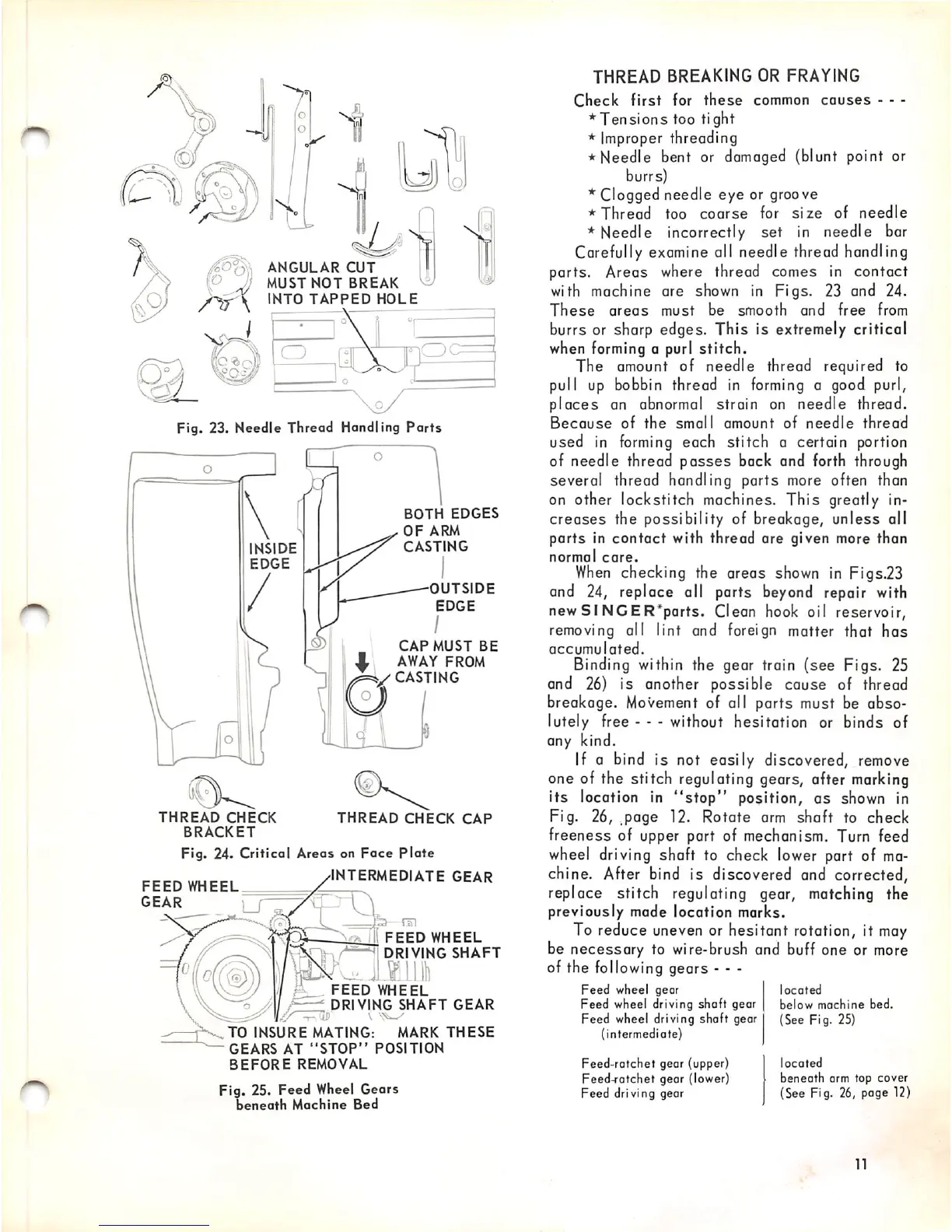
angular
cut
r
Jj
MUST
NOT
BREAK
^
/V\
into
TAPPED
HOL^
/
C
Fig. 23. Needle Thread Handling
Parts
CT
INSIDE
EDGE
THREAD
CHECK
BRACKET
BOTH
EDGES
OF
ARM
CASTING
I
OUTSIDE
EDGE
/
CAP
MUST
BE
X
AWAY
FROM
CASTING
O
"*
THREAD
CHECK
CAP
Fig.
24.
Critical
Areas on
Face
Plate
INTERMEDIATE
GEAR
FEED
WHEEL
GEAR
13-
rm
FEED
WHEEL
DRIVING
SHAFT
!Jih
FEED
WHEEL
DRIVING
SHAFT
GEAR
\
'N-
•
TO
INSURE
MATING;
MARK
THESE
-GEARS
AT
"STOP"
POSITION
BEFORE
REMOVAL
Fig. 25. Feed Wheel Gears
beneath
Machine
Bed
THREAD BREAKING OR FRAYING
Check
first
for
these
common
causes
- - -
*Tensions
too tight
* Improper threading
* Needle bent or damaged (blunt point or
burrs)
* Clogged needle
eye
or groove
★Thread
too
coarse
for
size
of
needle
* Needle incorrectly set in needle bar
Carefully examine all needle thread handling
parts. Areas where thread comes in contact
with machine are shown in Figs. 23 and 24.
These
areas
must
be
smooth
and
free
from
burrs or sharp edges. This is extremely critical
when
forming
a purl stitch.
The amount of needle thread required to
pull up bobbin thread in
forming
a good purl,
places
an abnormal strain on needle thread.
Because
of
the
small
amount
of
needle
thread
used in
forming
each stitch a certain portion
of needle thread
passes
bock and forth through
several thread handling parts more often than
on other lockstitch machines. This greatly in
creases
the
possibility
of breakage,
unless
oil
parts in contact with thread are given more than
normal
core.
When
checking the areas
shown
in Figs.23
and 24, replace all parts
beyond
repair with
new
Si
NC ER*parts. Clean hook oil reservoir,
removing all lint and foreign matter that
has
accumulated.
Binding within the gear train (see Figs. 25
and
26)
is another possible cause of thread
breakoge.
Movement
of oil parts must be abso
lutely
free---
without hesitation or binds of
any kind.
If a bind is not easily discovered,
remove
one of the stitch regulating gears, after
marking
its location in
"stop"
position, as
shown
in
Fig. 26, .page 12. Rotate arm shaft to check
freeness of upper port of mechanism. Turn feed
wheel driving shaft to check lower part of
ma
chine. After bind is discovered and corrected,
replace stitch regulating gear,
matching
the
previously made location marks.
To reduce uneven or hesitant rotation, it
may
be necessary to wire-brush and buff one or more
of the following gears - - •
Feed
wheel geor
Feed wheel driving shaft geor
Feed wheel driving shaft gear
(intermediote)
Feed-ratchet geor (upper)
Feed-rotchet gear (lower)
Feed
driving geor
located
belaw
machine
bed.
(See Fig. 25)
located
beneath orm top cover
(See Fig. 26, page 12)
11


 To Next Page