WARNING
■
A discharged vehicle battery may already freeze at temperatures just below
0 °C. In case of frozen battery carry out no jump-starting - risk of explosion!
■
Pay attention to the warning instructions relating to working in the engine
compartment » page 183, Engine compartment.
■
The non-insulated parts of the terminal clamps must never make contact
with each other. In addition, the jump-start cable connected to the positive
terminal of the battery must not come into contact with electrically conduct-
ing parts of the vehicle - risk of short circuit!
■
Do not clamp the jump-start cable to the negative terminal of the dis-
charged battery. There is the risk of detonating gas seeping out the battery
being ignited by the strong spark which results from the engine being started.
■
Route the jump-start cables so that they cannot be caught by any rotating
parts in the engine compartment.
■
Do not bend over the battery - risk of caustic burns!
■
The vent screws of the battery cells must be tightened firmly.
■
Keep any sources of ignition (naked flame, smouldering cigarettes, etc.)
away from the battery - risk of an explosion!
■
Never jump-start vehicle batteries with an electrolyte level that is too low -
risk of explosion and caustic burns!
Note
■
There must not be any contact between the two vehicles otherwise current
may flow as soon as the negative terminals are connected.
■
The discharged battery must be properly connected to the system of the vehi-
cle.
■
Switch off the car phone or refer to the operating instructions for the car phone
on how to proceed in these circumstances.
■
We recommend you buy jump-start cables from a car battery specialist.
Jump-starting
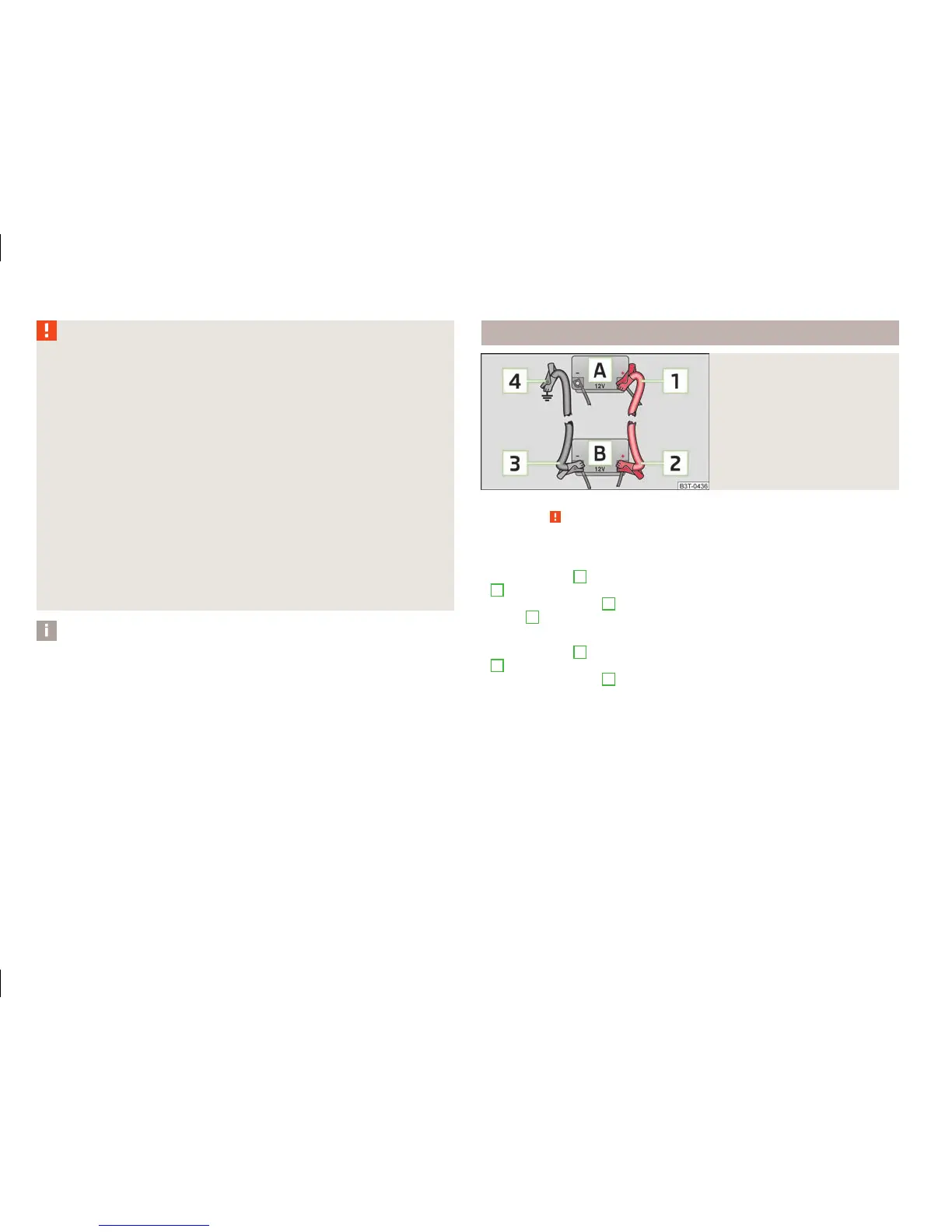
Fig. 181
Jump-starting using the battery
from another vehicle: A - flat ve-
hicle battery, B - battery provid-
ing current
First read and observe the introductory information and safety warn-
ings on page 209.
The jump-start cables must be attached in the following sequence:
Connecting positive terminals
›
Attach one end
1
» Fig. 181 to the positive terminal of the discharged battery
A
.
›
Attach the other end
2
to the positive terminal of the battery supplying the
power
B
.
Connecting negative terminal and engine block
›
Attach one end
3
to the negative terminal of the battery supplying the power
B
.
›
Attach the other end
4
to a solid metal part which is connected firmly to the
engine block, or to the engine block itself.
Starting engine
›
Start the engine on the vehicle providing the power and allow it to idle.
›
Now start the engine of the vehicle with the discharged battery.
›
If the engine does not start, terminate the attempt to start the engine after
10 seconds and wait for about 30 seconds before repeating the process.
›
Disconnect the cables in exactly the reverse order to the one described above.
ä
210
Do-it-yourself








 To Next Page