4
Concept/Description
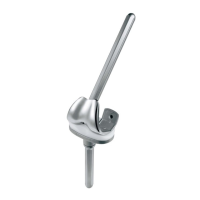
The RT-PLUS™ is a constrained rotating knee prosthesis for cemented implantation.
The prosthesis is designed to allow an internal/external rotation of approximately 10° in
each direction, which is locked by the tibial insert when extended. The peg design
provides the prosthesis with elongation capability, i.e., for distraction between the femoral
and tibial components. In an extreme flexed position, the femoral component can be lifted
off the tibial insert, which is intended to reduce the saggital leverage forces that have an
effect on the prosthesis stem in this load situation.
The implant allows sparing resections. The cut compatibility with the tricompartmental
prosthesis TC-PLUS permits, if necessary, an intraoperative switchover from the
resurfacing to the constrained rotating knee.
The femoral and tibial components of RT-PLUS are identical to those of RT-PLUS Modular,
with the exception of the additional option to connect stems and augmentation blocks.
Since the tibial inserts are the same, the femoral and tibial components in both these
systems are entirely cross-compatible.
The implants are available in five size (corresponding to TC-PLUS sizes 2, 4, 6, 8 and 10).
Apart from size 2, the sizes can be combined with the next size up or down (see product
overview on page 57).
The femoral and tibial components are anchored in the bone by cementable
intramedullary stems. These are comparatively slim and short in design, in order to enable
anchoring in narrow or dysplastic medullary cavities.
In the RT-PLUS knee system, the required stability and absorbtion of acting forces are
assured by the joint mechanism between tibial and femoral components, the condylar
articulating surfaces, the anchoring elements in the tibia and the femur and the still intact
soft tissue structures.
Important
RT-PLUS requires condylar support for the femoral/tibial components. The forces have to
be absorbed by both the condyles and the stems.



 To Next Page