6-2
Vehicle Testing Procedures
Data Collection Modes
Test procedures for collecting emission data may include:
No-Load Testing
•
In shop bay
•
On a chassis dynamometer
•
At idle
•
At idle and at a specified engine speed
•
At idle and at a specified vehicle speed
Under Load Testing
•
Steady state testing
•
Transient Tests
— Requires following a drive cycle trace on a
dynamometer. The drive consists of periods of
acceleration, deceleration and idle.
Engine Conditioning
Some vehicles require special conditioning before testing exhaust
emissions other than the procedure that follows. Failure to follow
the recommended procedures for these vehicles may cause invalid
test results or a vehicle to fail state tail pipe emission tests, even
when all systems are operating as designed.
✓
Some vehicles have an underhood label that specifies
the procedure to follow for a valid emission test.
1. Warm the engine to normal operating temperature, then
insert the exhaust sample probe into the tail pipe.
2. Raise the engine speed to 2000 RPM and maintain for 30
seconds or drive at 30 mph (50 km/h) for 30 seconds on a
chassis dynamometer.
3. Read the exhaust concentrations on the analyzer screen.
Tail Pipe Exhaust Gas Sampling
1. Insert the sample probe into the vehicle tail pipe. Make
sure that the sample probe is fully inserted.
2. Switch on the
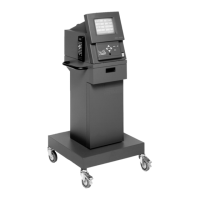
DGA 1000 Gas Analyzer
and leave it in the
Measurement Screen.
3. Read the exhaust concentrations on the screen.
4. Compare the values to local, state, federal and/or
manufacturer specifications.
If values exceed specifications, further diagnostic testing of the
vehicle may be required.
✓
A fuel-injected engine that meets all of the emission
requirements may still have problems masked by the
feedback fuel control system. Consult the vehicle
maintenance schedule and perform the recommended
service that may be required, including service on
emission control devices.


 To Next Page