
 Need help?
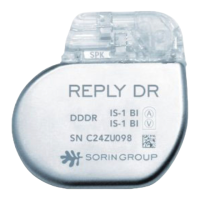
Do you have a question about the sorin REPLY DR and is the answer not in the manual?
General contraindications for pacemaker use, considering patient condition and age.
Complications related to the device itself, pacing leads, and medical issues like infection.
Risks associated with medical treatments like diathermy, defibrillation, radiation, lithotripsy, and ultrasound.
Details on the sterilization process (ethylene oxide) and packaging of the pacemaker and screwdriver.
Checks to perform before opening the sterile package, including date verification and device integrity.
Recommendations for creating the pocket for pacemaker implantation, specifying location and depth.
Guidance on selecting appropriate leads (atrial and ventricular) for optimal pacemaker function and compatibility.
Procedure for measuring pacing and sensing thresholds during the implantation process.
Step-by-step instructions for correctly connecting the atrial and ventricular leads to the pacemaker ports.
Procedure for verifying pacemaker functionality using an ECG immediately after implantation.
Description of the nominal mode, also known as emergency mode, for rapid safety function restoration.
Details on the standby mode, activated during self-test failure, and its operational parameters.
Explanation of magnet mode operation, including parameters and behavior when a magnet is applied.
How the pacemaker responds to electrical noise, switching to asynchronous mode at the basic rate.
Overview of different pacing modes like DDTA(R), DDTV(R), and DDTAV(R), explaining their functions and indications.
Details on pacing rates, including basic rate, maximum tracking rate, and rate hysteresis.
Parameters related to pacing and sensing, such as pulse amplitude, pulse width, sensitivity, and polarities.
Explanation of absolute refractory periods, committed period, automatic AV delay, and AVD Paced/Sensed Offset.
Functionality and parameters of the Rate Response feature, including sensor types and operating modes.
Description of therapeutic features like SafeR mode, Dplus mode, Rate acceleration, AV delay shortening, Rest rate, and Rate smoothing.
Strategies for managing atrial arrhythmias, including Overdrive, Post extrasystolic pause suppression, Acceleration on PAC, and Mode switching.
Methods for optimizing pacemaker operation, including automatic detection of implantation, polarity configuration, and lead impedance measurements.
Guidelines for standard and frequent follow-up visits, including battery status checks and device interrogation.
Explanation of the Elective Replacement Indicator (ERI) and its control parameters.
Conditions and procedures for explanting the pacemaker, including end of life and malfunction.
Overview of the programmer's capabilities, including impedance tests, threshold tests, and electrophysiologic studies.
Information obtained from interrogating device memories, such as battery depletion, statistics, and recorded episodes.
Methods for identifying the pacemaker model and serial number, using X-ray and the dedicated programmer.
Data on current drain values for different modes and conditions at the beginning of the pacemaker's life.
Table showing the relationship between magnet rate and battery impedance values.
Specifications of the pacemaker battery, including manufacturer, type, model, capacity, and voltage.
Estimated longevity of the pacemaker under various shipment and operating conditions.
Details of the warranty terms, including guarantee period, required documentation, and conditions for forfeiture.
Conditions for device replacement in case of failure, outlining Sorin CRM's commitment and limitations.
 General
| Brand | sorin |
|---|---|
| Model | REPLY DR |
| Category | Medical Equipment |
| Language | English |




 To Next Page