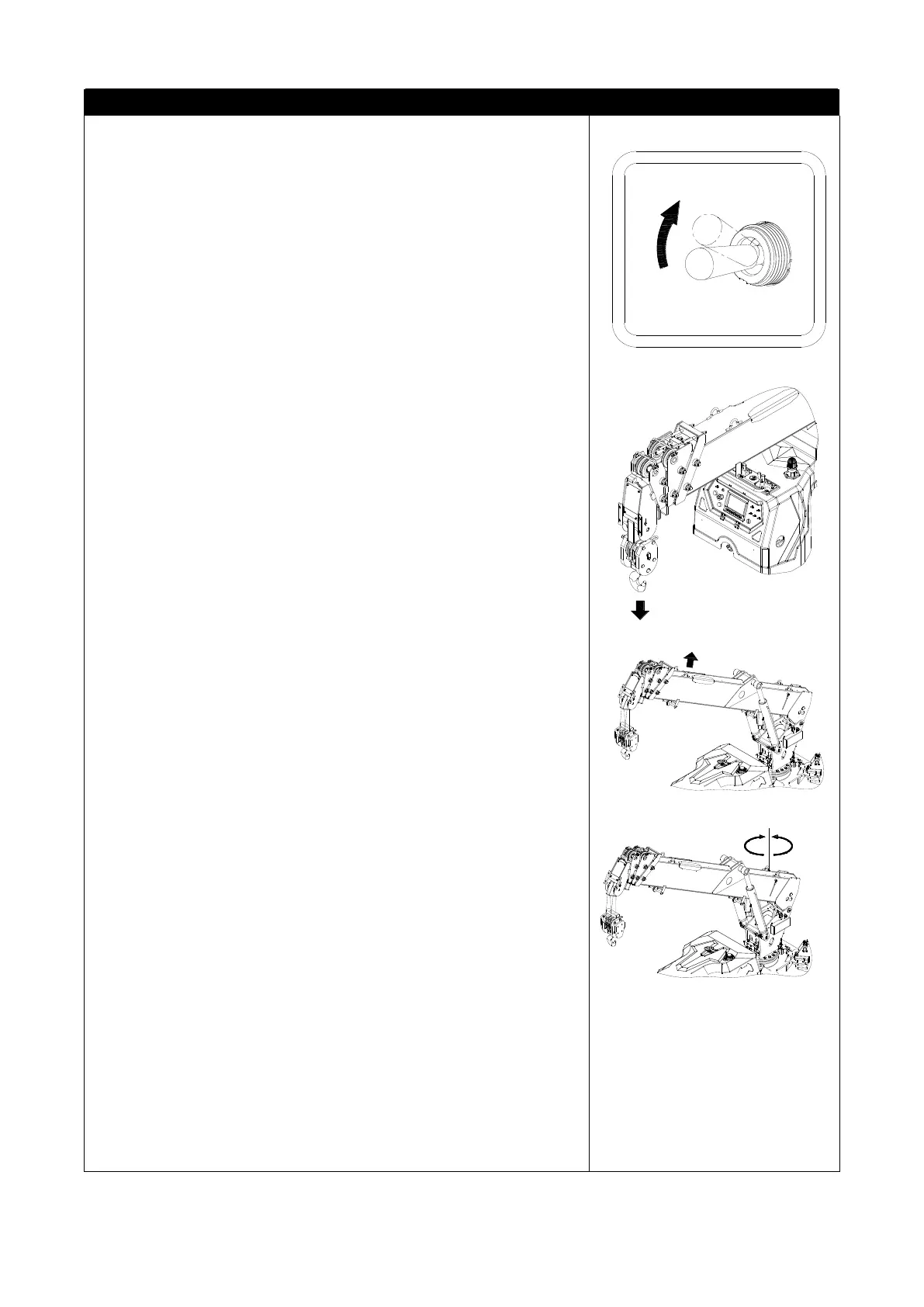
1. After the outrigger support is completed, move the working
mode switch down to the boom mode, release the switch, the machine
remains in the boom mode position, and the machine switches from
the outrigger operation mode to the boom operation mode.
2. At this time, the boom is fully retracted, and the buzzer sounds
an alarm. The machine is in a state of safety self-locking protection,
and the switch and handle do not work.
3. Put the hook operation on the boom to release the buzzer
alarm and release the self-locking protection of the machine.
4. Release the hook: Pull the hook handle (No. 4) back with one
hand, and pull the hook/hook switch up with the other hand, and the
hook will drop. When the hook is separated from the heavy hammer,
the buzzer will stop sounding. Alarm, release the switch, release the
hook to stop.
5. Pull the hook lifting handle (No. 4) backward to lower the hook,
so that the hook continues to fall for a certain distance.
6. Slowly push forward the boom up-and-down handle (No. 2) to
raise the boom.
7. In the process of raising the boom, pay attention to observe the
current angle of the display boom. When the angle meets the hoisting
requirements (commonly used hoisting angles are 40°-60°), release the
handle and the boom stops.
8. According to the position of the suspended object, slowly
operate the boom swing handle (No. 1) to rotate the boom to the
required direction.
9. Slowly operate the boom telescopic handle (No. 3) to expand
and contract the boom. While the boom is telescoping, the hook will
rise or fall with the boom. If it is too high or too low, it is necessary to
lift the hook to prevent the hook from touching the ground or touching
the heavy hammer.
10. Securely fix the hoisted object on the hook, slowly push the
hook lifting handle (No. 4) forward, and the handles 1 to 4 cooperate
with each other until the lifting of the heavy object is completed.



 To Next Page