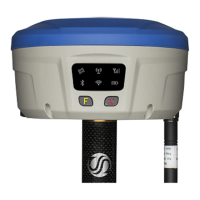
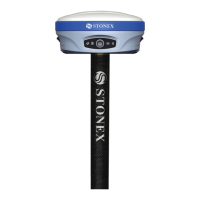
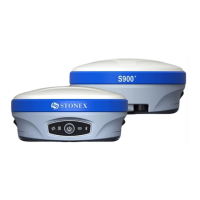
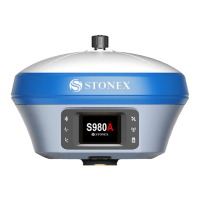
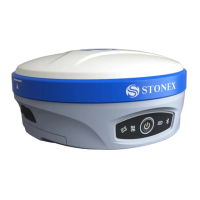
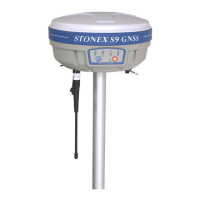
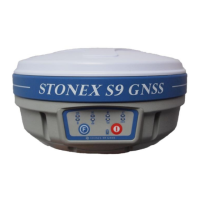
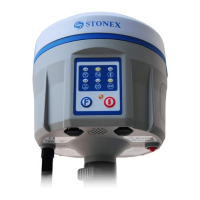
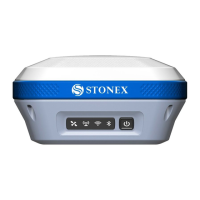
The Stonex S990A is a multi-frequency GNSS receiver designed for surveying applications, capable of operating as a base station or a standalone rover. Its integrated design makes it light and portable at 1.40 kg. The internal antenna supports all satellite system signals including GPS, GLONASS, Galileo, BeiDou, and QZSS, eliminating the need for RTK hardware upgrades for different satellite systems.
Function Description
The S990A integrates the latest Sensor Fusion system, enabling tilt measurement without calibration for more convenient field surveying. A key feature is Atlas reception, a differential corrections system broadcasted on L-Band, which enhances positioning accuracy in areas not covered by conventional CORS (e.g., due to lack of reference stations or GPRS signals). Atlas is satellite-broadcasted, ensuring reception almost worldwide, and offers better positioning accuracy than SBAS. The device includes a new GSM modem (EG25-G) providing worldwide LTE, UMTS/HSPA+, and GSM/GPRS/EDGE coverage, ensuring connectivity even in remote areas. It also features a new TRM 121 Radio module supporting radio transmission on two different band frequencies (410/470 MHz and 900 MHz hopping frequencies) and various radio protocols like Trimtalk 450(S), Satel, and PCC-EOT.
Important Technical Specifications
- Receiver:
- Signal Tracked: GPS (L1 C/A, L1C, L1P, L2C, L2P, L5), GLONASS (L1C/A, L1P, L2C/A, L2P, L3), BeiDou (B1, B2, B3, ACEBOC), GALILEO (E1, E5A, E5B, ALTBOC, E6), QZSS (L1 C/A, L1C, L2C, L5, L6), IRNSS (L5), SBAS (L1, L5).
- L-Band: Atlas H10 / H30 / Basic (optional).
- Bridging of RTK outages: aRTK - Works up to 20 minutes.
- Channels: 800.
- Position Rate: 10 Hz (optional 20-50Hz).
- Signal Reacquisition: < 1 s.
- RTK Signal Initialization: Typically < 10 s.
- Hot Start: Typically < 15 s.
- Initialization Reliability: > 99.9%.
- Internal Memory: 32 GB.
- Tilt sensor: E-Bubble, IMU.
- Positioning:
- High Precision Static Surveying: Horizontal 2.5 mm + 0.1 ppm RMS, Vertical 3.5 mm + 0.4 ppm RMS.
- Code Differential Positioning: Accuracy 0.40 m RMS.
- SBAS Positioning: Accuracy 0.60 m RMS.
- Real Time Kinematic (< 30 Km) – Network RTK: Fixed RTK Horizontal 5 mm + 0.5 ppm RMS, Fixed RTK Vertical 10 mm + 0.5 ppm RMS.
- Integrated GNSS Antenna: High accuracy four constellation micro-strip antenna, zero phase center, with internal multipath suppressive board.
- Internal Radio (optional):
- Model: TRM 121 1 W.
- Type: Tx - Rx.
- Frequency Range: 410-470 MHz, 902.4-928 MHz.
- Channel Spacing: 12.5 KHz / 25 KHz.
- Range: 3-4 Km in urban environment, Up to 10 Km with optimal conditions.
- Internal Modem:
- GSM integrated: EG25-G (LTE FDD, LTE TDD, UMTS, GSM bands).
- SIM: Nano SIM card.
- Communication:
- I/O Connectors: 5 pins Lemo (external power supply and external radio), Type-C (receiver power supply and data transfer), 1PPS port.
- Bluetooth: 2.1 + EDR, V4.1.
- Wi-Fi: 802.11 b/g/n.
- Web UI: For software upgrade, status/settings management, data download via Smartphone, tablet, or other electronic device with WI-FI capability.
- Reference outputs: RTCM 3.0, 3.2, CMR, CMR+, DGPS.
- Navigation outputs: NMEA 0183.
- Power Supply:
- Battery: Internal Rechargeable 7.2 V – 10.200 mAh.
- Voltage: 9 to 28 V DC external power input with over-voltage protection (5 pins Lemo).
- Working Time: Up to 10 hours.
- Charge Time: Typically 4 hours.
- Physical Specification:
- Dimensions: Ø 151 mm x 94.5 mm.
- Weight: 1.40 Kg.
- Operating Temperature: -40°C to 65°C (-40°F to 149°F).
- Storage Temperature: -40°C to 80°C (-40°F to 176°F).
- Waterproof/Dustproof: IP67.
- MIL-STD: MIL-STD-810H.
- Shock Resistance: Designed to endure a 2 m pole drop on concrete floor with no damage.
- Vibration: Vibration resistant.
Usage Features
The S990A is equipped with a colored full-touch display, allowing users to check receiver status, position, solution quality, and other important information. Through the display, users can initiate a static session, start a base using radio technology, or connect to an external radio.
- Web Interface: The receiver has Web UI functionality accessible via its internal Wi-Fi hotspot (named after its serial number). Users can connect with a smartphone, PC, or handheld device to view status, download data, and configure the receiver. The default IP address is 192.168.10.1, with "admin" as the username and "password" as the password.
- Dashboard: Displays device serial number, power level, language, device name, current working mode, satellites, license status (PERMANENT or expire date), position information, time, and status.
- Satellites: Shows sky plot and satellite table, allowing users to set the cutoff angle (up to 45°).
- Static Survey: Allows input of point name, antenna height (phase center, slant height, vertical height from edge/bottom, altimeter pieces), PDOP threshold, and collection interval. Auto-record can be activated to automatically collect data upon power-on.
- Download Raw Data: Enables downloading, deleting, and editing observation files and ephemeris. Raw data can be converted directly to RINEX format.
- Working Mode: Configures rover and base modes.
- Rover Mode: Selects datalinks (UHF, Network, External, Bluetooth). UHF mode allows selection of radio channel and protocol, with editable frequencies for channels 1-8 (410/470 MHz interval). Network mode configures Caster Service parameters (User, Password, APN, APN User, APN Password) and allows downloading mountpoint lists. External mode connects to external radios via 5-Pin LEMO cable, requiring matching baud rates. Bluetooth mode is for controller connection.
- Base Mode: Configures base-specific parameters such as base data type, start base, and base position (Single or Repeat Position with coordinates). Radio power can be set to HIGH for best performance.
- Satellite Settings: Configures satellite systems (GPS, GLONASS, BeiDou, Galileo, QZSS) and cutoff angle. RTK mode can be set to NORMAL or SureFix for more severe position calculation.
- Device Settings: Sets time zone, direct link mode, sensor, serial port baud rate, speaker, automatic power on/off with 5-pin cable, network enable, Wi-Fi hotspot share network, and NMEA configurations (output rate per message).
- Save Backup & Logs: Downloads backup data and logs (APP log, OS log).
- Information: Displays device model, serial number, firmware/hardware versions, antenna info, GNSS board info, Network module info, and UHF module info.
- Management: Upgrades firmware, registers device and GNSS board, sets passwords, performs self-test, formats internal disk, and restores factory settings. Firmware updates are performed via "online update" through the Web UI. Device registration requires a 32-digit code.
- Set the Language: The Web UI supports 8 languages: Italian, Chinese, English, Korean, Portuguese, Russian, Turkish, and Japanese.
- Basic Operation:
- Power On: Short press the power button, wait for one beep, then three more beeps for initialization.
- Power Off: Long press the power button until indicators flash and "power off" is prompted, then short press to confirm.
- Check & Switch Working Mode: Short press the power button to hear the current working mode and data link. Connect to a handheld or controller to set and switch modes.
- Receiver Self-Check: Press and hold the power button until "power off" is broadcasted, then press again until "self-check" is broadcasted. The receiver checks GNSS, radio, network, Wi-Fi, Bluetooth, and sensor modules. Results are voice broadcasted ("OK" or "fail").
- Display Touch Menu: Provides access to receiver status (HRMS, VRMS, PDOP, battery level), working mode selection (Static, Base, Settings), and static working mode configuration (sample interval, cutoff angle, start/stop recording). Base mode offers Radio and External options.
- Radio Base: Sets Base ID, PDOP Threshold, Data Type, Channel number, Power intensity (HIGH recommended), and Protocol type.
- External Base: Selects Baud Rate for communication via 5-Pin LEMO cable.
- Settings: Changes screen light time, initiates self-check, restores factory settings, and changes display language.
Maintenance Features
- IMU Technology: The S990A features new IMU technology for tilted measurements (TILT).
- Sensor Activation and Configuration: Enabled via Stonex Cube-a field software (Configure → System Settings → Sensor Options). Requires enabling "Pole Tilt Correction." Users can choose to display the tilt angle on screen and automatically collect points when the pole is considered vertical within a defined verticality tolerance (e.g., +/- 0.3°).
- Initialization: Requires a Fixed GNSS solution (Fixed, aRTK Fixed, Surefixed, or ExtraSafe Fixed). If the sensor needs initialization, Cube-a will prompt users to rotate the pole to adjust for the local magnetic field and move the receiver back and forth in different directions to adjust calibration parameters based on local GNSS position and accuracy.
- RMS Study and Sensor Calibration: Users can check tilt compensation accuracy via RMS Study (Calibrate menu → RMS Study). If RMS values are unsatisfactory, sensor calibration is recommended. Calibration involves keeping the pole tip at an exact point, verifying pole height, and following instructions to shake and rotate the receiver in specific directions. This process is repeated for 3 times (270° clockwise rotation). If calibration fails, it must be repeated.
- SIM Card Insertion: Insert the Nano SIM card into the slot on the bottom of the receiver before powering on. Unlock the slot, insert the card, close, and lock the slot.
- Firmware/Software Warranty: Stonex warrants firmware/software operation to be uninterrupted and error-free. Firmware/software fixes for non-conforming versions will be provided.
- Over Warranty Repair Policy: Customers pay standard repair fees and return shipment costs for services outside warranty.
- Environmental Recycling: Cardboard, plastic, and product parts must be recycled according to local regulations. In the EU, electric and electronic devices must be collected separately (crossed-out dustbin symbol).
- Safety Recommendations: Always follow warnings and cautions. Maintain a minimum separation distance of 20 cm from the radiating antenna. Do not collocate radio antennas with other transmitting devices. Do not switch on GSM or UHF modules without the antenna mounted. UHF antennas with gain > 5 dBi are prohibited. The required antenna impedance is 50 ohms.
- Rechargeable Lithium-ion Batteries: Avoid direct contact with damaged batteries. If battery fluid leaks, avoid contact; if in eyes, rinse with clean water and seek medical attention; if on skin/clothing, wash with clean water. Do not damage, expose to fire/high temperatures, immerse in water, drop, puncture, open, or short-circuit the battery.

 Need help?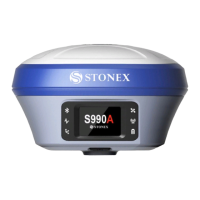

 To Next Page
 General