8 Inverter Functions Operation Manual
38
8.7 MPPT
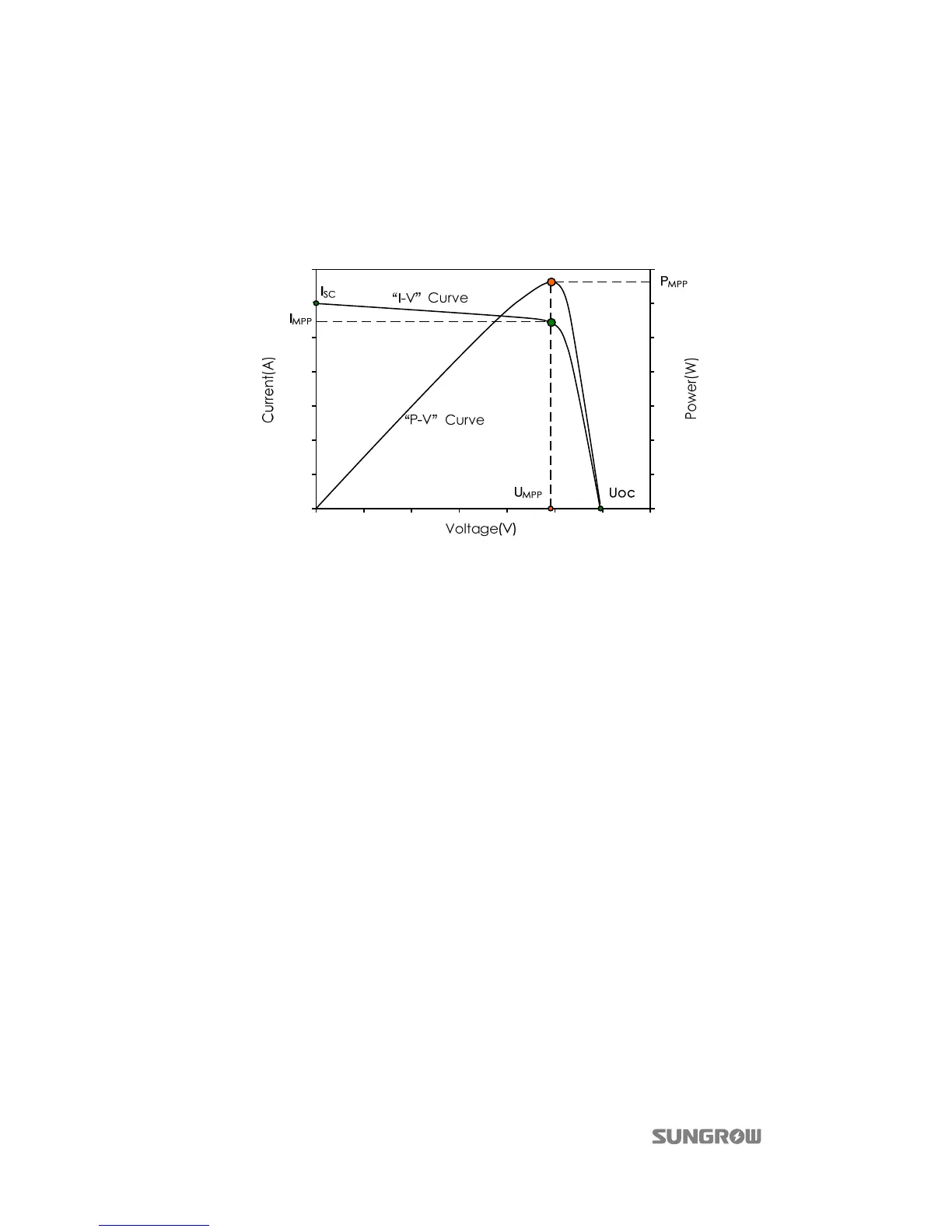
Maximum Power Point Tracking (MPPT) is a technique that the inverter uses to get the maximum
power from the PV arrays. PV arrays have a complex relationship between solar irradiation,
temperature and total resistance that produces a non-linear output efficiency known as the I-V
curve.
Fig. 8-4 I-V curve
8.8 Intelligent Temperature-Control Technology
Inverter will continuously detect the IGBT temperature and adjust the fan speed accordingly.
When the module temperature is low, inverter will decrease the fan speed to lower the device
noise and decrease the device operation consumption. As the module temperature increases,
inverter will increase the fan speed for well ventilation.
The intelligent temperature-control technology can synchronize the speed of fan and
temperature of the IGBT module and thus optimize the module temperature and other
conditions.
8.9 Anti-PID Effect Function (Optional)
8.9.1 Introduction to PID Effect
Potential Induced Degradation (PID) of the solar modules is a performance degradation caused
by high negative voltage. The PID effect can occur with all crystalline silicon solar cells that are
embedded in glass-foil modules, leakage currents can result under unfavorable conditions
(accelerated by high humidity and temperature) where the module joins with the frame and
causes short-circuits that lower the overall performance of the system.
This inverter is equipped with optional anti-PID function to effectively prevent the PID at the
station side.


 To Next Page