OPERATING YOUR SUPERMAX
13
SETTING THE DEPTH OF CUT
Adjusting the SUPERMAX for the proper contact
between the abrasive and the stock determines the
mechanical depth of cut. Determining the depth
of cut is the most important set-up procedure
before operating the SUPERMAX sander. It may
take some experimentation to determine the prop-
er depth of cut, given the variables of abrasive grit,
type of wood, and feed rate. For best results, use
scrap wood to practice sanding and to develop skill
and familiarity with the machine before doing fin-
ish work.
A good rule of thumb when sanding with grits
finer than 80 is to raise the conveyor table so the
drum(s) contacts the workpiece but still can be
rotated by hand. When using grits coarser than 80
grit, you can raise the conveyor table slightly more.
However, a combination of several variables will
determine the proper depth of cut to use, includ-
ing the following:
1. Abrasive type and grit size.
2. Width of the piece being processed.
3. Hardness of the piece.
4. Feed rate of the conveyor belt.
If your SUPERMAX is a single drum model, the
depth of cut is controlled by the table height
adjustment handle which raises or lowers the con-
veyor table under the drum. If your machine is a
dual drum version, the depth of cut of the primary
drum is also adjusted by the table height adjust-
ment handle.
On dual drum units, the depth of cut of the sec-
ondary drum is controlled by the two adjustment
knobs (analog indicators) located on both sides of
the drum. The drum adjustment knobs allow
proper depth of cut with virtually any abrasive grit
combinations on the drums. The two drums are
normally both used during sanding operations,
but either the primary or secondary drum can be
used alone.
Single or Primary Drum. To adjust the drum of
single drum models, or to adjust the primary
drum of dual drum models, set the drum height
equal to the thickness of the piece to be processed.
This is most easily done as follows: Lower the con-
veyor table to a depth greater than the thickness of
the board. Do not start the drum at this time.
Start the conveyor and feed the board until it is
beneath the drum(s). Raise the conveyor table so
the drum(s) contact the board but the drum(s) can
still be rotated by hand. Continue to run the
board through the machine. This is the setting for
the first sanding pass.
The depth of cut can be measured on the depth
gauge, or by fractions of a revolution of the height
adjustment handle. (Note: One revolution of the
handle will raise the table 3/32 of an inch; 1/3 of a
turn will equal 1/32 of an inch, etc.)
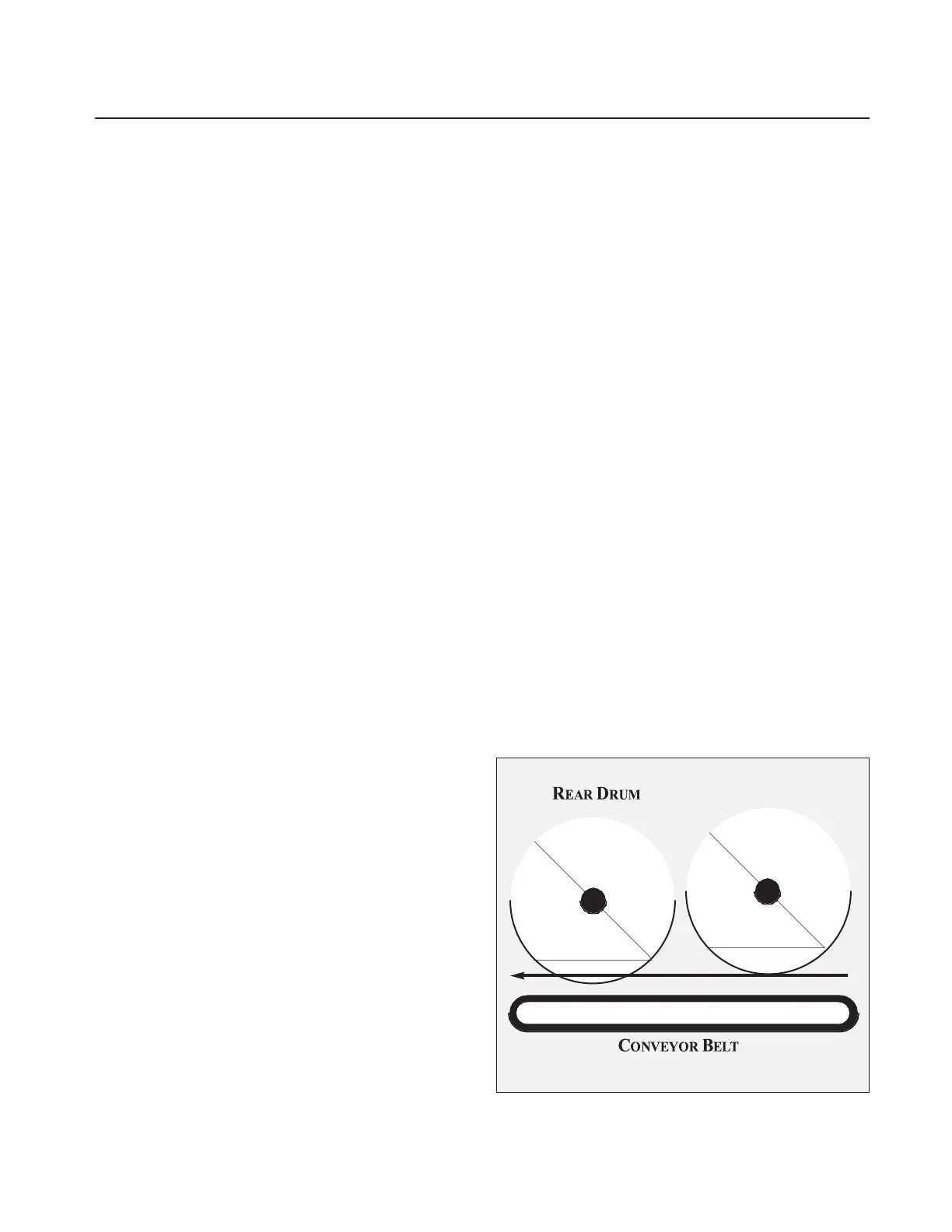
Secondary Drum. On dual drum models, sanding
with a different abrasive grit on each drum is pos-
sible in a single pass. The coarser abrasive is
wrapped on the primary (front) drum for dimen-
sioning and surfacing of the wood, while the finer
abrasive is wrapped on the secondary (rear) drum.
When used in this way, the secondary drum gener-
ally is positioned just slightly lower than the pri-
mary drum so it removes the scratches left by the
coarser grit on the primary drum (Fig. 14).
However, the exact depth of cut of the secondary
drum will depend on the specific abrasive grits on
each of the drums.
The chart on page 14 shows grit combinations
and rear drum settings, can also be found under
the dust cover of your machine. It suggests settings
for various abrasive grit combinations; try these to
start and make adjustments as necessary for your
work. When adjusting the secondary drum, turn
Fig. 14. Relative positions of dual drums.



 To Next Page