
 Need help?
Do you have a question about the TechnipFMC Smith Meter F4 and is the answer not in the manual?
Lists essential tools and equipment required to facilitate meter disassembly.
Procedure for removing the outer cover on specific meter models (C2 through JA10-S1 and A1).
Guidelines for servicing the high pressure packing gland with glycerine solution.
Step-by-step instructions for disassembling and servicing the packing gland assembly.
Instructions for removing the gear train components from the meter cover.
Details the procedure for adjusting rotor end clearance on C2 through G6 meter models.
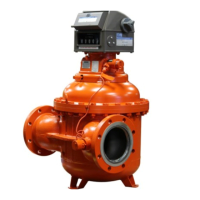
The Smith Meter® Rotary Vane PD Meters, specifically the 2-Bladed Double Case PD Meters, are positive displacement type meters designed for accurate measurement in various applications. This service manual provides comprehensive information for their inspection, maintenance, and service.
At its core, the Smith Meter® operates on the principle of positive displacement. The measuring function is achieved within a precisely defined chamber formed by moving blades, a rotor, the meter body, and a cover. As product flows through the meter, it causes the rotor and blades to turn. The blades rotate around a fixed cam, which guides their movement so they extend outwards but do not touch the meter body. This synchronized movement creates four distinct chambers per revolution of the rotor. Each chamber captures and displaces a known volume of product, allowing for accurate measurement of the total flow. The double-case design of these meters is a key feature, as it isolates the measuring chamber from external pressure differentials and piping strains. This isolation prevents distortion of the measuring unit, which could otherwise compromise accuracy.
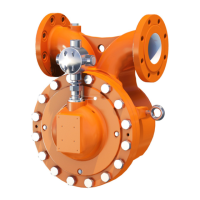
The design of the Smith Meter® emphasizes ease of use and reliable operation. The double-case construction means that the entire measuring unit can be removed vertically from the outer housing without disturbing the pipe connections. This significantly simplifies installation and removal processes, reducing downtime and potential for product spillage. Furthermore, within a given meter size, complete metering units and their individual parts are interchangeable. This interchangeability streamlines inventory management and facilitates repairs, as common parts can be used across multiple meters of the same size.
For enhanced durability and performance in challenging environments, a meter variation with tungsten carbide trim is available. This trim is specifically designed to resist accelerated wear caused by impurities such as sand and iron sulfide, as well as the low lubricity often found in condensates. This variation incorporates solid tungsten carbide journal rotor and thrust bearings, which are highly resistant to abrasion. Additionally, the blade bearing size and weight have been optimized to minimize rotational inertia, while the wear resistance of the bearings and cam has been substantially increased. The rotor and jackshaft gear assemblies in these specialized meters are made from hardened stainless steel, further contributing to their longevity and reliability in harsh operating conditions.
The Smith Meter® is designed with preventive maintenance in mind, offering several features that simplify inspection and service. The ability to easily remove the measuring unit from the outer housing encourages periodic inspections, as the process is less intrusive and time-consuming.
A critical aspect of maintenance involves the packing gland, which acts as a sealant and lubricant. For high-pressure packing glands, a glycerine solution is used for both sealing and lubrication. Regular servicing of the packing gland is recommended, with injections of glycerine solution at intervals determined by operational experience, but not exceeding 60 days. Prior to startup after a period of idleness, injecting 1 fluid ounce of glycerine solution into the packing gland is advised. The packing gland's design includes a reservoir overflow mechanism that prevents overfilling, ensuring proper lubrication without excess. It is important to note that lubricating grease should never be used in the packing gland.
The manual provides detailed procedures for disassembling and reassembling the meter, including the gear train, inner mechanism, and rotor components. This systematic approach ensures that all parts are inspected, cleaned, and replaced as necessary. Parts that are worn or damaged, such as those with nicks, gouges, or rough spots, should be dressed with a fine file or crocus cloth to restore their condition.
Clearance checks are a vital part of maintenance to ensure optimal meter performance. The manual provides a comprehensive clearance guide, listing recommended minimum and maximum fitting clearances for repaired meters. These clearances, including blade slot clearance, blade top end below rotor clearance, blade tip to housing clearance, rotor to block clearance, and blade roller to cam radius clearance, are checked using feeler gauges and micrometers. The ability to adjust rotor end clearance by dividing top and bottom clearance with an adjusting screw is a key maintenance feature, allowing for precise tuning of the meter. For larger meters (H8 and JA10 models), the rotor adjustment procedure is reversed due to their suspended rotor assemblies.
The manual also emphasizes the importance of maintaining a detailed record for each meter. This record should include nameplate data, clearances, progressive totalizer readings, meter factor, and parts used. Such information provides a valuable historical context for scheduling preventive maintenance programs. An increase in meter factor drift against throughput can serve as an indicator for initiating an inspection. The frequency of the first inspection is determined by operating conditions, including flow rate, fluid lubrication properties, and the potential presence of abrasive contaminants. Subsequent inspection intervals can then be adjusted based on the meter's condition observed during these checks.
During reassembly, specific instructions are provided for installing the inner unit cover, ensuring proper meshing of the rotor gear and lower jackshaft gear. Sealants like Loctite 518 are used on machined surfaces to prevent leaks, and specific torque values are provided for cinch bolts and cover screws to ensure secure and proper assembly. The manual also details the process of fitting new blades, which involves dressing down blade ends to achieve the correct clearances. This meticulous attention to detail during reassembly and adjustment ensures the meter operates within specified tolerances, maintaining its accuracy and extending its service life.
 General
| Brand | TechnipFMC |
|---|---|
| Model | Smith Meter F4 |
| Category | Measuring Instruments |
| Language | English |





 To Next Page