10
codice 09MAXX001
versione EN
revisione 01
Use and Maintenance Manual
MaxX
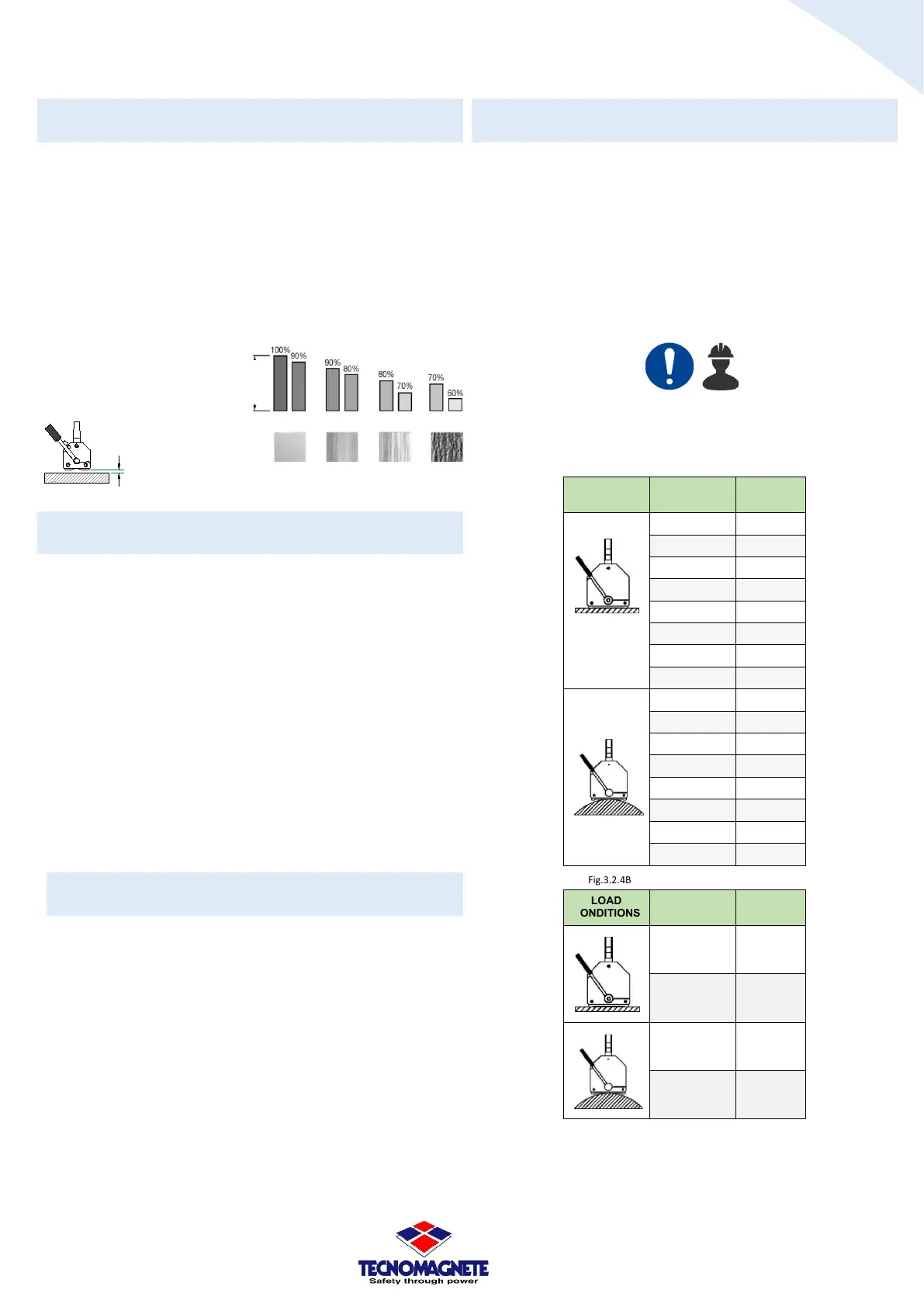
rectified fine milled medium milled rough
3.2.1. Air gap and roughness
The condition that guarantees the most efficient magnetic
attraction is obtained when the air gaps are reduced to a
minimum and there is a consistent surface of continuous
contact.
The worst results occur when there is a high air gap and a
minimum contact. A very important aspect is therefore the
degree of superficial roughness. A good contact surface
considerably decreases the air gaps thus obtaining an optimal
magnetic attraction force.
100% = rettificata
90 ÷ 80% = light milling
80 ÷ 70% = milling
70 ÷ 60% = rough
3.2.2 Contact surface
The magnetic attraction force is directly proportional to the
useful contact surface.
The superficial heat treatments of the material of which the load
is composed influences the physical structure as well as the
capacity of the load to absorb the magnetic flux.
The load made of annealed material is the best.
The load produced with hardened material does not
satisfactorily absorb the flow of time and the tendency to retain
a certain amount of magnetism when the MaxX has been
deactivated (DEMAG).
This amount of magnetism that remains on the load is defined as
magnetic residue and can create difficulties in detaching the
MaxX when it is deactivated (DEMAG). The magnetic residue
can be removed from the load by using a demagnetizer.
3.2.3 Type of material
Check the type of material to which the load is made to be
anchored magnetically. The technical characteristic
required by the material is its magnetic conductivity
(magnetic permeability). The technical characteristic
required by the material is its magnetic conductivity
(magnetic permeability).
1,0 mild steel
0,7 ÷ 0,8 alloy steel
0,5 cast iron
0,2 nichel
0 amagnetic stainless steel, brass, aluminium
3.2.4 Material thickness
It can be hypothesised that the path of the magnetic flux,
inside a load to be anchored magnetically, consists of a
semicircle that starts from the center of a Pole (north) and
arrives at the center of the next one (south). If the load
fails to contain all the generated magnetic flux, the leaking
part is dispersed and does not contribute to the anchorage.
L’attrazione risulta dunque minore di quella che si potrà
avere quando tutto il flusso è assorbito da un carico di
spessore adeguato a contenerlo.
CHECK THE MINIMUM THICKNESS OF THE LOAD
TO BE LIFTED AS IN THE FOLLOWING TABLES
Fig.3.2.4A
LOAD
CONDITIONS
MODEL
MIN.
THICKNES
S
[mm]
MaxX 125 20
MaxX 250 20
MaxX 300E 20
MaxX 500 25
MaxX 600E 25
MaxX 1000 40
MaxX 1500 45
MaxX 2000 55
MaxX 125 10
MaxX 250 10
MaxX 300E 10
MaxX 500 15
MaxX 600E 15
MaxX 1000 25
MaxX 1500 30
MaxX 2000 35
Fig.3.2.4B
LOAD
CONDITIONS
MODEL
MIN.
THICKNES
S [mm]
MaxX TG150 8
MaxX TG300 10
MaxX TG150 8
MaxX TG300 10
contact
surface
T
=Air gap


 To Next Page