Use and Maintenance Manual
MaxX
9.2
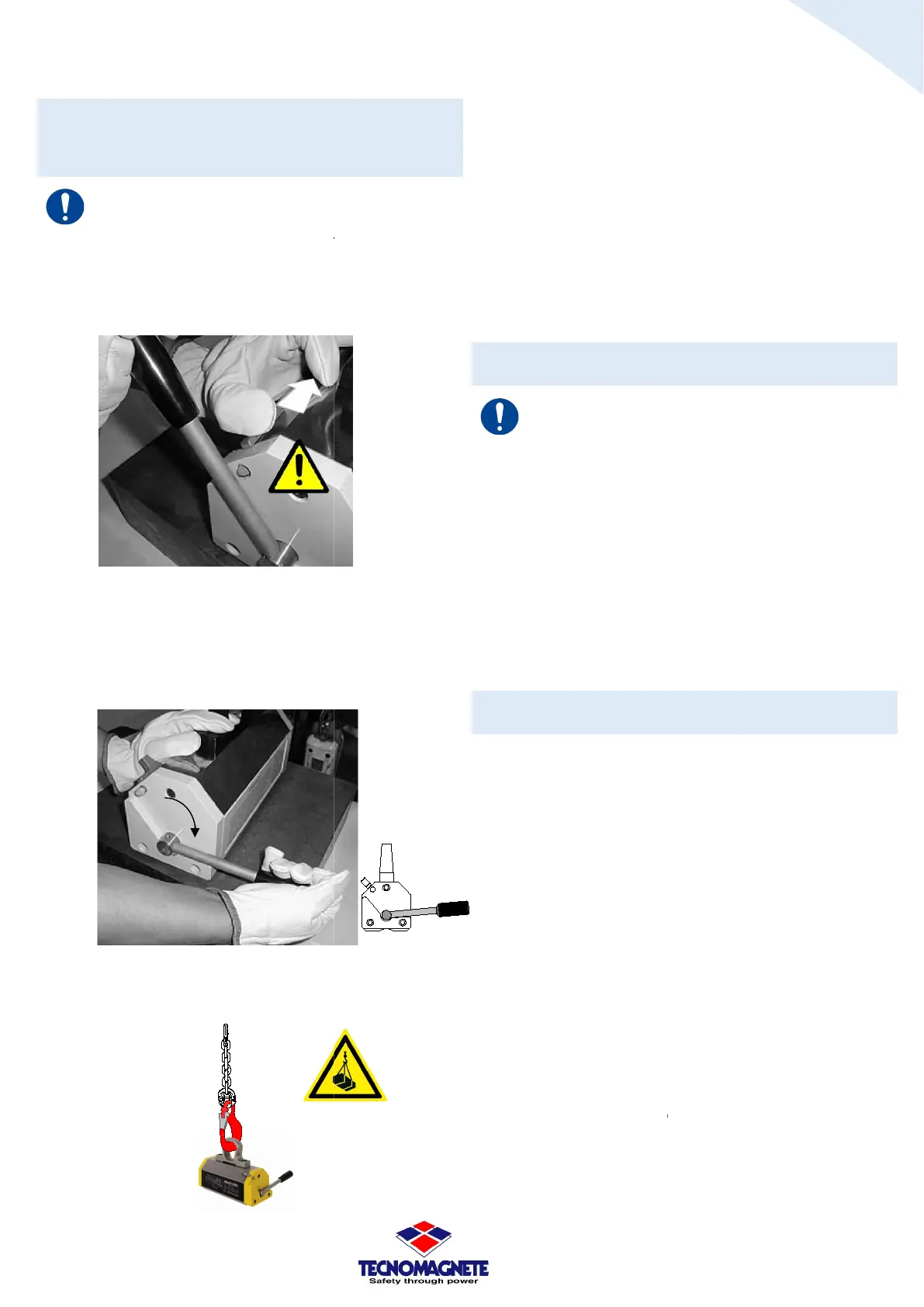
Demagnetisation
Demagnetize with the load perfectly on the
ground or on a support suitable for supporting the
weights of both the load and the MaxX.
a)
Manually move the mechanical lever stop device
until the lever is released during movement.
Fig.9.2A
b)
Holding with one hand the lever stop device in
position as described in phase a)
the lever, with the other hand, and make it rotate
until it accompanies it to the end stop in DEMAG
position.
Fig.9.2B
c) Move MaxX
with the same procedure described in
paragraph 7.1 in step a).
Fig.9.2C
-
Demagnetize with the load perfectly on the
ground or on a support suitable for supporting the
Manually move the mechanical lever stop device
until the lever is released during movement.
Holding with one hand the lever stop device in
proceed holding
the lever, with the other hand, and make it rotate
until it accompanies it to the end stop in DEMAG
with the same procedure described in
10
CHECKS and
MAINTENANCE
Adequate checks and maintenance are key factors in
ensuring that the MaxX
will last longer under optimum
operating and performance conditions and that it is
functionally safe over time.
10.1Controls –
Work equipment must be subject to periodic
inspections at frequencies determined on the basis of the
information supplied by the manufacturers, or the
standards of good practice, or in the absence thereof,
which can be inferred from the codes of good practice.
For this purpose, the types of contro
technical standards
1:2014 are reported:
DAILY CONTROL:
10.2 Checks -
Met
Below are the descriptions of
to the inspection methods:
VISUAL CHECK:
examination conducted with the
aim of identifying any anomalies or deviations
from normal conditions by means of visual checks.
Generally, the visual inspection is conducted
without disa
ssembling the equipment, unless there
are particular needs that may arise.
NON DESTRUCTIVE CHECK:
examinations such as penetrating liquids,
ultrasounds, magnetic particles, X
be necessary after the visual examination
FUNCTIONAL
TEST
controls, levers, indicator screws, etc. Functional
tests are those that allow to obtain a value or a
measure.
OPERATIONAL TEST
without load and/or tests for the functioning of the
device
s (with greater attention to the limiting
devices and indicators).
19
codice 09MAXX001
versione EN
revisione 01
Adequate checks and maintenance are key factors in
will last longer under optimum
operating and performance conditions and that it is
Standards
Work equipment must be subject to periodic
inspections at frequencies determined on the basis of the
information supplied by the manufacturers, or the
standards of good practice, or in the absence thereof,
which can be inferred from the codes of good practice.
For this purpose, the types of contro
ls derived from the
-1:2016 and ISO 12482-
see paragraph 10.4
: see paragraph 10.5
hod
Below are the descriptions of
the control methods, related
examination conducted with the
aim of identifying any anomalies or deviations
from normal conditions by means of visual checks.
Generally, the visual inspection is conducted
ssembling the equipment, unless there
are particular needs that may arise.
reference is made to
examinations such as penetrating liquids,
ultrasounds, magnetic particles, X
-rays, which may
be necessary after the visual examination
: concern tests carried out on
controls, levers, indicator screws, etc. Functional
tests are those that allow to obtain a value or a
OPERATIONAL TEST
: include tests with and
without load and/or tests for the functioning of the
s (with greater attention to the limiting
devices and indicators).


 To Next Page