information about any applicable alarm control levels. The ChallengerPlus panel
checks the user’s credentials in its user database and checks the corresponding
ChallengerPlus user’s alarm group.
If the corresponding ChallengerPlus user’s alarm group and the reader’s alarm
control level allow an alarm function, then the alarm function proceeds.
Note: In IP Extended mode, the number of users that can exercise alarm control
from the NAC is limited by the user capacity of the ChallengerPlus panel (2,000
users or 65,535 users if the ChallengerPlus panel has a TS1084 Memory
Expansion Module).
Alarm control levels are set up in CTPlus on the Alarm control levels tab for the
door. Alarm control levels must also be assigned to the door’s readers, which can
be done on the Alarm tab for the door. The alarm control functionality is
programmed in CTPlus on the Alarm tab for the door. See the “Programming
alarm control options” section on page 77 for instructions.
Bus formats
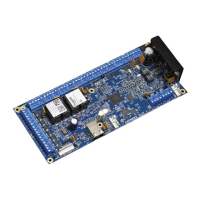
There are two RS-485 buses on the Network Access Controller. Each bus can
have up to 16 RAS devices. Each bus can support readers other than Tecom
readers.
Each bus supports the following protocols:
Tecom
OSDP (Open Supervised Device Protocol) version 2
SALLIS by SALTO Systems
Aperio
Each bus can use one protocol at a time, but the two buses can use different
protocols.
The bus format for each bus is defined on the NAC options tab of the DGPs form
for the NAC. See the “Bus options” section on page 45. If the bus format is
OSDP, then the baud rate of the bus can be configured, and encryption can be
enabled by entering the OSDP encryption key. OSDP encryption uses the AES
128-bit encryption algorithm.
When assigning a RAS to the NAC via the Assigned RAS tab of the DGPs form,
specify the bus format that the reader will use (which depends on the RAS’s
number). See the “Assigning RASs” section on page 47.
Note: The two 4-pin RS-485 cable sockets provide data and power from Bus 1.
For more information about the cable sockets, see the TS1066 Network Access
Controller Installation Manual.
Non-Tecom devices must meet certain requirements to work with the NAC, as
described in the following sections.


 To Next Page