EasyManua.ls Logo

Tektronix T912 - Compensation

Tektronix T912
101 pages
Print Icon
To Next Page IconTo Next Page
To Previous Page IconTo Previous Page
Loading...
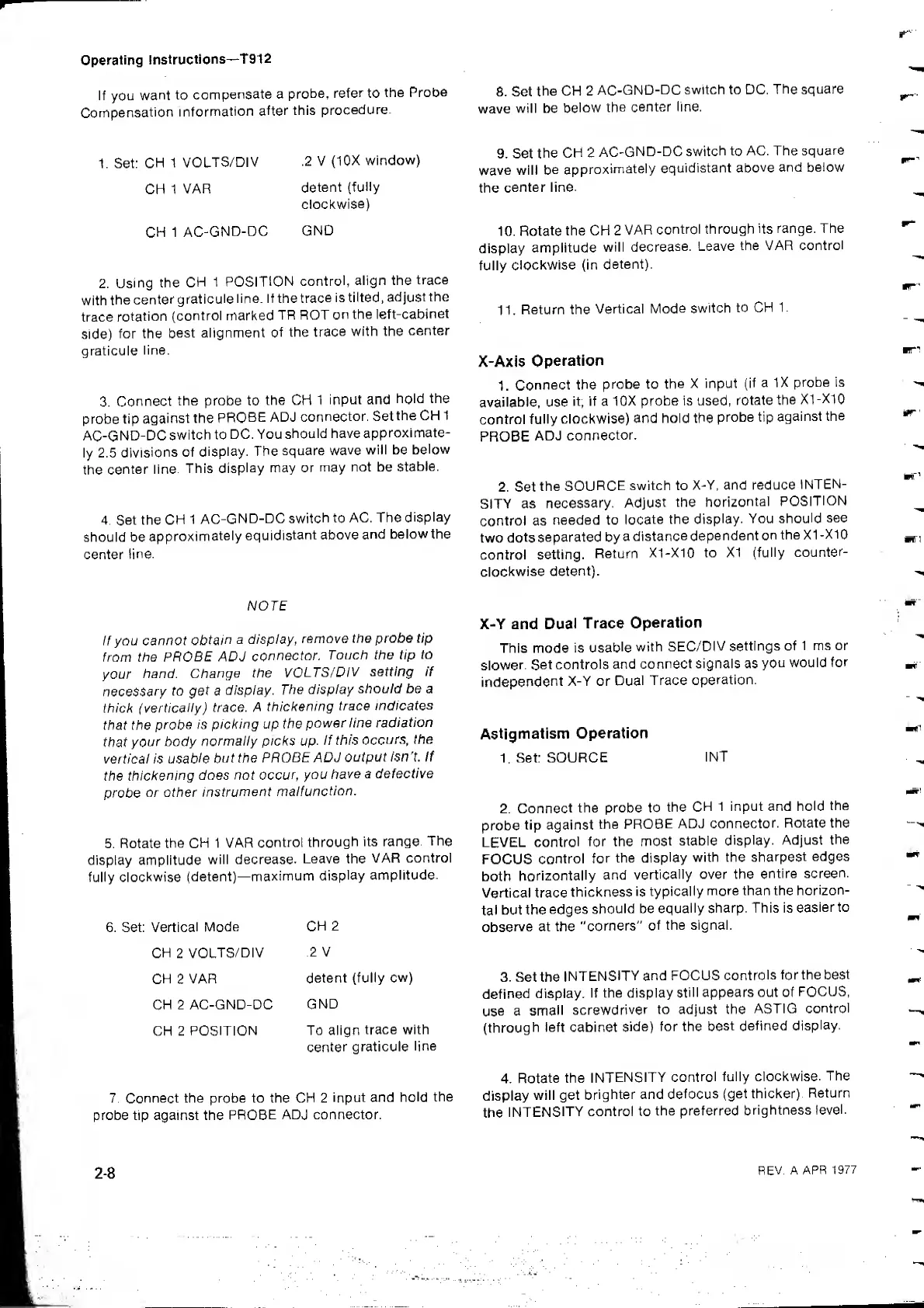
Operating
Instructions—
T912
If
you
want to
compensate
a
probe,
refer
to
the
Probe
Compensation
Information
after
this
procedure.
8.
Set
the CH 2
AC-GND-DC
switch to DC.
The
square
wave
will be
below
the
center line.
1. Set:
CH
1
VOLTS/DIV
.2 V
(10X
window)
CH 1
VAR
detent
(fully
clockwise)
CH
1
AC-GND-DC
GND
2.
Using
the
CH
1
POSITION
control,
align the
trace
with
the
centergraticule
line. If the
trace
istilted,
adjust
the
trace
rotation
(control marked
TR ROT
on
the
left-cabinet
side)
for the
best alignment
of
the
trace
with the
center
graticule
line.
3.
Connect
the probe to
the CH 1
input and
hold the
probe
tip
against
the
PROBE
ADJ
connector.
Set
the CH 1
AC-GND-DC
switch to
DC. You
should have
approximate-
ly 2.5
divisions
of
display. The
square
wave
will be
below
the
center line.
This
display
may or
may
not be
stable.
4. Set the CH
1
AC-GND-DC
switch to
AC. The
display
should be
approximately
equidistant
above
and belowthe
center
line.
9. Set
the CH 2
AC-GND-DC
switch to
AC. The
square
wave
will
be
approximately
equidistant
above
and below
the
center line.
10.
Rotate
the CH 2
VAR
control through
its
range. The
display
amplitude
will
decrease.
Leave
the VAR
control
fully
clockwise (in
detent).
11.
Return the
Vertical
Mode
switch
to CH
1.
X-Axis
Operation
1.
Connect the
probe to
the
X input
(if
a IX
probe is
available, use
it; if a
10X probe is used,
rotate
the
XI-XIO
control
fully
clockwise)
and hold the
probe tip
against
the
PROBE
ADJ
connector.
2.
Set
the
SOURCE
switch to
X-Y, and reduce
INTEN-
SITY
as
necessary.
Adjust
the
horizontal
POSITION
control as
needed to
locate
the
display.
You
should
see
two
dots
separated by
adistance
dependent
on
theXI-XIO
control
setting.
Return
X1-X10 to X1
(fully
counter-
clockwise
detent).
NOTE
If you
cannot
obtain
a display,
remove
the probe tip
from the
PROBE ADJ
connector.
Touch the tip
to
your
hand.
Change
the
VOLTS/DIV
setting if
necessary
to get a
display.
The display
should be a
thick
(vertically)
trace. A
thickening
trace
indicates
that the
probe
Is
picking up the
power line
radiation
that
your
body
normally picks up.
If this
occurs,
the
vertical is
usable
but
the
PROBE ADJ
output Isn't. If
the
thickening
does not
occur,
you
have
a defective
probe
or other
Instrument
malfunction.
5.
Rotate
the
CH
1 VAR
control
through
its range.
The
display amplitude
will decrease.
Leave the
VAR control
fully
clockwise
(detent)—
maximum
display
amplitude.
6.
Set;
Vertical Mode
CH
2
VOLTS/DIV
CH
2
VAR
CH
2 AC-GND-DC
CH 2
POSITION
CH
2
.2 V
detent (fully
cw)
GND
To align
trace with
center
graticule
line
X-Y and
Dual
Trace
Operation
This mode
is
usable
with
SEC/DIV
settings of
1 ms or
slower.
Set
controls and
connect
signals as
you
would
for
independent
X-Y or
Dual
Trace
operation.
Astigmatism
Operation
1,
Set:
SOURCE
INT
2.
Connect
the probe to
the
CH
1 input and hold
the
probe
tip against
the
PROBE
ADJ
connector.
Rotate the
LEVEL
control
for the
most
stable
display.
Adjust
the
FOCUS
control
for
the
display
with the
sharpest
edges
both
horizontally
and
vertically
over the
entire
screen.
Vertical trace
thickness
is
typically
more than the
horizon-
tal
but the
edges
should
be
equally
sharp. This is
easier
to
observe
at the
"corners"
of
the signal.
3.
Set the
INTENSITY
and FOCUS
controls
for the
best
defined
display.
If the display
still appears out of
FOCUS,
use
a
small
screwdriver
to adjust the
ASTIG
control
(through
left cabinet
side) for the
best
defined
display.
7.
Connect the probe to the CH 2
input and
hold
the
probe tip against the
PROBE
ADJ connector.
4.
Rotate
the
INTENSITY
control
fully clockwise.
The
display
will get
brighter and
defocus
(get thicker).
Return
the
INTENSITY
control to
the preferred
brightness
level.
rr"
2-8
REV.
A APR
1977

Related product manuals