EasyManua.ls Logo

Tektronix T912 - Trigger (Late); Trigger (Early)

Tektronix T912
101 pages
Print Icon
To Next Page IconTo Next Page
To Previous Page IconTo Previous Page
Loading...
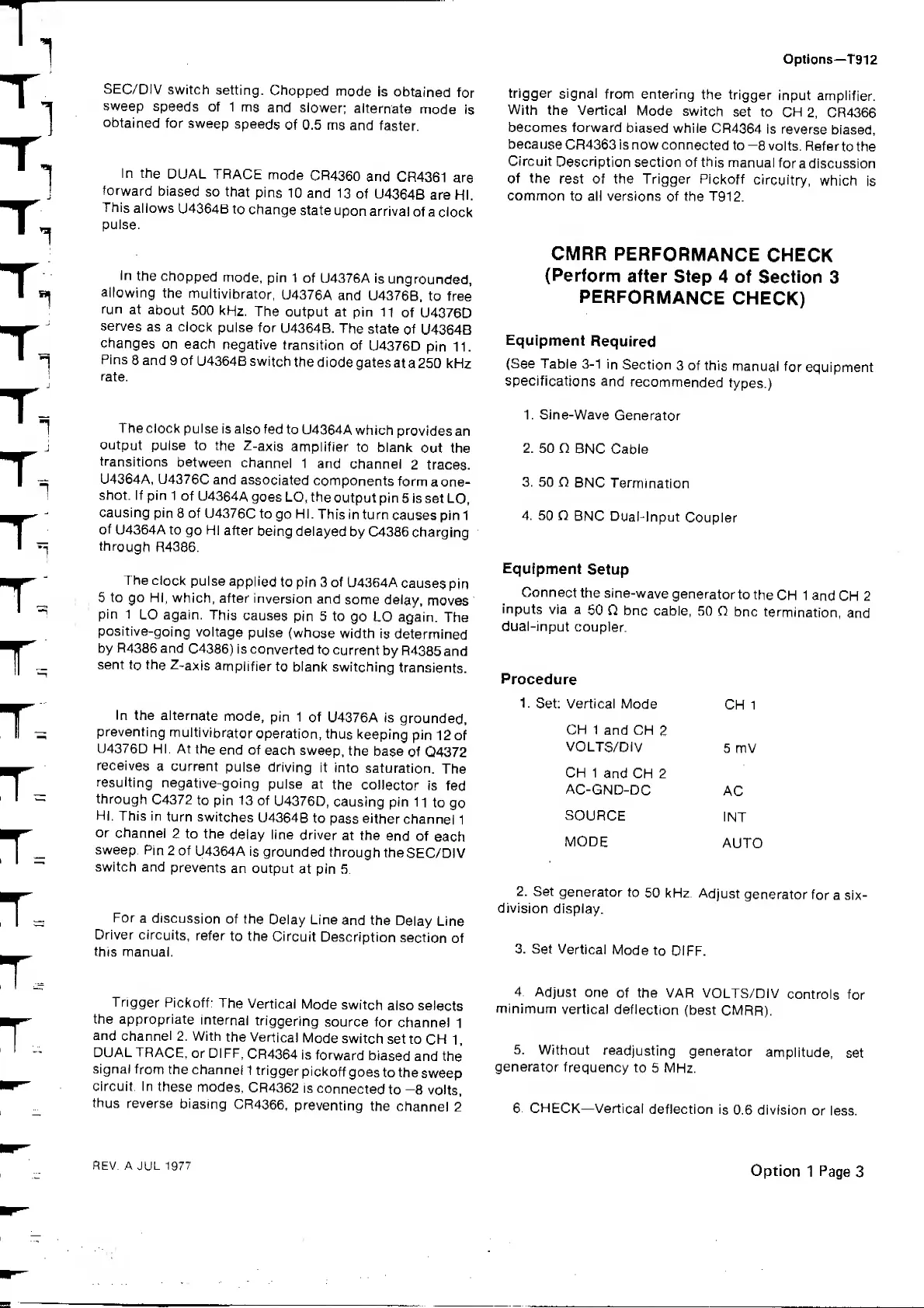
Options—
T91
2
SEC/DIV
switch
setting.
Chopped
mode
is
obtained
for
sweep speeds
of 1
ms
and
slower;
alternate
mode
Is
obtained
for
sweep
speeds
of 0.5 ms
and
faster.
In the
DUAL
TRACE
mode
CR4360
and CR4361
are
forward
biased
so
that
pins
10 and
13
of
U4364B
are
HI.
This
allows
U4364B
to
Change
state
upon
arrival
of a
clock
pulse.
In
the
chopped
mode,
pin
1
of U4376A
is
ungrounded,
allowing
the
multivibrator,
U4376A
and
U4376B,
to free
run
at
about
500
kHz.
The
output at pin
11
of
U4376D
serves
as a
clock
pulse for
U4364B.
The
state
of
U4364B
changes
on each
negative transition
of
U4376D
pin 11.
Pins
8 and
9 of
U4364B
switch
the
diode
gates
at
a 250 kHz
rate.
The clock
pulse
is
also fed
to
U4364A
which
provides
an
output
pulse to
the
Z-axis
amplifier
to
blank
out the
transitions
between
channel
1 and
channel
2 traces.
U4364A, U4376C
and
associated
components
form
a one-
shot. If pin
1 of
U4364A
goes LO, the
output pin
5 is set
LO,
causing
pin
8 of
U4376C
to
go
HI.
This in turn
causes pin 1
of
U4364A
to
go HI after
being delayed
by C4386
charging
through
R4386.
The
clock
pulse
applied
to pin
3 of U4364A
causes
pin
5 to go HI,
which,
after
inversion
and
some delay,
moves
pin
1
LO again.
This
causes
pin 5 to
go LO again.
The
positive-going
voltage
pulse
{whose
width
is
determined
by
R4386
and
C4386) is
converted
to
current
by
R4385and
sent
to the
Z-axis
amplifier
to
blank switching
transients.
In
the alternate
mode,
pin
1 of
U4376A is
grounded,
preventing
multivibrator
operation,
thus
keeping
pin
12 of
U4376D
HI. At
the
end of
each sweep,
the base
of Q4372
receives
a current
pulse driving
it into
saturation.
The
resulting
negative-going
pulse at
the
collector
is fed
through
C4372
to pin 13
of
U4376D,
causing pin
11
to
go
HI.
This in
turn
switches
U4364B
to
pass either
channel
1
or
channel
2 to the
delay line
driver
at the
end of
each
sweep.
Pin
2 of
U4364A
is
grounded
through
the
SEC/DIV
switch and
prevents
an output
at pin 5.
For
a discussion
of the
Delay Line
and the
Delay
Line
Driver circuits,
refer
to the
Circuit
Description
section
of
this
manual.
Trigger
Pickoff:
The
Vertical
Mode
switch
also
selects
the appropriate
internal
triggering
source for
channel
1
and
channel
2. With
the
Vertical
Mode
switch
set to
CH
1
,
DUAL TRACE,
or DIFF,
CR4364
is
forward
biased
and the
signal
from
the channel
1 trigger
pickoff
goes
to the
sweep
circuit. In
these modes,
CR4362
is
connected
to
-8
volts,
thus
reverse
biasing
CR4366,
preventing
the
channel
2
REV. A
JUL 1977
trigger
signal
from entering
the trigger
input
amplifier.
With
the Vertical
Mode switch
set
to CH
2,
CR4366
becomes forward
biased
while CR4364
is
reverse
biased,
because
CR4363 is now
connected
to
-8
volts.
Refer
to the
Circuit
Description
section of this manual
for
a discussion
of
the
rest of the Trigger
Pickoff
circuitry,
which
is
common
to all versions
of the
T912.
CMRR
PERFORMANCE
CHECK
(Perform
after
Step
4 of
Section
3
PERFORMANCE
CHECK)
Equipment
Required
(See Table
3-1
in
Section
3 of this
manual
for
equipment
specifications
and
recommended
types.)
1. Sine-Wave
Generator
2. 50 n
BNC Cable
3.
50
O
BNC
Termination
4.
50
n
BNC
Dual-Input
Coupler
Equipment
Setup
Connect
the sine-wave
generatorto
the
CH
1
andCH 2
inputs
via a
50 Q bnc
cable, 50 O
bnc
termination,
and
dual-input
coupler.
Procedure
1.
Set: Vertical Mode
CH 1
CH 1
and CH
2
VOLTS/DIV
5 mV
CH
1
and CH 2
AC-GND-DC
AC
SOURCE
INT
MODE
AUTO
2. Set
generator
to
50 kHz.
Adjust
generator
for
a six-
division
display.
3. Set
Vertical
Mode
to
DIFF.
4.
Adjust
one
of the VAR
VOLTS/DIV
controls
for
minimum
vertical
deflection
(best
CMRR).
5.
Without
readjusting
generator
amplitude,
set
generator
frequency
to
5
MHz.
6. CHECK—
Vertical
deflection
is
0.6 division
or less.
Option
1 Page
3

Related product manuals