Service Information—
T912
Troubleshooting Equipment
The following equipment is usefui fortroubieshooting.
1. Semiconductor Tester
Description:
Dynamic-type
tester. Must be
capable
of
measuring reverse breakdown
voitages
of at least
400 V.
Purpose: To test
semiconductors.
Example:
TEKTRONIX
Type 576 Curve Tracer or
TEKTRONIX 577
(D1 or D2)
Curve
Tracer with
177Test
Fixture.
2.
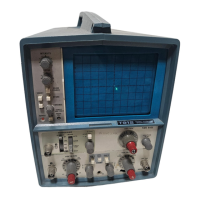
Test Oscilloscope
Description:
Frequency
response, dc to at least 15
MHz. A
10X, 10 MO voltage probe
should
be used to
reduce
circuit loading
for voltage measurements.
Purpose: To
check operating
waveforms.
3.
Multimeter
Description:
Non-loading
digital
multimeter.
Voltmeter,
10 MO input
impedance and 0 to 150 V
range; dc voltage accuracy,
within
0.15%;
display, 41/2
digits. Ohmmeter, 0
to
20 MO.
Purpose;
To
check voltages and
for general
troubleshooting.
4. Variable
Autotransformer
Description: Output
variable
from 0 to 140 V,
1.2
A
minimum
rating.
Must
have a
three-wire
power cord,
plug and receptacle.
Purpose: To vary the input
line
voltage when
troubleshooting
in
the
power supply.
Example: General Radio W8MT3VM or
W10MT3W
Metered
Variac
Autotransformer.
REV. A APR 1977
5. Vertical
Amplifier Extender Troubleshooting Fixture
Description: 18
inch ribbon
cable
with an
interface
connector at each
end
(Tektronix part
067-0773-00).
Purpose:
To operate
the vertical amplifier
outside
the instrument. Useful for
troubleshooting
the time
base which is inaccessible
with the vertical
amplifier
installed.
Troubleshooting Techniques
The
following checklist is arranged so that you
check
the
simple things
before
you
get the
instrument
taken
apart. Start at the
beginning.
1. Check the Control Settings. See
the Operating
Instructions
for
the
correct
control settings.
2. Check Associated Equipment and
Connectors.
Check to see that
the signal source is properly connected
and that the interconnecting cables are not
defective. Also
check the power cord and plug and the
power source for
defects.
3.
Check the
Performance of
the
instrument. If the
instrument does
not
meet specifications, the trouble may
be
corrected by readjusting the
instrument. See
the
Adjustment Procedure,
Section
4,
for instructions.
4.
Visual Check.
A visual check may
reveal
broken
connections, damaged components,
semiconductors not
firmly mounted, damaged
circuit boards, etc.
5.
Isolate the T rouble to a Circuit. To isolate
trouble to a
particular circuit,
note
the
trouble symptom. The
symptom
often
identifies the circuit where the
trouble is
located. For
example, poor focus
indicates that the crt
circuit
(including
the high-voltage
supply) is
probably at fault.
When trouble symptoms
appear in more than one circuit,
check affected
circuits
by
taking voltage and
waveform
readings.
Incorrect operation of
all circuits often indicates trou-
ble in the
power supply. Check first for correct voltage
of
the
individual supplies.
However,
a
defective component
elsewhere in the
instrument
can appear as a
powersupply
trouble and
may also affect
the operation of
other circuits.
Table
5-1
lists the
tolerances of
the power supplies.
Voltages are
measured between the
power supply
test
points
and ground. If a power
supply
voltage is within the
listed tolerance, assume
the
supply is working
correctly.
5-3


 To Next Page