EasyManua.ls Logo

Tektronix T912 - Page 49

Tektronix T912
101 pages
Print Icon
To Next Page IconTo Next Page
To Previous Page IconTo Previous Page
Loading...
Service
Information—
T91
2
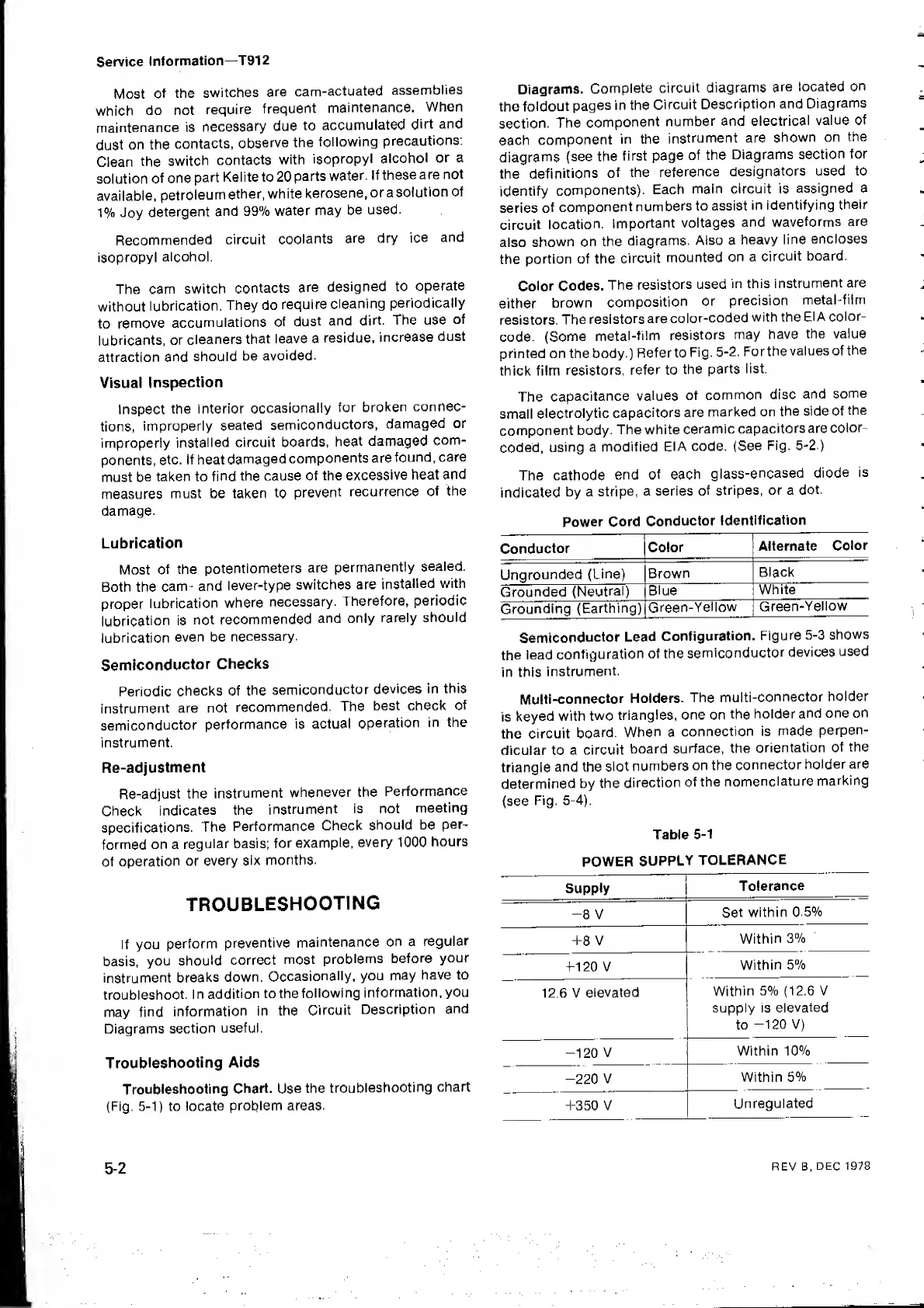
Most
of
the
switches
are
cam-actuated
assemblies
which
do not
require
frequent
maintenance.
When
maintenance is
necessary
due
to
accumulated
dirt and
dust
on the
contacts,
observe
the
following
precautions:
Clean
the
switch
contacts
with
isopropyl
alcohol or
a
solution
of
one
part Kelite to
20
parts
water.
If
these
are
not
available,
petroleum
ether, white
kerosene,
or a
solution
of
1%
Joy
detergent
and 99%
water
may
be
used.
Recommended
circuit
coolants
are
dry
ice
and
isopropyl
alcohol.
The cam
switch
contacts
are
designed to
operate
without
lubrication.
They do
require
cleaning
periodically
to
remove
accumulations
of
dust
and
dirt.
The use
of
lubricants,
or
cleaners
that
leave a
residue,
increase
dust
attraction
and
should
be
avoided.
Visual
Inspection
Inspect
the interior
occasionally
for
broken
connec-
tions,
improperly
seated
semiconductors,
damaged or
improperly
installed
circuit
boards,
heat
damaged
com-
ponents,
etc. If heat
damaged
components are
found,
care
must
be
taken to
find
the cause
of the
excessive
heat
and
measures
must be taken
to
prevent
recurrence
of
the
damage.
Lubrication
Most
of
the
potentiometers
are
permanently
sealed.
Both the
cam- and
lever-type
switches
are
installed
with
proper
lubrication where
necessary.
Therefore, periodic
lubrication
is
not
recommended
and only
rarely
should
lubrication
even be
necessary.
Semiconductor
Checks
Periodic
checks of
the
semiconductor
devices
in this
instrument
are not
recommended.
The
best check
of
semiconductor
performance
is actual
operation
in the
instrument.
Re-adjustment
Re-adjust
the
instrument
whenever the
Performance
Check
indicates
the
instrument
is not
meeting
specifications.
The
Performance
Check
should be
per-
formed
on a
regular basis;
for
example,
every 1000
hours
of
operation
or
every
six months.
TROUBLESHOOTING
If you
perform
preventive
maintenance
on
a
regular
basis,
you
should
correct
most
problems
before
your
instrument
breaks
down.
Occasionally,
you may
have to
troubleshoot.
In
addition
to the
following
information, you
may
find
information
in the
Circuit
Description
and
Diagrams
section
useful.
Troubleshooting
Aids
Troubleshooting
Chart.
Use
the
troubleshooting
chart
(Fig. 5-1) to
locate
problem areas.
Diagrams.
Complete
circuit diagrams
are
located
on
the
foldout
pages
in the
Circuit
Description
and
Diagrams
section.
The
component
number and
electrical
value of
each
component
in the
instrument are
shown on
the
diagrams
(see the
first
page
of the
Diagrams
section
for
the
definitions
of
the
reference
designators
used to
identify
components).
Each
main circuit is
assigned a
series
of
component
numbers
to assist
in identifying
their
circuit
location.
Important
voltages
and
waveforms
are
also
shown on
the
diagrams.
Also a
heavy line
encloses
the
portion of the
circuit
mounted
on
a
circuit
board.
Color
Codes.
The
resistors
used
in this
instrument
are
either
brown
composition
or
precision
metal-film
resistors.
The
resistors
are
color-coded
with the
El
A
color-
code.
(Some
metal-film
resistors may
have
the value
printed on the body.)
Refer to
Fig.
5-2.
For the
values of
the
thick film
resistors,
refer
to
the
parts
list.
The
capacitance
values
of
common
disc
and
some
small
electrolytic
capacitors
are
marked on
the side of
the
component
body.
The white
ceramic
capacitors
are
color-
coded,
using
a modified
EIA code.
(See
Fig.
5-2.)
The cathode
end
of each
glass-encased
diode
is
indicated
by a
stripe,
a series
of
stripes, or a
dot.
Power
Cord
Conductor
Identification
Conductor
Color
Alternate
Color
Ungrounded
(Line)
Brown
Black
Grounded
(Neutral)
Blue
White
Grounding
(Earthing)
Green-Yellow
Green-Yellow
Semiconductor
Lead
Configuration.
Figure
5-3
shows
the
lead
configuration
of the
semiconductor
devices
used
in this
instrument.
Multi-connector
Holders.
The
multi-connector
holder
is
keyed
with
two
triangles, one on
the
holder
and one
on
the
circuit
board.
When
a
connection is made
perpen-
dicular to
a circuit
board
surface, the
orientation
of
the
triangle
and the
slot
numbers
on the
connector
holder
are
determined
by the
direction
of
the
nomenclature
marking
(see
Fig.
5-4).
Table
5-1
POWER
SUPPLY
TOLERANCE
Supply
Tolerance
-8
V
Set
within
0.5%
-L8 V
Within
3%
f120 V
Within
5%
12.6 V
elevated
Within
5%
(12.6
V
supply is
elevated
to
-120
V)
-120
V
Within 10%
-220
V
Within 5%
+350 V
Unregulated
5-2
REV B,
DEC 1978

Related product manuals