EasyManua.ls Logo

Tektronix T912 - Page 55

Tektronix T912
101 pages
Print Icon
To Next Page IconTo Next Page
To Previous Page IconTo Previous Page
Loading...
Service
Information—
T91
2
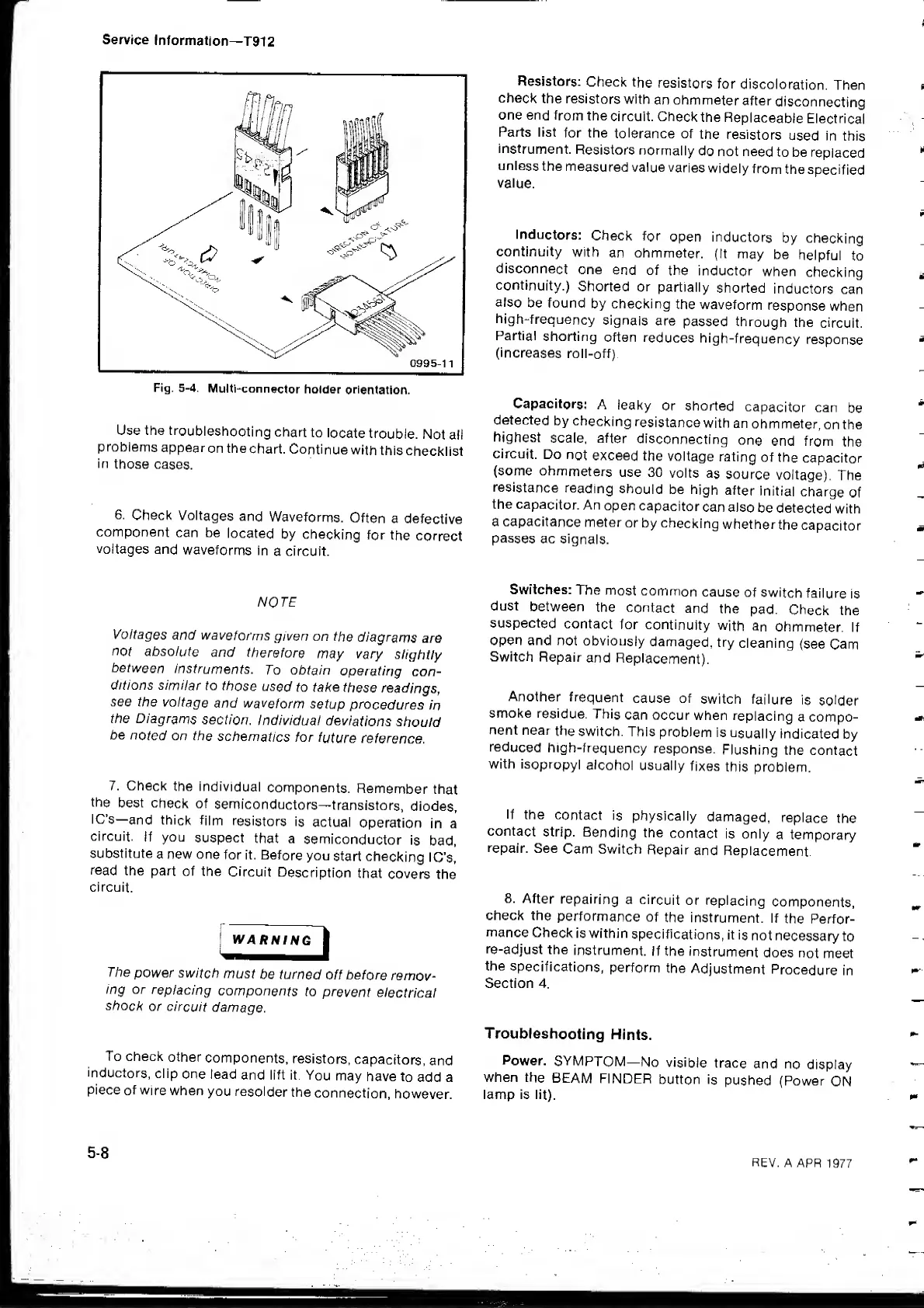
Use the
troubleshooting
chart
to
locate
trouble.
Not
all
problems
appear
on the
chart.
Continue
with
this
checklist
in
those
cases.
6.
Check Voltages
and
Waveforms.
Often
a
defective
component
can be
located
by
checking
for
the
correct
voltages
and
waveforms
in
a circuit.
Resistors:
Check
the
resistors
for
discoloration.
Then
check
the resistors
with
an ohmmeter
after
disconnecting
one end
from
the
circuit.
Check
the
Repiaceable
Elect
ricai
Parts list
for the
tolerance
of
the
resistors
used in this
instrument.
Resistors
normally
do
not
need
to be
replaced
unless
the
measured
value
varies
widely
from
the
specified
value.
Inductors:
Check
for
open
inductors
by checking
continuity
with
an ohmmeter.
(It
may
be
helpful
to
disconnect
one
end of the
inductor
when
checking
continuity.)
Shorted
or
partially
shorted
inductors
can
also
be found
by checking
the
waveform
response
when
high-frequency
signals
are
passed
through
the
circuit.
Partial
shorting
often
reduces
high-frequency
response
(increases
roll-off).
Capacitors;
A
leaky
or shorted
capacitor
can
be
detected
by
checking
resistance
with an
ohmmeter,
on the
highest
scale, after
disconnecting
one
end from
the
circuit.
Do
not
exceed
the
voitage
rating
of the
capacitor
(some
ohmmeters
use 30
volts
as
source
voltage).
The
resistance
reading
should
be
high
after
initial
charge
of
the
capacitor.
An
open
capacitor
can also
be
detected
with
a capacitance
meter
or by
checking
whetherthe
capacitor
passes
ac
signals.
NOTE
Voltages
and
waveforms
given on
the
diagrams
are
not
absolute
and
therefore
may vary
slightly
between
instruments.
To obtain
operating
con-
ditions simitar
to
those
used
to take
these
readings,
see
the
voltage
and
waveform
setup
procedures
in
the
Diagrams
section.
Individual
deviations
should
be
noted
on the
schematics
for
future
reference.
7.
Check
the
Individual
components.
Remember
that
the
best
check
of
semiconductors—
transistors,
diodes.
IC’s—
and thick
fiim
resistors
is
actual
operation
in a
circuit.
If you
suspect
that a
semiconductor
is
bad,
substitute
a new one
for it.
Before
you
start
checking
iC’s.
read
the part
of the
Circuit
Description
that
covers
the
circuit.
WARNING
The
power
switch
must
be turned
off before
remov-
ing or
replacing
components
to
prevent
electrical
shock
or
circuit
damage.
To check
other
components,
resistors,
capacitors,
and
inductors,
clip
one lead
and lift it.
You
may
have
to
add a
piece
of wire
when
you
resolder
the
connection,
however.
Switches:
The
most
common
cause
of
switch
failure
Is
dust
between
the
contact
and
the
pad.
Check
the
suspected
contact
for
continuity
with
an
ohmmeter.
If
open and not
obviously
damaged,
try
cleaning
(see
Cam
Switch
Repair
and
Replacement).
Another
frequent
cause of
switch
failure
is
solder
smoke
residue.
This
can occur
when
replacing
a compo-
nent
near
the switch.
This
problem
is
usually
indicated
by
reduced
high-frequency
response.
Flushing
the contact
with
isopropyl
alcohol
usually
fixes
this
problem.
If
the
contact
is
physically
damaged,
replace
the
contact
strip.
Bending
the
contact
is only
a temporary
repair.
See
Cam Switch
Repair
and
Replacement.
8.
After
repairing
a
circuit
or
replacing
components,
check the
performance
of
the
instrument.
If
the Perfor-
mance
Check
is within
specifications,
it
is
not
necessary
to
re-adjust
the
instrument.
If the
instrument
does
not
meet
the
specifications,
perform
the
Adjustment
Procedure
in
Section
4.
Troubleshooting
Hints.
Power.
SYMPTOM—
No
visible
trace
and
no
display
when
the
BEAM
FINDER
button
is
pushed
(Power
ON
lamp is lit).
5-8
REV.
A
APR
1977

Related product manuals