1 Evaluation Module Overview
1.1 Introduction
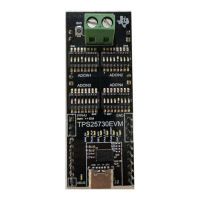
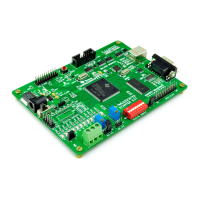
The TPS25730EVM allows for configuration and testing of the TPS25730 by utilizing four sets of switches for
configuration and a terminal block for testing the TPS25730 under load. Labeled LEDs act as indicators of
device status, and the potential final design solution size is illustrated by the white box around C1, R33, and J2.
The TPS25730 is a USB-PD controller used for sink-only applications. The TPS25730 is intended for devices
that only sink power by the USB-PD, in the Standard Power Range (as defined by the USB-PD 3.1
specification), between 5 V and 20 V. Practically, this means that a design using this device utilizes a USB-C
®
connector and is compatible with the USB-PD 3.1 specification. To use the TPS25730EVM, a USB-PD capable
power source needs to be connected via a USB-C cable to the USB-C port of the TPS25730EVM. This user's
guide describes how the TPS25730EVM can be used to test various sink power configurations using on-board
switches.
1.2 Kit Contents
The kit for the TPS25730EVM contains:
1 TPS25730EVM
1.3 Specification
This section describes applications for the TPS25730.
The TPS25730 is a PD controller that enables the sinking of power to the system through a USB-C connector
using the USB-PD specification, as shown in Figure 1-1. Due to the ability to configure power settings by
voltage dividers at the ADCINx pins, no EEPROM is needed, which reduces BOM cost and saves board space.
Additionally, no software or GUI is required, minimizing development time.
With the ADCINx pins configured the desired settings, as described in Section 2.7, the TPS25730 sinks the
negotiated amount of power through the PPHV pin from a USB-PD capable source.
How this negotiation occurs is detailed in the Universal Serial Bus Power Delivery Specification. This
specification can be accessed at USB Power Delivery.
In broad terms:
1. The USB-C cable that is connected to a source is plugged into the USB-C port of the TPS25730EVM.
2. A 5 V implicit Type-C contract is established.
3. The source sends the capabilities as an ordered list to the sink, through the CC line.
4. The sink makes a request for a specific Power Data Object (PDO) from the list.
5. The source accepts this request and sends a PS_Ready message to indicate that the bus is ready to deliver
power.
6. Power is delivered from the source through the VBUS line of the USB cable, through the TPS25730 power
path, and to the load through PPHV.
Evaluation Module Overview www.ti.com
2 TPS25730 Evaluation Module SLVUCP4 – NOVEMBER 2023
Submit Document Feedback
Copyright © 2023 Texas Instruments Incorporated



 To Next Page