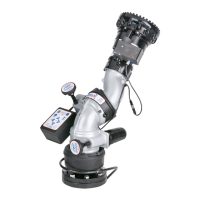
The Task Force Tips (TFT) Hand Held Automatic Pressure Control Nozzles, including the Ultimatic, Mid-Matic, and Handline series, are designed for firefighting applications. These nozzles provide excellent performance under most firefighting conditions and are compatible with both fresh water and fire fighting foam solutions.
Function Description:
These nozzles are designed to control water flow and pattern, offering automatic pressure control to maintain a consistent nozzle pressure across a range of flows. This feature helps to provide a stable stream and predictable reaction force for the operator. The Ultimatic, Mid-Matic, and Handline models offer various flow ranges and nominal pressures to suit different operational needs. Some models incorporate an IMPULSE Trigger Valve System for flow control, while others use lever-type or twist shutoff mechanisms. Pattern control allows adjustment from straight stream to wide fog, and a flush control feature helps clear small debris.
Important Technical Specifications:
The nozzles are constructed from durable materials, including Aluminum 6000 series hard anodized MIL8625 class 3 type 2, stainless steel 300 series, nylon 6-6, and nitrile rubber.
- Maximum Operating Pressure (with valve shut off):
- Ultimatic: 800 psi (55 bar)
- Mid-Matic: 300 psi (21 bar)
- Handline: 300 psi (21 bar)
- Operating Temperature Range of Fluid: 33 to 120°F (1 to 50°C)
- Storage Temperature Range: -40 to 150°F (-40 to 65°C)
- Flow Ranges (GPM / L/min) and Nominal Pressures (PSI / BAR):
- Ultimatic:
- 10-125 GPM (40-500 L/min) at 100 PSI (7 bar)
- 10-100 GPM (40-400 L/min) at 75 PSI (5 bar) (for IMPULSE Trigger Valve System)
- Mid-Matic:
- 70-200 GPM (260-760 L/min) at 100 PSI (7 bar)
- 70-200 GPM (260-680 L/min) at 75 PSI (5 bar) (for IMPULSE Trigger Valve System)
- 70-180 GPM (260-680 L/min) at 55 PSI (3 bar)
- Handline:
- 95-300 GPM (360-1140 L/min) at 100 PSI (7 bar)
- 95-250 GPM (360-950 L/min) at 75 PSI (5 bar)
- 95-225 GPM (360-850 L/min) at 55 PSI (3 bar)
- Standard Coupling: 1, 1-1/2 NH or 1-1/2 NPSH for Ultimatic; 1-1/2 NH for Mid-Matic; 1-1/2 or 2-1/2 NH for Handline. Other threads, coupling sizes, or connector styles can be specified.
Usage Features:
- Flow Control:
- Lever Type Flow Control (Slide Valve & Ball Valve): Allows operators to regulate flow with detented positions for slide valves. Ball valve models are shut off when the handle is fully forward. TFT recommends a pistol grip for easier handling and stress reduction.
- Tip Only: Nozzles without an internal shut-off valve, requiring a separate ball valve.
- Twist Shutoff: Valve opened or closed by rotating the valve ring, with detents at intermediate positions.
- IMPULSE Trigger Flow Control: Features an optional lock and a slow-close mechanism to prevent water hammer. The closing speed can be adjusted. Operators are warned against releasing the grip on a flowing nozzle without control.
- Pattern Control: Full pattern control from straight stream to wide fog, adjusted by turning the stream shaper. A "flush" position is available to clear debris.
- Initial Opening Adjustment (Ultimatic): Allows adjustment of the initial gap between the baffle and discharge opening, affecting low pump pressure flow.
- Use with Salt Water: Permissible with thorough fresh water cleaning after each use.
- Foam Aspirating Attachments: Multi-expansion or low expansion attachments can be used to increase expansion ratio, though this will decrease stream reach.
Maintenance Features:
- Durability: Designed to be damage resistant and require minimal maintenance.
- Field Lubrication: Factory lubricated with high-quality silicone grease. Moving parts should be checked regularly for smooth operation. Break Free CLP (spray or liquid) lubricant can temporarily restore smooth operation, but re-application will be needed. Aerosol lubricants should be used in moderation to avoid O-ring swelling.
- Color-Coded Handle Covers and Pistol Grips: Available in various colors for discharge control coding, replaceable following specific instructions.
- Service Testing: Must be tested annually per NFPA 1962. Units failing tests must be removed from service, repaired, and retested.
- Repair: Factory service is available, typically with a quick turnaround. Repair parts and procedures are also available for user repairs, though TFT assumes no liability for user-serviced equipment.
- Operation and Inspection Checklist: A comprehensive checklist for pre-use and pre-service inspections ensures all components are operational, free of damage, and properly adjusted.
The manual emphasizes the importance of understanding the manual and receiving proper training before use. It highlights the inherent dangers of firefighting and emergency response, stressing personal responsibility for equipment knowledge, proper training, physical condition, and maintenance. Warnings are provided regarding inadequate pressure/flow, equipment misuse, freezing damage, nozzle reaction, loss of control, electrical hazards, and stream power. Specific cautions are given for mismatched couplings, dissimilar metals, dents/nicks in the nozzle tip, and using compressed air foam.

 Need help?
 General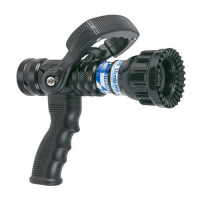

 To Next Page