19
the No. 15 hole. If only 10 pounds
pressure is required, place No. 10
h
ole over Vent Pipe. After this is
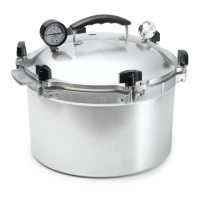
done, listen for the Pressure
Regulator Weight to signal when
correct pressure has been obtained.
This signal will be escaping steam.
When the correct pressure has been
reached, the Pressure Regulator
Weight will jiggle and sputter.
Possibly a few drops of water will
trickle from the Pressure Regulator
Weight. You now begin counting the
processing/cooking time from this
moment. Reduce the heat so that the
Pressure Regulator Weight will jiggle
only about one to four times a
minute. Do not permit constant
jiggling, for this will cause excessive
loss of moisture. The occasional
jiggle and the hissing sound indicate
that you are maintaining the correct
pressure. If the steam escapes in a
steady stream after you’ve reduced
the heat, nudge the control to set
pressure Regulator Weight properly.
At the end of the processing time,
turn off the heat source. If using
cans, remove the selective Pressure
Regulator Weight to release steam
quickly. If using jars, allow cooker to
cool by itself; do not remove the
selective Pressure Regulator Weight
until steam pressure gauge registers
zero. This could take 15 minutes or
more. Remove the selective Pressure
Regulator Weight slowly. After steam
pressure gauge registers zero and
selective Pressure Regulator Weight
is removed, the cooker may be
opened safely.
Safety Tips For
Home Canning
Home food preservation must be
done with care to protect the quality
and safety of the food. Jars or cans
containing low-acid foods such as
vegetables, meats, poultry and
seafood must always be processed
under pressure to prevent spoilage or
food poisoning. The bacteria which
cause botulism, a severe and poten-
tially fatal form of food poisoning,
are not killed by using the hot water
bath canning process. Low-acid
foods must be processed under
p
ressure at a temperature of 240°F
(115.5°C) for the full recommended
period of time.
To ensure the safety of the foods
you process at home, follow these
precautions:
•
Use only fresh food products.
• Keep all work surfaces, food and
equipment clean.
• Make sure the pressure canner is
CANNING INSTRUCTIONS
FERMENTATION. Any bulged
can or can with a loose seal should
be considered suspicious. Bulging is
due to carbon dioxide gas produced
from fermentation, although other
bad smelling gases may be mixed
with it. Fermentation results from
under cooking or from the intro-
duction of air through a leak. The
product will smell sour, appear soft
and discolored, and have an
offensive odor.
FLAT SOUR.There is nothing
about the outside appearance of
a can to suggest flat sour
spoilage. Flat sour food is
typically soft and mushy,
although it may sometimes
appear firm. Flat sour foods smell
and taste sour, a result of organ-
isms (thermopiles) which
develop best at lukewarm
temperatures. To avoid flat sour
spoilage, follow thorough
processing times and tempera-
tures, and work quickly while
canning to avoid holding foods
at lukewarm temperature.
Corn, peas, green beans,
greens and asparagus are prone
to flat sour spoilage. To avoid flat
sour, follow these tips:
• Can only fresh products. The
flat-sour germs may develop
before the product is canned
and all the cooking in the world
won’t destroy the sour flavor
after it has developed. Two
hours from the garden to jar is
a good rule of thumb.
• Don’t let pre-heated or scalded
products stand at lukewarm
temperature. Get them into the
can quickly and have them as
hot as possible when they’re
put into the cans.
• Have the water boiling to
avoid waiting too long for the
temperature to come up after
the cans are packed in the
cooker.
• Don’t try to can too much in
one cooking.
• Keep burner at a relatively
high temperature.
• Don’t let cans stand after
being packed or before putting
them into the cooker.
• Don’t pack cans too tightly;
this ensures the heat will get
to the center of the can.
• Cool quickly. Don’t stack cans
while cooling.
• Store in a cool place.
BOTULINUS. This rarely occurs
alone in canned food but is
found in connection with other
spoilage. A rank cheesy odor is
typical of botulism in its well-
developed stage. Discard without
tasting all canned foods which
show any signs of spoilage. This
will minimize the risk of botulism
poisoning, although the presence
of this spoilage cannot always be
determined by the appearance or
odor of the food.
Botulinus spores are found in
the soil, so thorough washing of
all soil-contaminated products is
a good precaution. Be careful not
to under-process. Don’t pack
foods too tightly. Get the heat to
the center of the can.
If you have too much
spoilage, there is something
wrong with your processing
method.
Some Causes Of Spoilage



 To Next Page