40
Q. May a pressure cooker be used
for processing fruits?
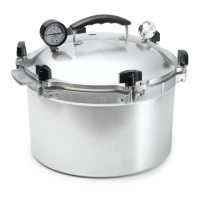
A. Yes. If it’s deep enough it may be
used as a hot water bath canner.
A
rrange sealed cans or jars on rack.
Add enough boiling water to com-
pletely cover jars by 1–2 inches. Put
lid on pot, but leave the Pressure
Regulator Weight off so all the steam
escapes through the Vent Pipe and
no pressure builds up in the cooker.
Q. Must glass jars and lids be
sterilized by boiling before canning?
A. No, not when a boiling hot water
bath or pressure-canner method is
used. The containers as well as the
food are sterilized during processing.
But be sure jars and lids are thor-
oughly clean, and to prevent break-
age, have jars hot when filling them.
Q. Why is the cooking liquid used
for packing some vegetables and
boiling water for others?
A. Cooking liquid is recommended for
packing most vegetables because it
may contain minerals and vitamins
dissolved out of the food. Boiling
water is recommended when cooking
liquid is dark, gritty, or strong-
flavored, and it may be used if there
isn’t enough cooking liquid.
Processing time is the same
whether hot cooking liquid or boiling
water is used for packing.
Q. Why is liquid sometimes lost
from glass jars during processing?
A. Loss of liquid may be due to a
number of things:
1
) Cooking food too short a time to
drive out the air that is in it
before packing it in the jars.
2) Packing jars too full.
3) Leaving air bubbles in the jars.
4) Not keeping pressure steady in a
pressure canner.
5) Lowering pressure too suddenly at
the end of the processing period.
6) Food is packed to tightly.
7) Food is processed at too high a
temperature.
8) Leakage of steam between lid and
bottom of pressure cooker.
Q. Should liquid lost during
processing be replaced?
A. No, never open a jar and refill
with liquid—this would let in bacte-
ria, and you’d need to process again.
Loss of liquid does not cause food to
spoil, although the food above the
liquid may darken.
Q. What causes cloudy liquid in
canned fruits and vegetables?
A. Cloudy liquid may be a sign of
spoilage. It may also be caused by
the minerals in hard water or by
starch from overripe vegetables.
Q. How can you tell whether food
with cloudy liquid is spoiled?
A. Boil the food and note the odor.
Do not taste or use any food having
an off odor.
Q. Why does canned fruit some-
times float in jars?
A. Fruit may float because the pack is
too loose or the syrup too heavy. It’s
also possible that air in the tissues of
the fruit has not all been forced out
during heating and processing.
Q. Why does my food turn
moldy after processing?
A. Mold can only form in the
presence of air. Therefore, jars are not
sealed if mold is present.
Q. What makes canned foods
change color?
A. Darkening of foods at the tops of
jars may be caused by oxidation due
t
o air in the jars or by too little
heating or processing to destroy
enzymes. Over-processing may cause
discoloration of foods throughout the
containers.
Pink and blue colors sometimes
seen in canned pears, apples and
peaches are caused by chemical
changes in the coloring matter of
the fruit.
Iron and copper from utensils used
in preparing foods, or from the water
in some localities, may cause brown,
black and gray colors in some foods.
Corn turns brown during processing
when too high a temperature is
used. The high temperature causes a
carmelization of the sugar in corn. It
may also be caused by some chemi-
cal, such as iron, in the water used
in canning.
When canned corn turns brown,
the discoloring may be due to the
variety of corn, the state of ripeness,
or over-processing.
A common cause of highly
colored foods fading is the dissolving
of coloring materials by the packing
liquid. The use of plain tin cans will
cause some foods to
lose color.
QUESTIONS AND ANSWERS ON HOME CANNING



 To Next Page