17
Parker Hannifin Corporation
Tube Fittings Division
Columbus, OH
FluidConnectors
Bulletin 4390-974250
Cut 250 Saw Use and Maintenance Manual
12
Troubleshooting
This chapter lists the probable faults and malfunctions that could occur while the machine is being used and suggests possible
remedies for solving them.
The first paragraph provides diagnosis for TOOLS and CUTS, the second for ELECTRICAL COMPONENTS.
12.1 — Blade and cut diagnosis
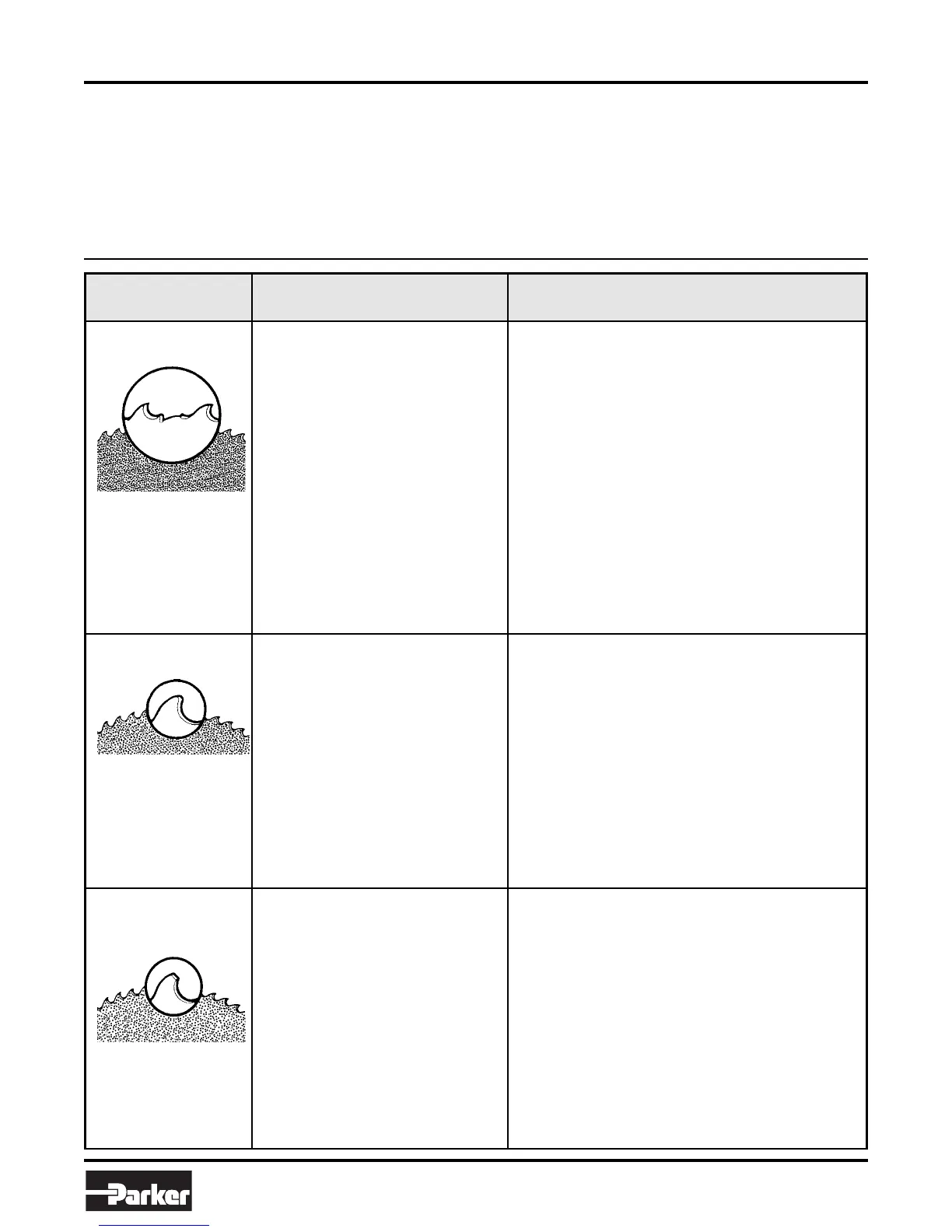
PREMATURE WEAR Incorrect running in of the blade
Incorrect cutting speed
Unsuitable tooth profile
Wrong tooth pitch
Low quality blade
Insufficient lubricating fluid
FAULT PROBABLE CAUSE REMEDY
TOOTH BREAKAGE Advancing too fast
Improper cutting speed
Improper tooth pitch
Low quality blade
Ineffective gripping of the part in the vice.
Previously broken tooth left in the cut
Cutting resumed on a previously made cut.
Insufficient lubricant
Accumulation of excess material on
the blade.
Decrease advance, exert less cutting pressure
Change blade speed and/or diameter. See Chapter “Material
classification and choice of blades”
and the
Table of
cutting speeds according to blade diameter.
Choose a
suitable blade.
See Chapter “Material classification and choice of
blades”.
Use a better quality blade.
Check the gripping of the part.
Remove any excess pieces.
Make the cut elsewhere, turning the part.
Check the level of the liquid in the tank. Increase the flow of
lubricating coolant. Check that the hole and the outlet tubes
are not blocked.
Check the blend of lubricating coolant and choose a better
quality blade.
See Chapter “Material classification and choice of blades”
in the paragraph
on
Running in the blade.
Change blade speed and/or diameter. See Chapter “Material
classification and choice of blades” and the
Table of
cutting speeds according to blade diameter.
Choose a suitable blade.
See Chapter
“Material classification and choice of
blades” in the paragraph on
Type of blades.
Choose a suitable blade.
See Chapter “Material classification and choice of blades”.
Use a better quality blade.
Check the lubrication level. Increase the flow of lubricate
fluid, check that the hole and the fluid outlet tube are not
blocked.
CHIPPED BLADE Hardness, shape or flaws in the material
(oxides, inclusions, lack of homogeneity,
etc.)
Incorrect cutting speed
Incorrect tooth pitch
Vibration
Blade incorrectly sharpened
Low quality blade
Incorrect emulsion of the lubricating
refrigerant
Reduce the cutting pressure and/or the advance.
Change blade speed and/or diameter. See Chapter “Material
classification and choice of blades” and the
Table of
cutting speeds according to blade diameter.
Choose a suitable blade.
See Chapter “Material classification and choice of
blades”.
Check gripping of the part.
Replace the blade with one that is more suitable and correctly
sharpened.
Use a better quality blade.
Check the percentage of water and oil in the emulsion.


 To Next Page