Silicon Image
Confidential for Philips
Consumer Electronics
Internal Use Only
SiI9185A 3:1 HDMI 1.3 Switch
Preliminary Data Sheet
Silicon Image, Inc.
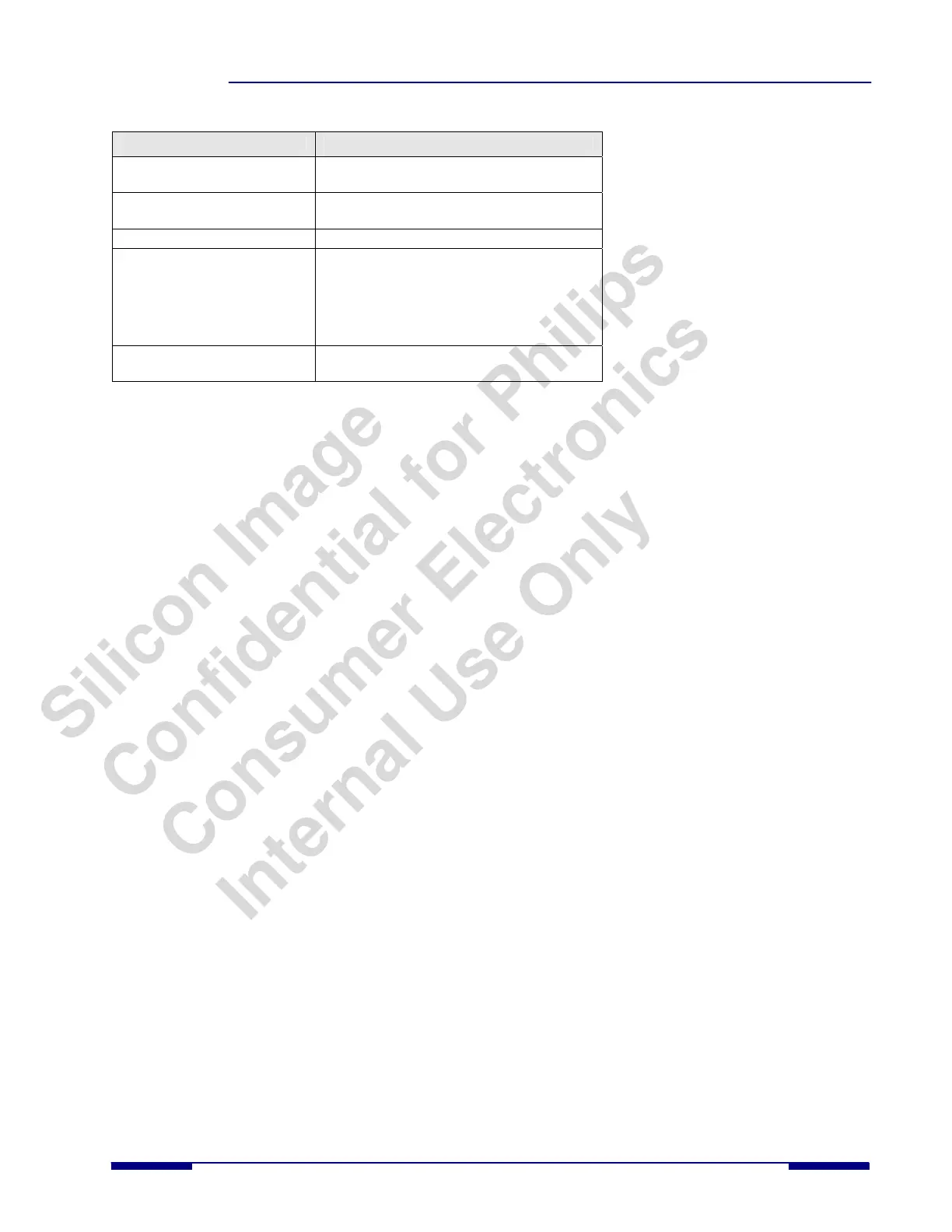
Table 3. Hot Plug Control Signal Levels
Condition HPD[2:0] Level
No power to the SiI9185A.
Example: TV unplugged.
Low
SiI9185A out of Reset in I
2
C
mode
Low (default)
SiI9185A in Standalone mode Pass-through from HPDIN
SiI9185A in I
2
C mode, register
programming
Four options: selected by the HP_CTRL_x bits:
0b00 = Low
0b01 = High (3.3V)
0b10 = Tri-state
0b11 = Pass-Through
Port not selected in Standalone
mode
Low
Note that to be HDMI compliant, each HPD Output is ANDed with its respective RPWR input. Hence a given HPD
Output pin can only reflect a High state when the RPWR input of that port detects a High input (and the appropriate
HP_CTRL_ bits are set to 01b, or they are set to 11b with the HPDIN signal being detected as High).
RPWR[0:2](+5V) and TPWR(+5V) Control Pins
The three RPWR (+5V) input signals on the receive side of the SiI9185A (RPWR0, RPWR1, and RPWR2) indicate that
an HDMI cable is connected and 5V is electrically present. The PWR(+5V) signal on the transmit side of the SiI9185A
(TPWR) notifies the receiving device that the transmit port has this 5V present. When the selected receive port is
actually connected to a source device (a DVD player, for example), determined by monitoring the active port’s
RPWR[0:2](+5V) signal, then the transmit port of the SiI9185A sends the receiver-present signal (TPWR) to the HDMI
receiver on the video processing board.
The RPWR(+5V) signal of the selected Rx port, (RPWR0, RPWR1, and RPWR2) is transferred to TPWR under the
control of PSEL[1:0] signals, which can come from registers in I
2
C Control mode, or pins in Standalone mode. The
TPWR signal to the transmit port is pulled low for a period of 1 µS when the port selection is changed. After this time, it
follows the state of the newly selected port.
RPWR input pins have internal pull-down resistors. When a port is not used, simply leaving them unconnected is
sufficient.
SiI-DS-1016-0.80 © 2007 Silicon Image, Inc. CONFIDENTIAL 11



 To Next Page