14-4
ZRA_Aero Z Owner’s Manual
OM_ZRA_Aero Z_0913RevA
CHAPTER 14: TRANSPoRTATioN oPTioNS
IWARNING
Do NOT use your TiLite Aero Z or ZRA wheelchair with a WTORS unless the WTORS has been
installed fully in accordance with the instructions of the manufacturer of such restraints and SAE
J2249.
IWARNING
ALWAYS attach the WTORS to your TiLite Aero Z or ZRA wheelchair at all four (4) of the TiLite
Transit Tie-Down Option securement points in accordance with the instructions provided by the
manufacturers of the WTORS and SAE J2249.
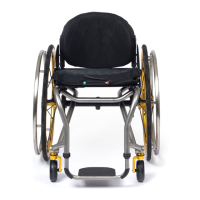
Note: See Figure 14-4 for the location of the four (4) TiLite installed WTORS securement points.
IWARNING
ALWAYS attach vehicle-anchored occupant restraints (pelvic belts and upper torso belts) in
accordance with the instructions of the manufacturer of such restraints and SAE J2249.
USE PROPER EQUIPMENT/USE ONLY AS INSTRUCTED
IWARNING
You MUST use your Aero Z or ZRA wheelchair in strict accordance with all warnings and
instructions contained in this Owner’s Manual.
IWARNING
The Aero Z equipped with TiLite’s Transit Tie-Down Option was dynamically tested in a forward-
facing orientation with a 165-pound (75 kg) anthropomorphic test dummy restrained by BOTH a
wheelchair anchored pelvic belt, a vehicle-anchored upper torso (shoulder) belt and a wheelchair-
anchored lower leg restraint. Every TiLite Aero Z equipped with TiLite’s Transit Tie-Down Option
comes equipped with pelvic-belt mounting bolts (for use with an optional Q’Straint wheelchair-
anchored pelvic belt) and a wheelchair-anchored lower leg restraint. All three restraints should
be used to reduce the possibility of head and chest impacts with components of the motor
vehicle. TILITE REQUIRES THAT PELVIC, UPPER TORSO AND LOWER LEG RESTRAINT
BELTS BE USED FOR MAXIMUM PROTECTION IN A FRONTAL IMPACT COLLISION. TILITE
RECOMMENDS THAT THE PELVIC BELT USED BE WHEELCHAIR-ANCHORED.
IWARNING
The ZRA equipped with TiLite’s Transit Tie-Down Option was dynamically tested in a forward-
facing orientation with a 130-pound (59 kg) anthropomorphic test dummy restrained by BOTH a
vehicle-anchored pelvic belt and a vehicle-anchored upper torso (shoulder) belt. BOTH pelvic and
upper torso (shoulder) belts should be used to reduce the possibility of head and chest impacts
with components of the motor vehicle. TILITE REQUIRES THAT BOTH PELVIC AND UPPER
TORSO BELTS BE USED FOR MAXIMUM PROTECTION IN A FRONTAL IMPACT COLLISION.
IWARNING
The backrest angle may be adjustable on your TiLite Aero Z or ZRA wheelchair. You must adjust
the backrest angle so that it does not exceed the angle specied in Table 14-1 below, when the
wheelchair is occupied during transit in a motor vehicle.


 To Next Page