14-7
ZRA_Aero Z Owner’s Manual
OM_ZRA_Aero Z_0913RevA
CHAPTER 14: TRANSPoRTATioN oPTioNS
TABLE 14-1
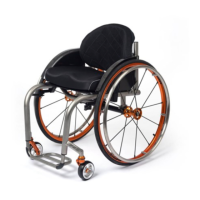
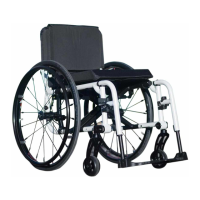
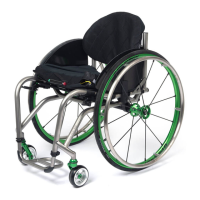
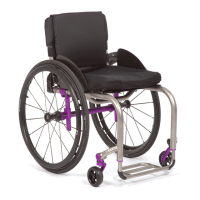
TiLite Wheelchair Test Conguration
ZRA/ Aero Z (Titanium Frame) Aero Z (Aluminum Frame)
Seat Width 16” 16”
Seat Depth 16” 17”
Seat Back Height 20.25” 20.5”
Rear Seat Height 14.75” 17”
Seat Angle 7 degrees 7 degrees
Seat Back Angle 97 degrees 92 degrees
Wheelchair Weight 24 lbs. 24.2 lbs
Seat Sling Tension Adjustable Bolt-On Tension Adjustable Bolt-On
Back Upholstery Tension Adjustable by Straps
Tension Adjustable by Straps Padded
Nylon
Backrest Type
Folding, Aluminum Adjustable
Height with Aluminum TiShaft Back
Release Bar
Folding, Aluminum Adjustable
Height with Aluminum TiShaft Back
Release Bar
Frame Angle 70 degrees 80 degrees
Wheels
22” Wire Wheels with 4 degrees of
camber
24” Shadow Wheels with 2 degrees
of camber
Casters
5” Performance 5-Spoke Billet
Aluminum Wheels with Polyurethane
Tires
5” Litespeed Billet Aluminum wheels
with Soft Roll Tires
Footrest
Titanium Footrest with Flat ABS
Cover
Angle Adjustable Footrest
Other Options None None
Mass of ATD 130 lbs. 165 lbs.
Maximum User Weight 165 lbs. 265 lbs.
The TiLite Aero Z (Titanium Frame) and ZRA wheelchairs with the Transit Tie-Down Option were tested in
accordance with ISO 7176-19 Section 5.2 using a surrogate WTORS that complied with Annex E of ISO
7176-19 and a three-point, vehicle-anchored, occupant restraint system consisting of a shoulder belt and a
pelvic belt. The anthropomorphic test dummy weighed as set forth in Table 14-1. The wheelchair that was
tested passed the frontal impact test congured as described in Table 14-1. The TiLite Aero Z (Titanium
Frame) or ZRA wheelchair was not tested with a wheelchair-anchored pelvic belt, and TiLite does
not offer this wheelchair with a wheelchair-anchored pelvic belt.
The TiLite Aero Z (Aluminum Frame) wheelchair with the Transit Tie-Down Option was tested in
accordance with ISO 7176-19 Section 5.2 using a WTORS that complied with ISO 10542 and a three-
point occupant restraint system consisting of a vehicle-anchored upper torso (shoulder) belt and a
wheelchair-anchored lap belt. In addition, a wheelchair-anchored lower leg restraint was utilized. The
anthropomorphic test dummy weighed as set forth in Table 14-1. The wheelchair that was tested passed
the frontal impact test congured as described in Table 14-1. The TiLite Aero Z (Aluminum Frame)
was tested with a wheelchair-anchored pelvic belt. Therefore, TiLite offers a wheelchair-anchored
pelvic belt as an optional accessory for this wheelchair. TiLite recommends that the TiLite Aero Z
(Aluminum Frame) be used with a wheelchair-anchored pelvic belt when the wheelchair is used for
occupied transit use in a motor vehicle.
The rider of a TiLite Aero Z or ZRA wheelchair must not weigh more than the Maximum User Weight stated
above. If there are items attached to the wheelchair, such as backpacks, seat pouches, etc., the weight
of such attached items must be counted as part of the Maximum User Weight limit for the wheelchair. In


 To Next Page