13
E
N
G
L
I
S
H
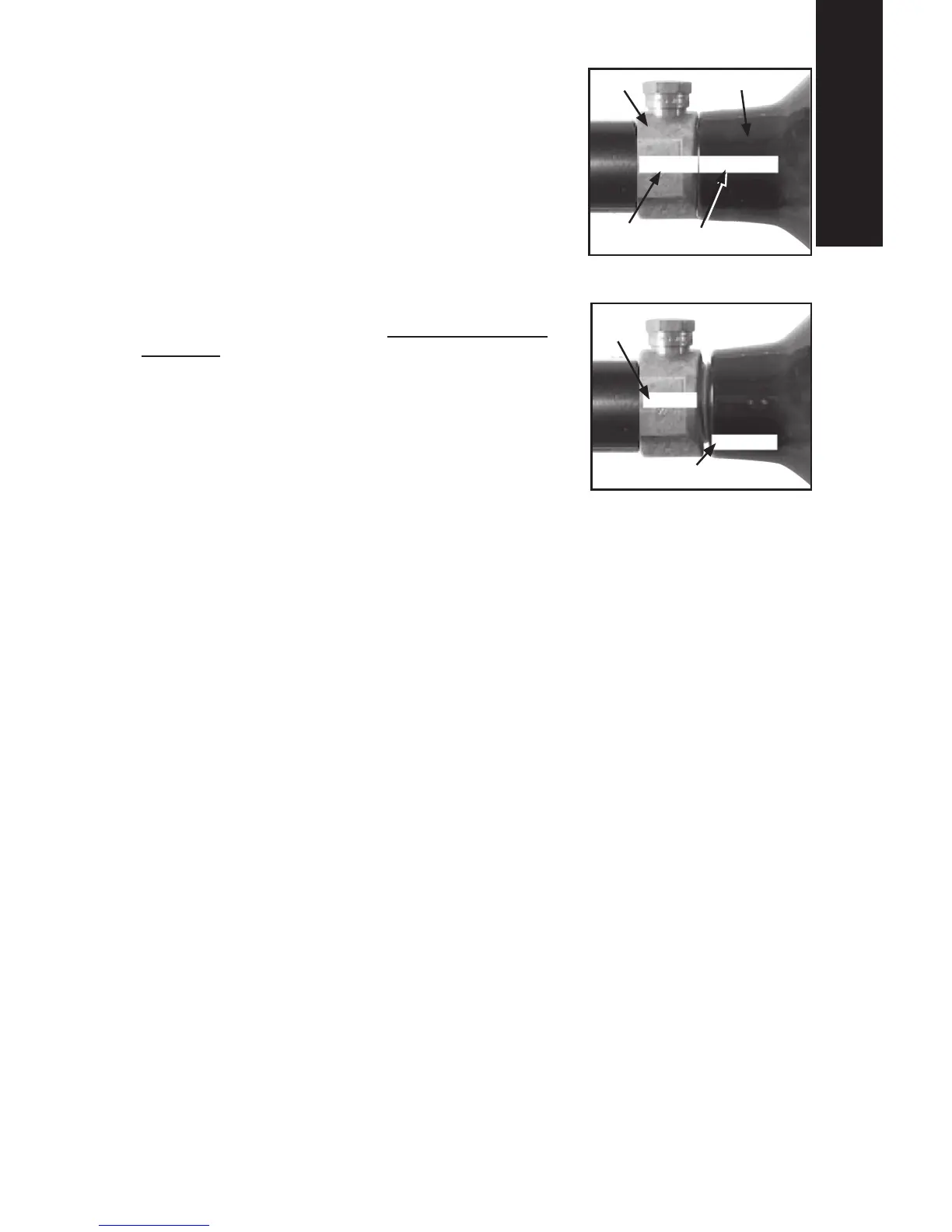
Whenever you turn the cylinder during removal, watch the
marks on the cylinder and the cylinder valve to be sure
that they rotate together. If at any time these marks start
to separate as shown in Figure 10, the cylinder is starting
to unscrew from the cylinder valve and you must STOP
and take the entire unit to a “C5” certied airsmith for safe
removal and/or repair.
NOTE: The cylinder valve should unscrew from the paintball
marker in about 3 or 4 full turns. If you nish the 4
th
full turn
and the cylinder valve is not unscrewed from the paintball
marker, STOP! Take the entire unit to a “C5” certied
airsmith for safe removal and/or repair.
Locate a “C5” Certied Airsmith at www.paintball-pti.com/
search.asp.
Whether you have a new or used rellable air or CO2
cylinder, you are at risk if any of the following has occurred:
• The valve unit was replaced or altered after
purchase.
• An anti-siphon device was installed.
• The valve unit was removed from the cylinder for
any reason.
• Any modication was done to the rellable air or
CO2 cylinder.
If any of these conditions has occurred, take your air or CO2 cylinder to a “C5” Certied
Airsmith for inspection or contact the cylinder manufacturer.
Air/CO2 Cylinder Safety Tips
SAFETY TIPS to ensure that your air or CO2 cylinder is safe for play:
• Improper use, lling, storage, or disposal of air or CO2 cylinder may result in
property damage, serious personal injury or death.
• Make sure that any maintenance or modication to any air or CO2 cylinder is done
by a qualied professional, such as a “C5” certied airsmith.
• The use of anti-siphon devices is not recommended. However, if one is already
installed on your air or CO2 cylinder or is desired, it is critical that your cylinder be
checked by, or the device installed by, a qualied professional.
• All air or CO2 cylinders must be lled only by properly trained personnel.
• Cylinder valves must be installed only by properly trained personnel.
• Do not overll a cylinder! Never exceed the air or CO2 cylinder’s capacity.
• Do not expose pressurized air or CO2 cylinder to temperatures exceeding 130
degrees Fahrenheit (55 degrees Celsius).
• Do not use caustic cleaners or strippers on the air or CO2 cylinder or cylinder valve
and do not expose to corrosive materials.
• Do not modify the air or CO2 cylinder in any way. Never try to disassemble the
cylinder valve from the air or CO2 cylinder.
• Any air or CO2 cylinder that has been exposed to re or heated to a temperature
Figure 9: Properly marked
Valve and Cylinder
1
2
3
4
Figure 10: Misaligned Valve
and Cylinder
3
4



 To Next Page