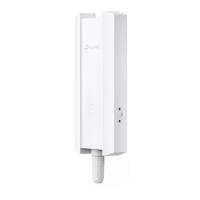
The TP-Link 5G Outdoor Router is a combined wired network connection device with an integrated WAN router, designed to simplify configuration and save space. It provides wired access for multiple computers and mobile devices through its Ethernet ports and antennas, making it a central hub for outdoor networks.
Key Features and Specifications:
Product Overview:
The router integrates WAN routing capabilities, offering a comprehensive solution for network connectivity. Its design aims to reduce setup complexity and optimize space utilization.
Appearance:
The router features LEDs on its front panel (from top to bottom) that indicate its operational status.
- Signal Strength LED:
- Solid white: Signal strength above 75%.
- Solid green: Signal strength between 50% and 75%.
- Solid orange: Signal strength below 50%.
- Off: No mobile network signal.
- Network Type LED:
- Solid white: Device is on a 5G network.
- Solid green: Device is on a 4G network.
- Solid orange: Device is on a 3G network.
- Off: Device is not registered on the network.
- Power LED:
- On: Device is powered on and working properly.
- Flashing: Device is initializing, resetting, or upgrading.
- Off: Device is powered off.
- RESET Button: Press and hold for at least 5 seconds until all LEDs blink to restore factory default settings.
- Ethernet Port LAN: Used for connecting the router to a PC or other Ethernet network devices.
- Grounding Terminal: Provides a grounding connection for safe operation and stability.
Hardware Connection:
- SIM Card Installation: Remove the SIM slot cover, insert the SIM card securely with triangular indicators pointing in the same direction, and re-secure the cover with screws.
- Lightning and ESD Protection: Proper grounding is crucial for outdoor devices. Connect the grounding terminal to grounding facilities using a suitable grounding wire that meets local installation requirements.
- Mounting:
- Pole Mounting: Lead the pole mounting strap through the back of the router, wrap it around the pole, feed it through the screw-block, and tighten until secure. The router must be mounted upright.
- Wall Mounting: Place the mounting bracket, mark two screw holes (6 mm), drill the holes, insert plastic wall anchors, secure the bracket, and then align the router's mounting tabs with the bracket's slot, pushing it downward until it locks.
- Cable Connection:
- Fit an Ethernet cable through the Spiral Cover, Bracket, and O-Ring, then connect it to the port.
- Fit the O-Ring to the head of the Bracket and screw the Bracket to the device body.
- Fit the Ethernet cable through the Seal's slit (thicker side towards the Bracket) and plug the seal to the Bracket.
- Screw the Spiral Cover to the Bracket.
- Power On: The router can be powered via a passive PoE adapter or a PSE device (e.g., PoE switch) compliant with LPS or PS2 standards.
- Via Passive PoE Adapter: Connect the router to the PoE adapter. The PoE adapter can be mounted by removing its bracket, drilling holes, inserting wall anchors, securing the bracket, and then sliding the adapter into place.
- Via PoE Switch: Connect an Ethernet cable from a PoE switch (802.3at compliant) to the router's Ethernet port.
- Hardware Connection Verification: Check the Network LED. If it's on, the router is connected to the internet. For optimal connectivity, ensure LEDs are white or green. If not, relocate the router for a stronger signal.
Internet Connection Setup:
The router includes a Quick Setup wizard and supports manual configuration.
- Quick Setup Wizard: Guides users through initial setup.
- Manual Setup:
- Mobile Data: Enabled by default, can be disabled.
- Network Mode: Supports 5G/4G/3G, 4G/3G, 5G Only, 4G Only, and 3G.
- Profile Name, PDP Type, APN Type, APN, Username/Password, Authentication Type: Configurable based on ISP information.
- Test Internet Connectivity: A diagnostic tool is available under Advanced > System Tools > Diagnostics to check internet connectivity.
- Create a Connection Profile: Allows users to create custom internet connection profiles if ISP settings are not auto-detected.
- Upgrade ISP Information: Users can download and install the latest ISP upgrade file from the TP-Link support page.
- PIN Management: Allows changing PIN settings for the SIM card, including enabling/disabling PIN Lock and Auto-unlock PIN.
- Data Settings: Monitors real-time data usage, sets monthly/total data allowances, and provides usage alerts.
- USSD: Allows querying service data from the service provider.
Network Settings Customization:
- LAN Settings:
- Change LAN IP Address: Default is 192.168.254.1. Can be changed to avoid conflicts or meet specific network requirements. Supports IGMP Snooping.
- DHCP Server: Configures the router to assign IP addresses to clients automatically.
- Reserve LAN IP Addresses: Assigns permanent IP addresses to specific devices on the LAN.
- IPv6 LAN Settings: Supports RADVD and DHCPv6 Server address types for IPv6 address assignment.
- Dynamic DNS Service Account: Allows remote access to the router using a domain name, even with a dynamic WAN IP.
- Static Routes: Configures pre-determined paths for network information to reach specific hosts or networks.
- RIP Settings: Activates RIP for the WAN interface, allowing configuration of RIP version and operation. Supports MD5 Authentication for enhanced security.
SMS Functionality:
- View Messages: Accesses the inbox to read messages.
- Edit and Send a New Message: Composes and sends new SMS messages.
- View Sent Messages: Displays a list of sent messages.
- View Drafts: Shows unsent messages saved as drafts.
- SMS Settings: Configures the Message Center number.
NAT Forwarding:
The router's NAT feature allows devices on the LAN to share a public IP address, while forwarding features enable external hosts to communicate with specified local devices.
- ALG (Application Layer Gateway): Supports address and port translation for application layer protocols like FTP, TFTP, H323.
- Virtual Servers: Sets up public services on the local network by redirecting external port requests to designated computers with static IP addresses.
- Port Triggering: Dynamically opens external ports when a local host initiates a connection to a triggering port, useful for online games and VoIP.
- DMZ (Demilitarized Zone): Exposes a local PC to the internet, opening all ports, useful for applications with unclear port requirements (e.g., IP cameras, database software).
- UPnP (Universal Plug and Play): Allows applications or host devices to automatically find the NAT device and open corresponding ports, facilitating multiplayer gaming, peer-to-peer connections, and real-time communication.
Network Security:
- Firewall & DoS Protection: SPI Firewall and DoS Protection safeguard the router from cyber attacks. Configurable protection levels for ICMP-Flood, UDP-Flood, and TCP-Flood attacks.
- Service Filtering: Prevents specific users from accessing services or blocks internet access.
- IP & MAC Binding: Binds a device's IP address to its MAC address to prevent ARP spoofing and attacks.
- IPv6 Firewall: Protects the IPv6 network from internet access, with options to allow access to specific local servers.
VPN Server & Client:
The router supports various VPN connections.
- OpenVPN Server: Creates an OpenVPN connection for remote devices to access the home network. Requires enabling the server, generating a certificate, and configuring client software.
- PPTP VPN Server: Creates a PPTP VPN connection for remote devices. Requires enabling the server, setting client IP address range, username/password, and configuring client devices (e.g., Windows built-in PPTP software).
- IPSec VPN Server: Creates an IPSec VPN connection for remote devices. Requires enabling Dead Peer Detection, configuring server parameters (Connection Name, Remote IPSec Gateway, IP Address for VPN, Subnet Mask, Key Exchange Method, Authentication Method, Pre-Shared Key, Perfect Forward Secrecy), and configuring advanced settings (Encryption Algorithm, Integrity Algorithm, Diffie-Hellman Group, Key Lifetime). Client devices (e.g., Windows built-in IPSec software) need to be configured with the pre-shared key.
- VPN Connections: Displays currently connected OpenVPN, PPTP, and IPSec VPN clients.
Router Management:
- Set System Time: Configures the router's system time, either manually, from a PC, or from the internet. Supports Daylight Saving Time.
- Control the LED: Enables Night Mode to specify a time period when LEDs are off.
- Test Internet Connectivity: Uses diagnostic tools (Ping, Traceroute, Nslookup) to check connectivity.
- Update the Firmware: Allows online or manual firmware updates to improve features and network experience.
- Back Up and Restore Configuration Settings: Backs up current settings to a file and restores previous settings from a backup file. Also supports resetting to factory defaults.
- Reboot the Router: Manually reboots the router or schedules regular reboots.
- Administration Management:
- Change Login Password: Modifies the password for accessing the web management page.
- Local Management: Controls local devices' authority to manage the router, including enabling HTTPS management.
- Remote Management: Allows remote devices to manage the router over HTTP and/or HTTPS.
- HTTP Referer Head Check: Protects against CSRF attacks.
- ICMP Ping: Controls the router's replies to ICMP Ping requests.
- Session ID: Saves Session ID to Flash to prevent connection issues.
- System Log: Views and saves system logs for troubleshooting. Supports local caching and remote sending of logs.
TP-Link Cloud Service:
Provides a way to manage cloud devices remotely via a TP-Link ID and the Aginet app.
- Register a TP-Link ID: Creates a new TP-Link ID for cloud management.
- Change TP-Link ID Information: Modifies email address and password associated with the TP-Link ID.
- Manage User TP-Link IDs: Admin accounts can add or remove other TP-Link IDs (Users) to manage the router. User accounts have limited permissions (cannot reset to factory defaults or add/remove other TP-Link IDs).
Troubleshooting (FAQ):
- Forgot web management password: Reset via TP-Link ID or by holding the Reset button.
- Cannot log in to web management page: Check physical connection, IP address configuration, browser URL, and computer's internet options.
- Cannot access internet after EWAN configuration: Check internet status, configure DNS server, restart modem/router, reset to factory defaults, upgrade firmware, check TCP/IP settings.
- Cannot find/connect to wireless network: Check wireless function, adapter driver, WLAN LED, router range, and wireless channel. For authentication issues, confirm wireless password.
- Cannot access internet with Mobile WAN (SIM card) configured: Verify SIM card type, service area, credit, LAN connection, Mobile WAN parameters, PIN management, data settings, roaming settings, and antenna type.
- FCC Compliance: Class B digital device, complies with Part 15 of FCC Rules. Requires a minimum separation distance of 23 cm from all persons for RF exposure.
- CE Mark Warning: Class B product, may cause radio interference in domestic environments.
- Operating Frequencies:
- 2400MHz~2483.5MHz/ 20dBm
- 5150MHz~5250MHz (Indoor use only) / 23dBm
- 5250MHz~5350MHz (Indoor use only) / 23dBm
- 5470MHz~5725MHz / 30dBm
- WCDMA Band 1,8 / Power Class 3
- LTE Band 1,3,7,8,20,28,40 / Power Class 3
- LTE Band 38,42,43 / Power Class 2 & Power Class 3
- 5G N1,3,7,8,20,28,40 / Power Class 3
- 5G N38,41,77,78 / Power Class 2 & Power Class 3
- Frequency band 5150 - 5350 MHz: Indoor use only, limited outdoor use (not attached to fixed installations or external body of road vehicles, fixed infrastructure, or fixed outdoor antenna). UAS use limited to 5170 - 5350 MHz.
- EU Declaration of Conformity: Complies with directives 2014/53/EU, 2009/125/EC, 2011/65/EU and (EU) 2015/863.
- RF Exposure Information: Meets EU requirements (2014/53/EU Article 3.1a) for public exposure to electromagnetic fields.
- National Restrictions: For EU/EFTA countries and Northern Ireland, device may only be used indoors. For Great Britain, device may only be used indoors.
- Canadian Compliance Statement: Contains licence-exempt transmitter(s)/receiver(s) complying with Innovation, Science and Economic Development Canada’s licence-exempt RSS(s).
- Safety Information: Keep away from fire/hot environments, do not disassemble, use damaged chargers, use only recommended chargers, adapter for indoor use (≤40°C), adapter easily accessible, waterproof outdoor router, secure waterproof cover, installation by instructed/skilled person, plug as disconnect device, use original power supplies.
- Operating Temperature: -40°C to 55°C (-40°F to 131°F), 10%-90%RH Non-condensing.
- Storage Temperature: -40°C to 70°C (-40°F to 158°F), 5%-90%RH Non-condensing.
- Medical Device Interference: Product emits electromagnetic fields. Keep product and power adapter >15 cm (6 inches) away from pacemakers or other implanted medical devices.
Product Label Symbols:
- DC voltage
- AC voltage
- Class II equipment
- Polarity of output terminals
- Energy efficiency Marking
- Indoor use only
- Caution
- Operator’s manual
- RECYCLING (WEEE symbol)

 Need help?
 General

 To Next Page