33
Chapter
5
Customize Your Network Settings
1. Make sure the routers use different LAN IP addresses on the
same subnet. Disable Router B’s DHCP function.
2. Visit http://tplinkmodem.net or http://192.168.254.1, and log
in with the password you set for the Router A.
3. Go to Advanced > Network > Static Routing.
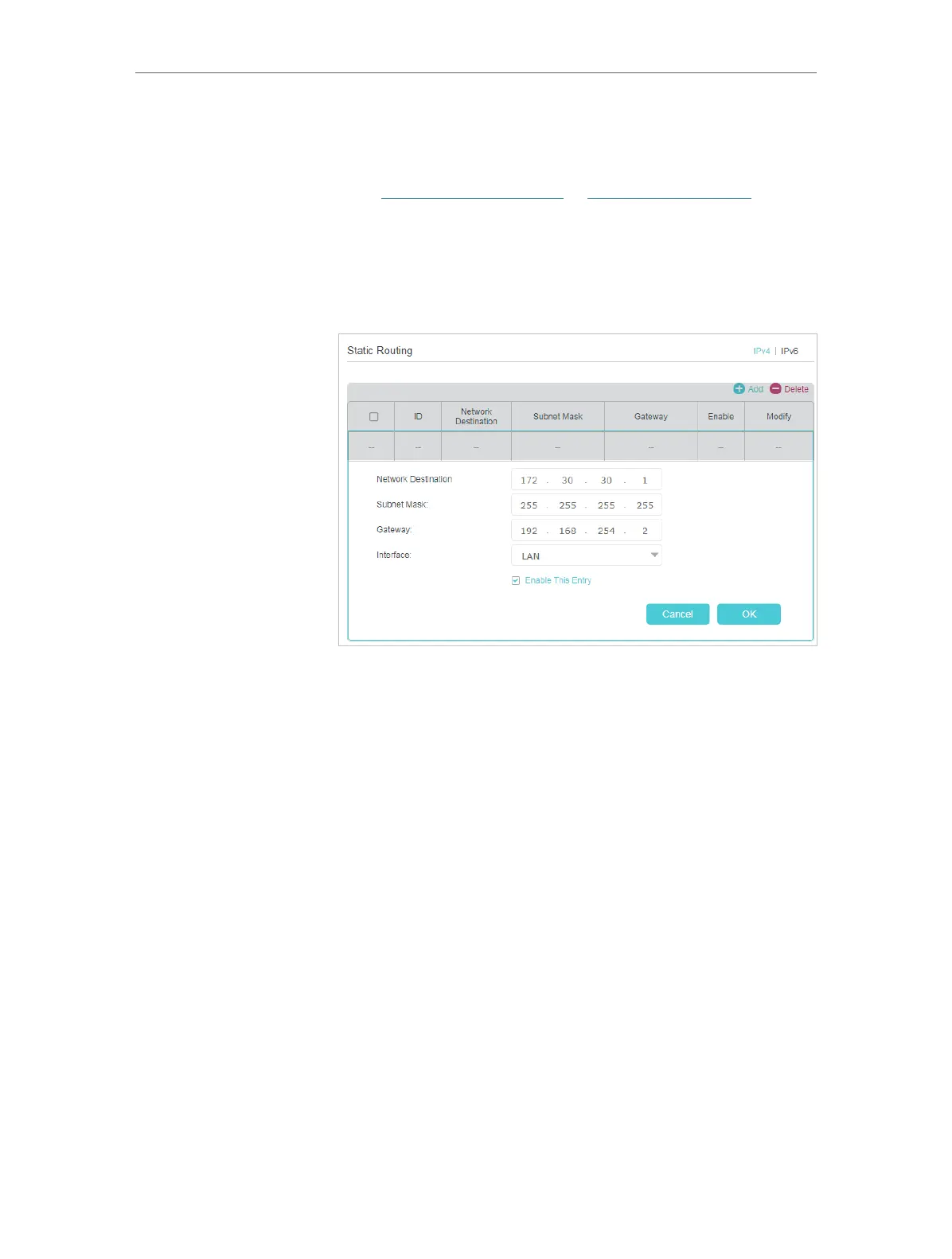
4. Click Add to add a new static routing entry. Finish the settings
according to the following explanations:
• Network Destination: The destination IP address that you
want to assign to a static route. This IP address cannot be on
the same subnet with the WAN IP or LAN IP of the Router A.
In the example, the IP address of the company network is the
destination IP address, so here we enter 172.30.30.1.
• Subnet Mask: Determines the destination network with the
destination IP address. If the destination is a single IP address,
enter 255.255.255.255; otherwise, enter the subnet mask of
the corresponding network IP. In the example, the destination
network is a single IP, so here we enter 255.255.255.255.
• Gateway: The IP address of the gateway device to which the
data packets will be sent. This IP address must be on the
same subnet with the router’s IP which sends out the data. In
the example, the data packets will be sent to the LAN port of
Router B and then to the Server, so the default gateway should
be 192.168.254.2.
• Interface: Determined by the port (WAN/LAN) that sends
out the data packets. In the example, the data is sent to the
How can I
do that?



 To Next Page