17
! WARNING
Indicates a hazardous situation which, if not avoided, could result in death or serious injury.
Prevention
Overview
When using an ATV, prevention is the name of the game. “Had you only
known” something could go wrong, you would have prevented it. If you
don’t notice your conditions and surroundings before riding your ATV, you
give up control over the situation. Using ATV prevention techniques helps
you forecast potential hazards before they injure you or damage your ATV.
Following the safety instructions and warnings in this manual will help
you “P.A.S.S.” the safety test. P.A.S.S. stands for “Prevention,” “Active
Riding,” “Sound Judgment,” and “Supervision.” Remembering P.A.S.S.
and what it stands for will help you have a safe, predictable ride every
time you go out on your ATV.
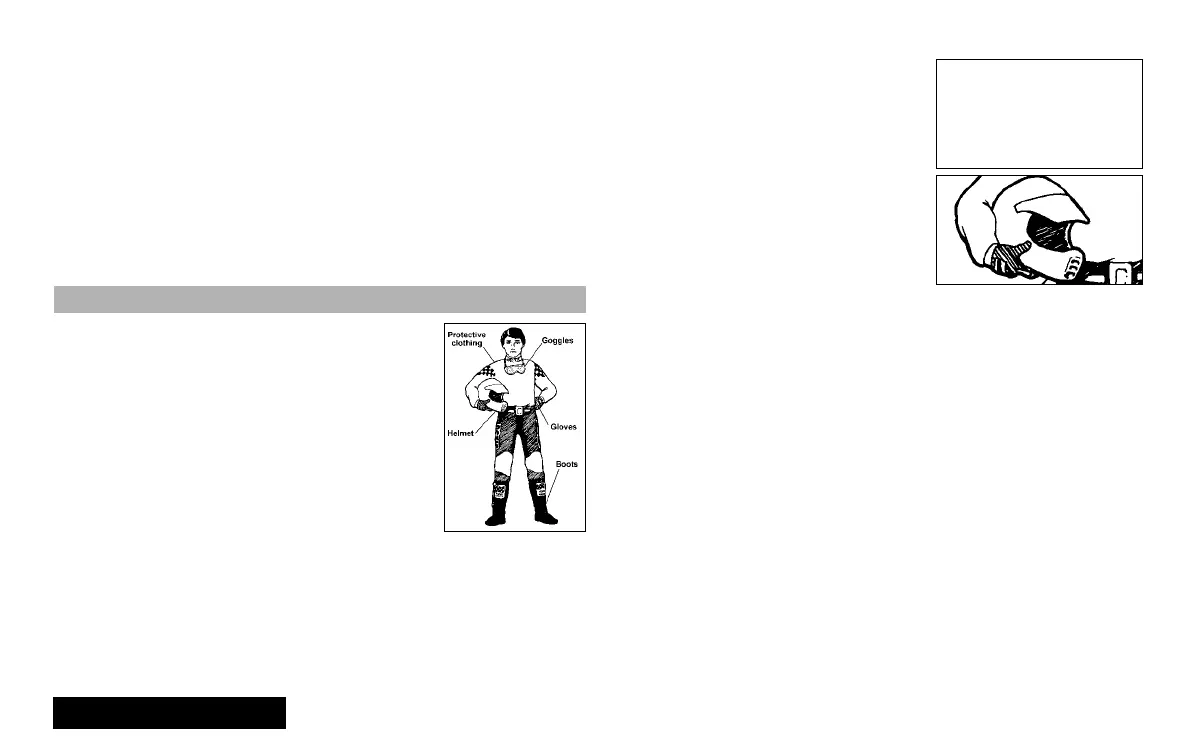
You’ll find it important to dress correctly for ATV
riding in order to prevent scraped skin and serious
head injuries. It’s easy and could save you time in
the long run not having to contend with an injury.
Of course, it also makes sense to remember the
seasons. Wear a hat under your helmet and a
snowmobile suit in the winter and lighter, protec-
tive clothing in the summer.
Helmet
There are several types of helmets on the
market, but make sure you wear a helmet
that complies with the current standards
of the U.S. Department of Transportation
(DOT), The Snell Memorial Foundation,
or the American National Standards Insti-
tute (ANSI). Helmets that comply with
one or more of these agency’s standards
have a sticker on the inside or outside of
the helmet.
These helmets should provide full-face
protection.
If you drop or damage your helmet, get a
new one immediately. Your helmet may not protect your head from
injury if it has cracks, fissures, or other damage to its outside or core
padding.
Remember, your helmet won’t do you any good if the chin strap isn’t
fastened.
Eye Protection
Wear eye protection, such as goggles, to completely surround your eyes to
prevent getting dirt or other items in your eyes. Sunglasses are not recom-
mended; they don’t prevent objects from flying in through the sides.
Long Pants and Long Sleeved Shirt
The goal is to protect your body from branches, long grass, airborne
objects, or anything else that could scrape your skin. The more thick and
durable the material, the better protection it’ll provide.
Clothing and Gear
Helmets should have
one of these:
1. DOT label
2. Snell label
3. ANSI Z90.1 label


 To Next Page