74
RT-SVX34V-EN
Maintenance
Fan Belt Adjustment
The supply fan belts must be inspected periodically to
assure proper unit operation.
Replacement is necessary if the belts appear frayed or
worn. Units with dual belts require a matched set of belts to
ensure equal belt length. When installing new belts, do not
stretch them over the sheaves; instead, loosen the
adjustable motor-mounting base.
Once the new belts are installed, adjust the belt tension
using a Browning or Gates tension gauge (or equivalent)
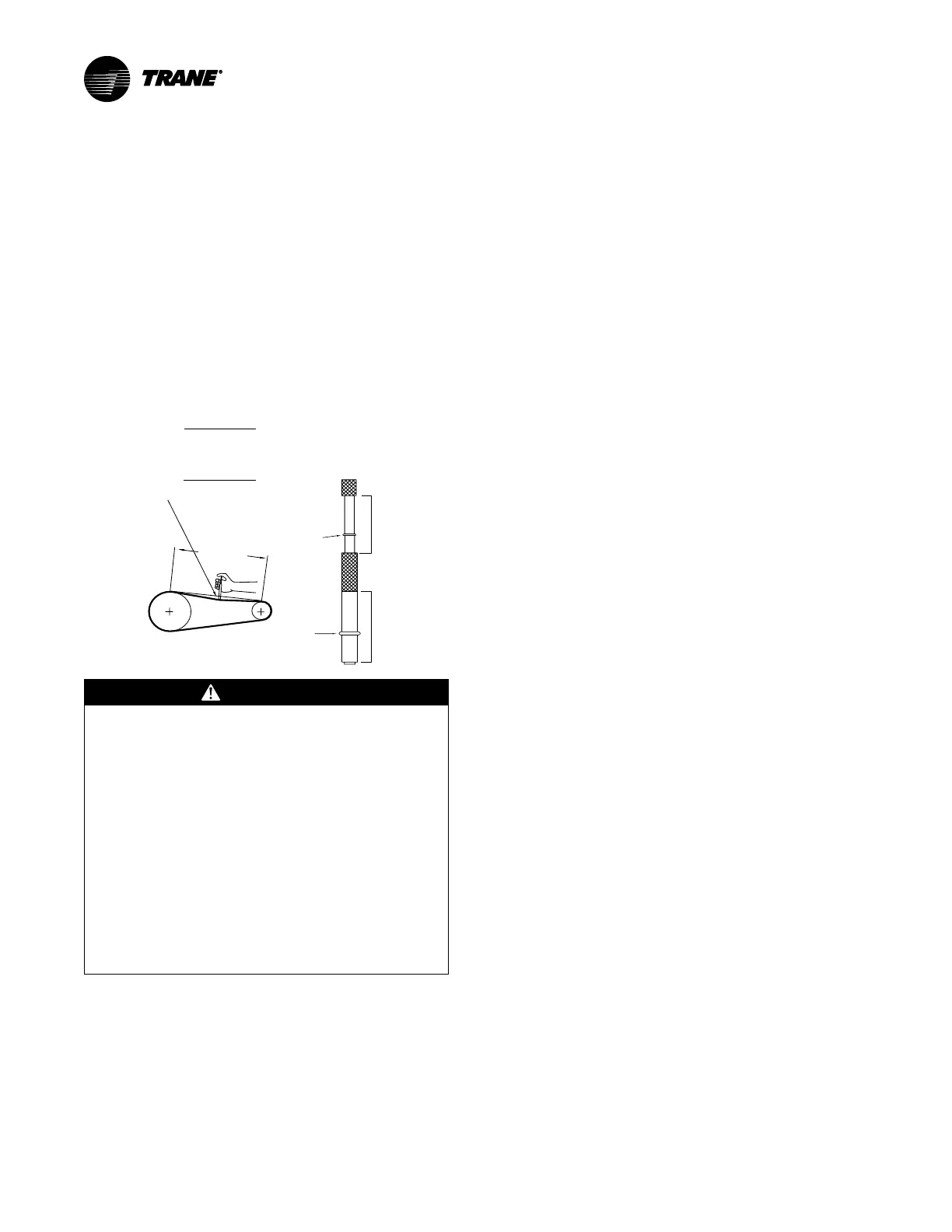
illustrated in Figure 67, p. 74.
Figure 67. Typical belt tension gauge
Deflection = Belt Span (in.)
64
Deflection = Belt Span (mm)
152
Force Scale
Span Scale
Large
O-Ring
Small
O-Ring
Belt Span
WARNING
Hazardous Voltage w/Capacitors!
Failure to disconnect power and discharge capacitors
before servicing could result in death or serious
injury.
Disconnect all electric power, including remote
disconnects and discharge all motor start/run
capacitors before servicing. Follow proper lockout/
tagout procedures to ensure the power cannot be
inadvertently energized. For variable frequency drives
or other energy storing components provided by
Trane or others, refer to the appropriate
manufacturer’s literature for allowable waiting periods
for discharge of capacitors. Verify with a CAT III or IV
voltmeter rated per NFPA 70E that all capacitors have
discharged.
1. To determine the appropriate belt deflection:
a. Measure the center-to-center distance, in inches,
between the fan sheave and the motor sheave.
b. Divide the distance measured in Step 1a by 64; the
resulting value represents the amount of belt
deflection for the proper belt tension.
2. Set the large O-ring on the belt tension gauge at the
deflection value determined in Step 1b.
3. Set the small O-ring at zero on the force scale of the
gauge.
4. Place the large end of the gauge on the belt at the
center of the belt span. Depress the gauge plunger until
the large O-ring is even with the of the second belt or
even with a straightedge placed across the sheaves.
5. Remove the tension gauge from the belt. Notice that
the small O-ring now indicates a value other than zero
on the force scale. This value represents the force (in
pounds) required to deflect the belt(s) the proper
distance when properly adjusted.
6. Compare the force scale reading in step 5 with the
appropriate “force” value in Table 33, p. 75. If the force
reading is outside of the listed range for the type of
belts used, either readjust the belt tension or contact a
qualified service representative.
Note: The actual belt deflection force must not exceed
the maximum value shown in Table 33, p. 75 .
7. Recheck the new belt's tension at least twice during the
first 2 to 3 days of operation. Readjust the belt tension
as necessary to correct for any stretching that may
have occurred. Until the new belts are “run in”, the belt
tension will decrease rapidly as they stretch.



 To Next Page