WSHP-SVX022A-EN
37
Maintenance
WARNING
Hazardous Service Procedures!
Failure to follow all precautions in this manual and on
the tags, stickers, and labels could result in death or
serious injury.
Technicians, in order to protect themselves from
potential electrical, mechanical, and chemical
hazards, MUST follow precautions in this manual and
on the tags, stickers, and labels, as well as the
following instructions: Unless specified otherwise,
disconnect all electrical power including remote
disconnect and discharge all energy storing devices
such as capacitors before servicing. Follow proper
lockout/tagout procedures to ensure the power can
not be inadvertently energized. When necessary to
work with live electrical components, have a qualified
licensed electrician or other individual who has been
trained in handling live electrical components perform
these tasks.
Preventive Maintenance
Filter maintenance must be performed for proper operation
of the equipment. Filters should be inspected at least every
three months, and replaced when dirty. Filter sizing is
shown in Table 11, p. 37:
Table 11. Filter sizing
Unit Size
(60) Hz
Filter Size (Nominal) inches
006-018 10 x 10, 10 x 30 (std height unit)
006-018 7 ¾ x 30 5/8 (low height unit)
Check the contactors and relays within the control panel at
least once a year. It is good practice to check the tightness
of the various wiring connections within the control panel.
A strainer (60 mesh or greater) must be used on an open
loop system to keep debris from entering the unit heat
exchanger and to have a clean system.
For units on well water, it is important to check the
cleanliness of the water-to-refrigerant heat exchanger. If
contaminated with dirt and scaling as a result of bad water,
the heat exchanger will have to be back flushed and
cleaned with a chemical that will remove the scale. This
service should be performed by an experienced service
person.
Water quality should be checked periodically. See Table
12, p. 37.
Table 12. Water quality
Scaling Amount
Calcium and magnesium (total hardness) Less than 350 ppm
Corrosion
pH 7-9.5
Hydrogen Sulfide Less than 1 ppm
Sulfates Less than 25 ppm
Chlorides Less than 125 ppm
Carbon Dioxide Less than 75 ppm
Total dissolved solids (TDS) Less than 1000 ppm
Biological Growth
Iron Bacteria Low
Erosion
Suspended Solids Low
Filter Replacement (Standard
Height Configuration)
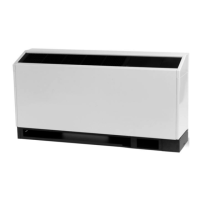
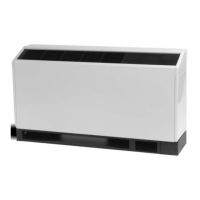
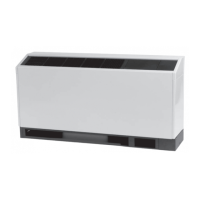
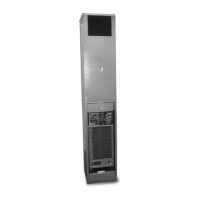
Filter replacement is done at the front return-air opening of
the console unit. The maintenance process is done through
the following process:
1. Through the return-air opening, insert a screwdriver
and depress the screws on the subbase.
2. Remove two filter brackets and slide filter to the back of
the console unit.
3. Allow the front edge of the filter to drop to floor level.
4. Pull the filter out of the front opening.
Note: REVERSE the cycle to install a new filter.
Filter Replacement (Low Height
Configuration)
Filter replacement is done at the front return-air opening of
the console unit. A slotted screwdriver is needed for the
replacement. The maintenance process is done through
the following process.
1. Insert screwdriver and depress grill tab (2-per grille).
2. Rotate grille down, and lift grille upward to remove
grille. The removal of one grille is required.
3. Slide the filter through the grille hole in the cabinet
front.
Note: REVERSE the process to install a new filter.


 To Next Page