The
following
i
nformation
is
in ac
co
rdance
with
the requirements
of
t
he
U.
S.
National Highway
Tr
~
ffic
Sa
fe
ty
Admin!str
.
~ion
.
Department
of
Transportation
.
BRAKE BURNISHING PROCEDURE
Brakes should be bedded in progressively during the first 300 miles. This
IS
done
gradually by increasing brake lever pressure during the period,
and braking from progressively increasing speeds.
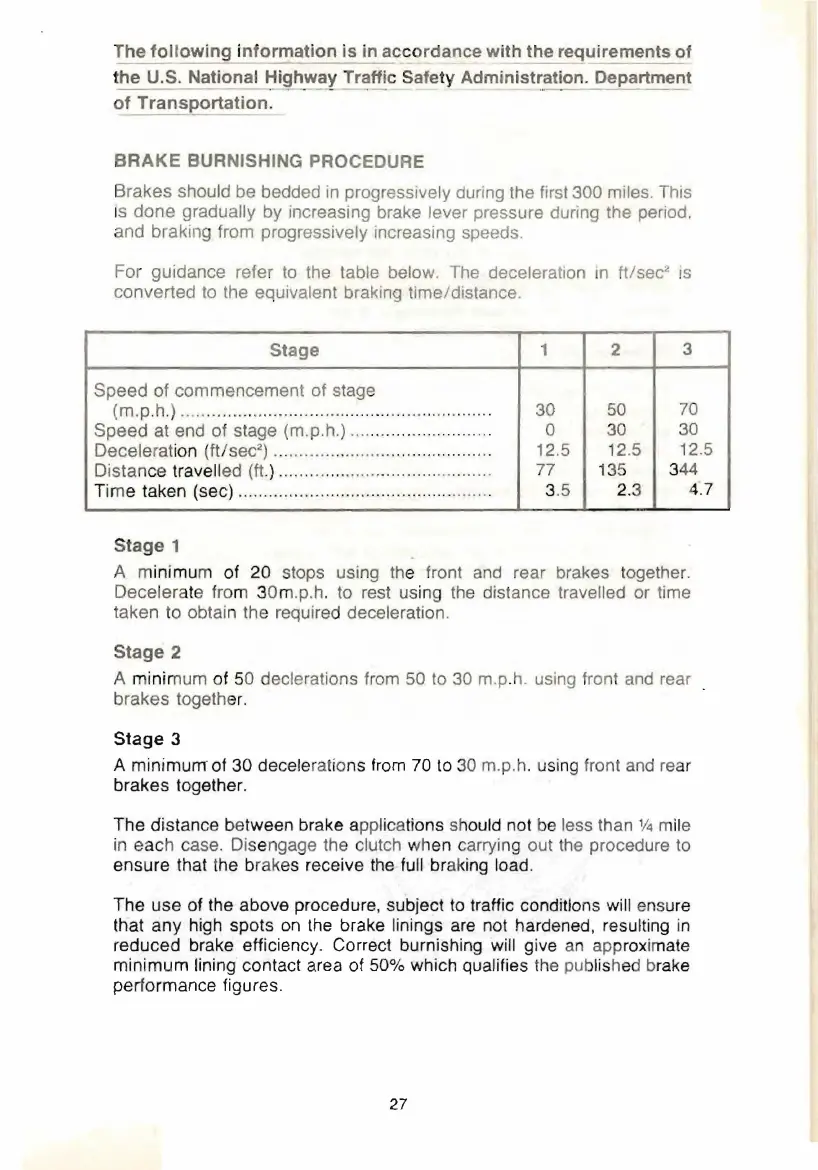
For guidance refer
to
the table below. The deceleration
in
ft/sec
2
IS
converted
to
the equivalent braking time/distance.
Stage 1
2
3
Speed of commencement of stage
(m.p.h.)
..
.
..
.......................
....
........................... .
30
50
70
Speed at end of stage (m.p.h
.)
...
..
.....................
..
0 30
30
Deceleration (f
tl
sec
2
) .
..
.......
....
.........
...
.
..............
. .
12.5
12
.5
12.5
Distance travelled
(ft.) ..........
.. ..
..... , ..........
..
..
..
....
..
77
135
344
Time taken (sec) ..
.. ..
..........................................
..
3.5
2.
3
4.7
S
ta
ge 1
A minimum of 20 stops using
th
e front and rear brakes together.
Decelerate f
ro
m 30m.p.h.
to
rest
us
i
ng
the distance travelled
or
time
taken to obtain
th
e requi
re
d deceleration.
Stage
2
A
minimum of 50 declerations from 50
to
30
m.p.h. using
fr
ont
and
rear
brakes together.
Stage
3
A
minimum
of 30 decelera
ti
ons from
70
to
30 m.p.h. u
sin
g front
and
re
ar
brakes together.
The distance between brake applications should not
be
less than
V4
m
il
e
in each case.
Di
sengage the clutch
wh
en carryi
ng
out the procedure to
ensure that the brakes receive
the
full br
ak
ing
load.
The use of the above procedure, subject
to
traHic
condrtlons will ensu
re
that any high spots
on
the brake linings are not hardened. resulting
in
reduced brake efficiency. Correct burnishing will give
an
ap
p
rox
imate
minimum lining contact area of
50% which qualifies the
pu
blished brake
performance figures.
27



 To Next Page