COOLING SYSTEM
Frost Precautions
The
car
heater
cannot
be completely drained
by normal
methods. Therefore
ftost damage will
not be
prevented by
merely draining the radiator.
For your
safeguard during freezing weather,
an approved
anti-
freeze solution should
be added to the coolant
in the radiator,
pages 52 and 53. Because ofthe
searchingeffect of these
solutions,
advise your
Dealer
to check the
system for leaks before
adding
the anti-freeze.
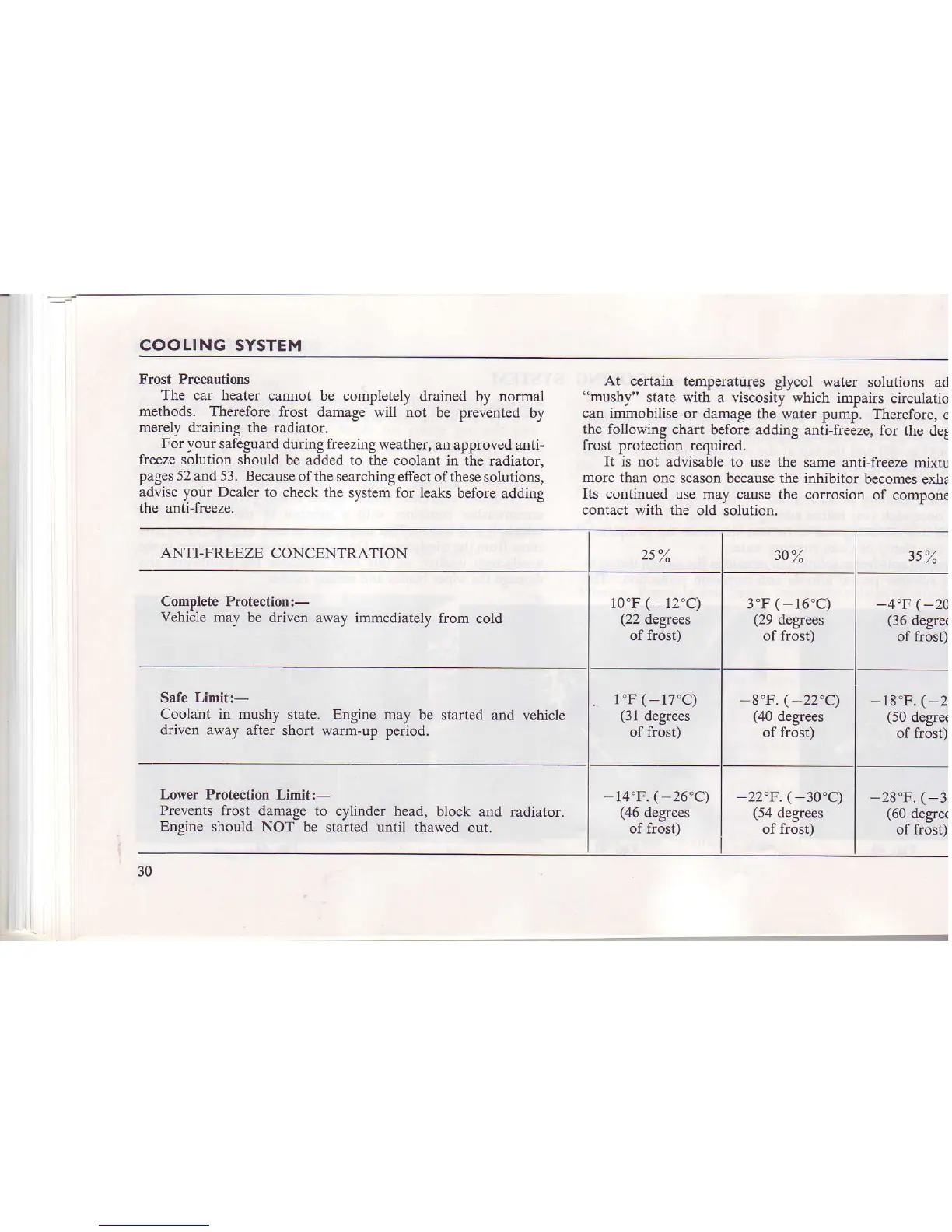
At certain temperatures
glycol water
solutions
ad
"mushy"
state with
a
viscosity
which impairs
circulatio
can immobilise
or damage the water
pump. Therefore,
c
the
following chart
before adding anti-freeze,
for the deg
frost
protection
reouired.
It ls not
advisable to use the
same alti-freeze mixtu
more
than one
season because the inhibitor
becomes exha
Its continued
use may cause the
corrosion of
compone
contact with the
old solution.
ANTI-FREEZE
CONCENTRATION
30%
Complete Protection:-
Vehicle may
be driven away immediately
from
cold
lo'F
(
-
12'C)
(22
degrees
of frost)
3"F
(
-
16.C)
(29
degrees
of frost)
-4"F
(
-20
(36
degree
of frost)
Safe
Limit:-
Coolant in mushy
state. Engine may
be started and vehicle
driven away after short warm-up
period.
1'F
(
-
l7'C)
(31
degrees
of frost)
-8'F.
(
-22'C)
(40
degre€s
of frost)
I RoF r_tl
(50
dege€
of frost)
Lower Protection
Limit:-
Prevents frost danage to
cylinder head, block
and radiator.
Ensine
should NOT be started until thawed
out.
-14"F.
(
-26'C)
(46
degrees
of frost)
-22"F.
(
30.C)
(54
degrees
of frost)
-
)RoF r- ?'
(60
degree
of frost)
30



 To Next Page