Need help?
Do you have a question about the TVS Stryker 3V 2021 and is the answer not in the manual?
Explains warning, caution, and note symbols used in the manual.
Information about standard equipment and the Day Running Lamp (DRL).
Guidance on the first 1000 km to ensure maximum life and smooth performance.
Advice on familiarisation, apparel, personal limits, and safety gear.
Covers posture, cornering, and warnings against unsafe riding practices.
Details braking methods, common issues, and safety precautions.
Guidance on accessory installation, emission control, and general riding advice.
Details on locating and recording frame and engine serial numbers.
Identifies and locates controls and levers on the handlebar.
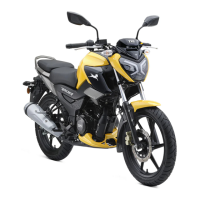
Identifies major components on the left side of the motorcycle.
Identifies major components on the right side of the motorcycle.
Locates front and rear lights, fenders, and other components.
Explains the function and positions of the ignition and steering lock keys.
Introduces the digital display, its self-test, and the tachometer function.
Details various indicator lights like side stand, turn signals, helmet, and fuel.
Explains service alerts, low battery warnings, and fuel gauge readings.
Describes speedometer, top speed, and gear position indicators.
Details odometer, lap timer, clock, and trip meter functions.
Specifics on Trip F meter and how to use Mode/Set buttons.
Procedures for switching between ODO, LAP, TOP SPEED, and CLOCK settings.
Step-by-step guide to setting the digital clock time and format.
How to adjust display brightness and switch between KMPH/MPH.
How to use the horn button.
How to operate the left and right turn signal indicators.
How to use the clutch lever for gear shifting.
How to use the engine kill switch.
Operation of the front brake and throttle for speed control.
How to use the electric starter to start the engine.
Procedure to open/close the fuel cap and info on the EVAP system.
Explains how to shift gears using the lever and indicators.
How to apply the rear brake and its effect.
Instructions for using the centre and side stands for parking.
Details on the included tool kit and its recommended use.
Step-by-step guide to access battery and fuses by removing cover frame L.
Proper usage and precautions for the smartphone charging socket.
Items to check before starting to ride for safety and performance.
Procedure for starting the engine and moving the vehicle.
Tips for inclines, stopping the vehicle, and parking safely.
Importance of spark plug and air cleaner for fuel efficiency.
How clutch slip, oil condition, and riding affect fuel economy.
Checks for leaks, tyre pressure, chain slackness for economy.
Tips on avoiding unnecessary idling and frequent braking to save fuel.
Explains the importance and purpose of the periodic maintenance schedule.
Details service intervals and activities for engine, filters, and chassis components.
Details service intervals for lighting, battery, brakes, and wheels.
Lists recommended oils, fluids, and lubricants for various vehicle parts.
How to access, check, and charge the maintenance-free battery.
Procedure for checking and replacing fuses to resolve electrical issues.
How to inspect, clean, and replace the spark plug for optimal performance.
Method for checking and topping up engine oil to prevent damage.
How to adjust clutch lever play for proper engagement and clutch life.
How to adjust rear shock absorber spring pre-load for different loads.
How to check front brake fluid level and signs of issues.
How to visually check brake pads for wear and when to replace them.
Procedure for adjusting the free play of the rear brake pedal.
How to use wear indicators to determine if brake shoes need replacement.
Recommended tyre pressures for solo and pillion riding.
Importance of tread depth and correct tyre rotation direction.
Advice on handling tubeless tyre punctures and avoiding rim damage.
Proper lubrication, cleaning, and adjustment of the drive chain for longevity.
Detailed steps for cleaning, lubricating, and adjusting the drive chain.
Step-by-step guide to safely remove and reinstall the front wheel.
Step-by-step guide to safely remove and reinstall the rear wheel.
Steps for preparing and storing the motorcycle for extended periods.
Steps to take when preparing the motorcycle for regular use after storage.
Recommended items and checks for taking trips over 500 km.
Comprehensive checks for bolts, tyres, lights, cables, and overall condition before long rides.
Table for recording the first 7 scheduled services based on mileage or time.
Table for recording services 8 through 11 based on mileage or time.
Details on engine type, bore, stroke, compression, and transmission type.
Dimensions, weight, tyre sizes, and pressure ratings.
Details on brake system types and electrical components like ignition and battery.
Bulb types, fuse ratings, capacities, and general caution.
 General
| Engine Type | Single Cylinder, 4 Stroke, Air Cooled |
|---|---|
| Displacement | 124.53 cc |
| Kerb Weight | 117 kg |
| Front Brake | Disc |
| Rear Brake | Drum |
| Ground Clearance | 173 mm |
| Gearbox | 5 Speed |
| Fuel Tank Capacity | 10 liters |

 To Next Page