LOAD HANDLINGLOAD HANDLING
1-251-25
WARNINGWARNING
■■ Do not lift the forks or start with mastDo not lift the forks or start with mast
tilted forwardtilted forward
Do not perform the following operations when theDo not perform the following operations when the
mast is tilted forward: lifting the forks, elevatingmast is tilted forward: lifting the forks, elevating
and retracting the mast, and starting and travelingand retracting the mast, and starting and traveling
with the truck.with the truck.
■■ Do not handle loads on a slopingDo not handle loads on a sloping
gradegrade
■■ Do not squeeze loads into a stackDo not squeeze loads into a stack
Do not squeeze loads into a stack by using theDo not squeeze loads into a stack by using the
truck’s traction force or by moving the masttruck’s traction force or by moving the mast
forward. This will cause damage to the truck orforward. This will cause damage to the truck or
loads, possibly causing the truck to loads, possibly causing the truck to tip over.tip over.
■■ Do not lift off-centered loadsDo not lift off-centered loads
Make sure that the loads are evenly positionedMake sure that the loads are evenly positioned
across the forks and that the load’s center ofacross the forks and that the load’s center of
gravity is aligned with gravity is aligned with the truck’s center of the truck’s center of gravitygravity..
Off-centered loads can cause the truck to turnOff-centered loads can cause the truck to turn
over.over.
■■ Keep the chains tightKeep the chains tight
A A slack slack chain chain can can lead lead to to a a mast mast rail rail or or carriagecarriage
hang-up, which might cause the sudden fall ofhang-up, which might cause the sudden fall of
loads or the carriage, or make the truck tip over.loads or the carriage, or make the truck tip over.
Keep the lift chains stretched tight at all times.Keep the lift chains stretched tight at all times.
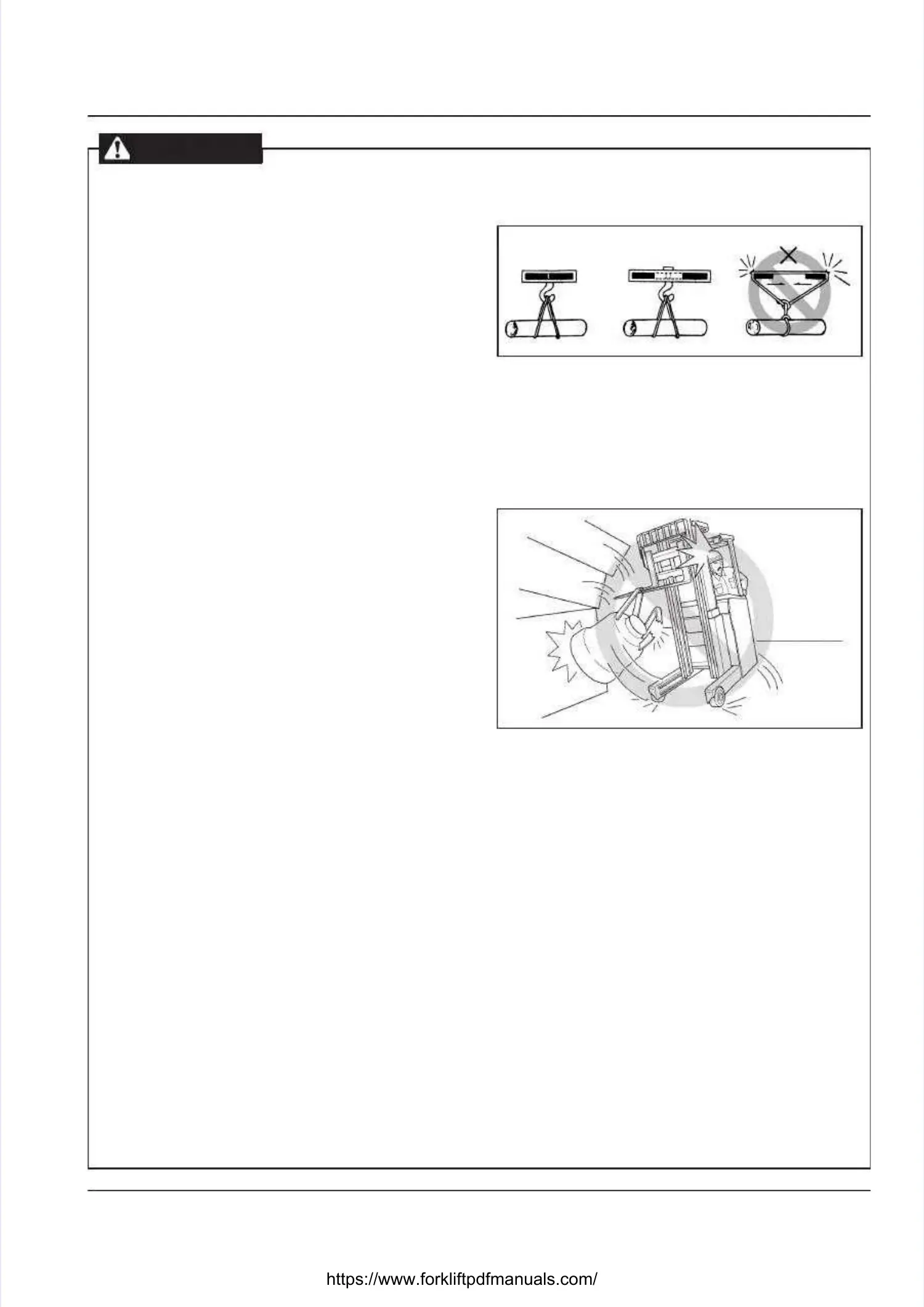
■■ Do not hang loads from wire Do not hang loads from wire ropesropes
attached directly to the forks:attached directly to the forks:
••
Do not hang Do not hang loads from wire loads from wire ropes attachedropes attached
directly to the forks or attachment. If the wiredirectly to the forks or attachment. If the wire
ropes break or slide off, personal injury mightropes break or slide off, personal injury might
result. In particular, never attach a wire rope onresult. In particular, never attach a wire rope on
one of the forks to lift a load; there is a dangerone of the forks to lift a load; there is a danger
that the lift truck will turn over.that the lift truck will turn over.
•• Use a hook Use a hook attachment or attachment or crane arm crane arm attachmentattachment
to hang loads.to hang loads.
◎◎Make sure that the wire ropes are strong Make sure that the wire ropes are strong
enough to withstand the weight of the loadenough to withstand the weight of the load
and are properly attached. The ropes shouldand are properly attached. The ropes should
be as short as possible and still have anbe as short as possible and still have an
adequate angle of spread between the legs.adequate angle of spread between the legs.
◎◎ Travel and turn when very carefully with a Travel and turn when very carefully with a
hanging load held by wire ropes; otherwise,hanging load held by wire ropes; otherwise,
if the load swings, the truck could tip over orif the load swings, the truck could tip over or
nearby items could be damaged.nearby items could be damaged.



 To Next Page