INSTRUMENTS AND CONTROLSINSTRUMENTS AND CONTROLS
2-282-28
LASER BEAMSLASER BEAMS
The fork positioning laser unit uses a laser. Laser safety requirements are dened in IEC 60825-1.The fork positioning laser unit uses a laser. Laser safety requirements are dened in IEC 60825-1.
1) Laser safety1) Laser safety
Unlike incandescent lamps, lasers can damage your skin or eyes if not used properly. The operator andUnlike incandescent lamps, lasers can damage your skin or eyes if not used properly. The operator and
his fellow workers must be careful.his fellow workers must be careful.
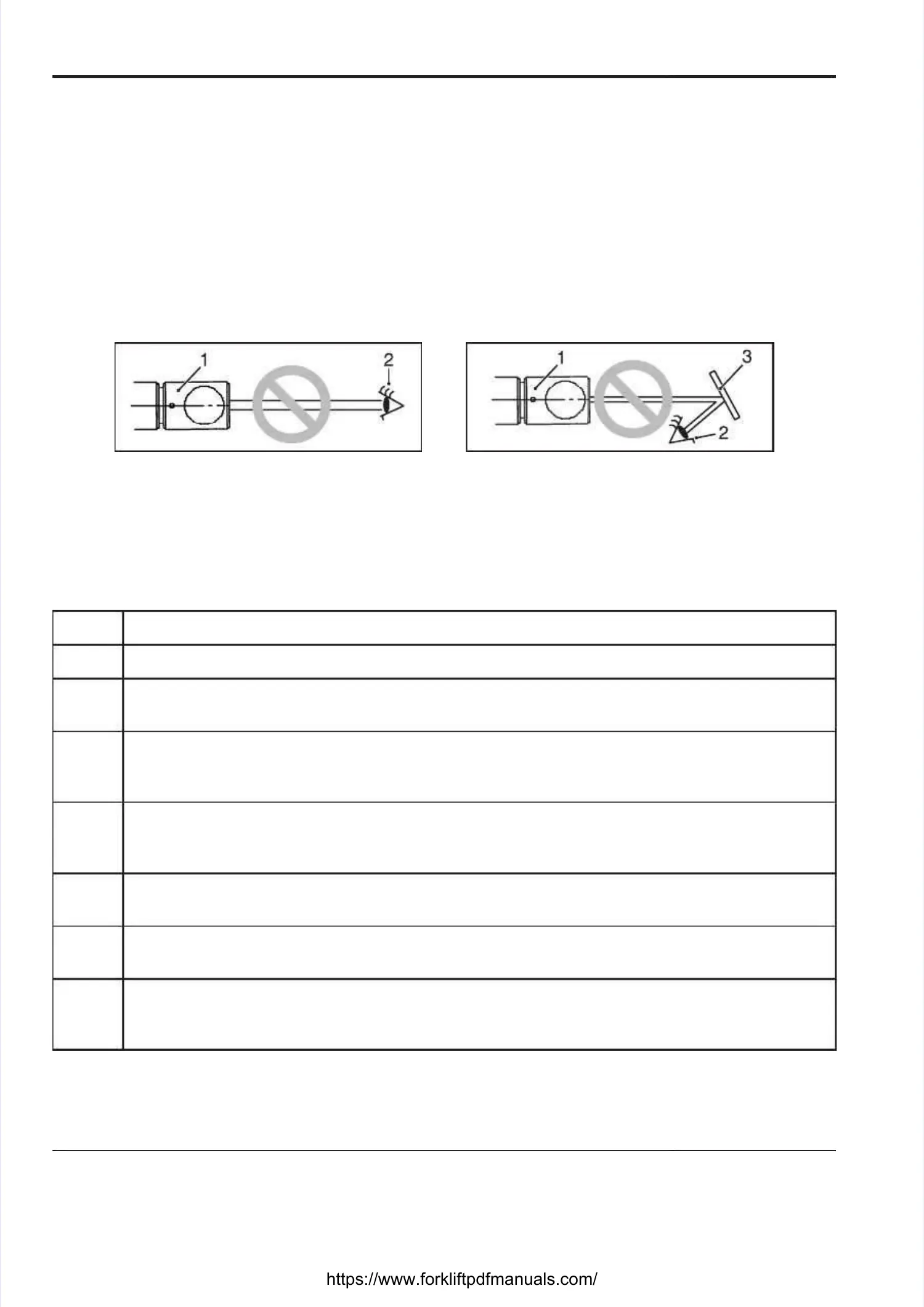
In particular, special care must be taken to protect the eyes. Do not look directly at a laser light source orIn particular, special care must be taken to protect the eyes. Do not look directly at a laser light source or
a laser beam reected in a mirror. If you accidentally look at the laser beam and experience any problema laser beam reected in a mirror. If you accidentally look at the laser beam and experience any problem
with your vision or feel discomfort in your eyes, seek medical attention immediately.with your vision or feel discomfort in your eyes, seek medical attention immediately.
Do not look directly at the Do not look directly at the laser.laser. Do not look a laser reected in a mirror.Do not look a laser reected in a mirror.
11. . LLaasseer r bbeeaam m ssoouurrccee 22. . EEyyee 33. . MMiirrrroor r
2) 2) Laser classication Laser classication by IECby IEC
Light Light from from lasers lasers is is classied classied into seven into seven categories, acccategories, according to ording to the degree the degree of hazard.of hazard.
The UniCarThe UniCarriers fork riers fork positioning laser positioning laser unit uses unit uses a laser a laser to produce to produce light that light that is in is in Class 3RClass 3R..
Use Use caution caution when when using using the the laser laser unit.unit.
Class Class Degree Degree of of hazardhazard
11 ClaClass ss 1 l1 laserasers as are re safsafe foe for ur use se undunder er all all reareasonsonablably-ay-antinticipcipated ated condconditiitions ons of of useuse..
1M1M
Class 1M lasers are safe for use under all reasonably-anticipated conditions of use. HoweverClass 1M lasers are safe for use under all reasonably-anticipated conditions of use. However
they may be hazardous if the user uses an optical apparatus within the beam.they may be hazardous if the user uses an optical apparatus within the beam.
22
Class 2 lasers are lasers emitting radiation in the visible portion of the spectrum. The power ofClass 2 lasers are lasers emitting radiation in the visible portion of the spectrum. The power of
these lasers is such these lasers is such that they will normally be that they will normally be protected by a protected by a physiologicphysiological aversion response (blinkal aversion response (blink
reex).reex).
2M2M
Class 2M lasers emit in the visible region in the form of a large diameter or divergent beam. It isClass 2M lasers emit in the visible region in the form of a large diameter or divergent beam. It is
presumed that the human blink reex will be sufcient to prevent damaging exposure, but if thepresumed that the human blink reex will be sufcient to prevent damaging exposure, but if the
user places an optical apparatus within the beam, the laser output may become dangerous.user places an optical apparatus within the beam, the laser output may become dangerous.
3R3R
Class 3R lasers are potentially dangerous to observe directly, but the degree of risk is lower thanClass 3R lasers are potentially dangerous to observe directly, but the degree of risk is lower than
a Class 3B a Class 3B laser.laser.
3B3B
Class 3B lasers are Class 3B lasers are usually dangerous to observe directlyusually dangerous to observe directly. . A A diffuse reection is usually diffuse reection is usually not anot a
hazard.hazard.
44
Class 4 lasers are dangerous to the eye if there is direct exposure to laser beam and may causeClass 4 lasers are dangerous to the eye if there is direct exposure to laser beam and may cause
a dangerous diffuse reection. The direct beam can produce skin damage and can also be a rea dangerous diffuse reection. The direct beam can produce skin damage and can also be a re
hazard. Due caution must be taken when using Class 4 lasers.hazard. Due caution must be taken when using Class 4 lasers.




 To Next Page