UAD Powered Plug-Ins Manual - 530 - Chapter 53: SSL E Channel Strip
EQ
The UAD SSL E Channel Strip EQ module is divided into four frequency
bands: High Frequency (HF, blue knobs), High Midrange Frequency (HMF,
green knobs), Low Midrange Frequency (LMF, yellow knobs), and Low Fre-
quency (LF, orange knobs). The high and low bands can be switched from
shelving mode into bell (peak/dip) mode. The two midrange bands are fully
parametric. The EQ module can be disabled altogether or routed for dynam-
ics sidechain keying.
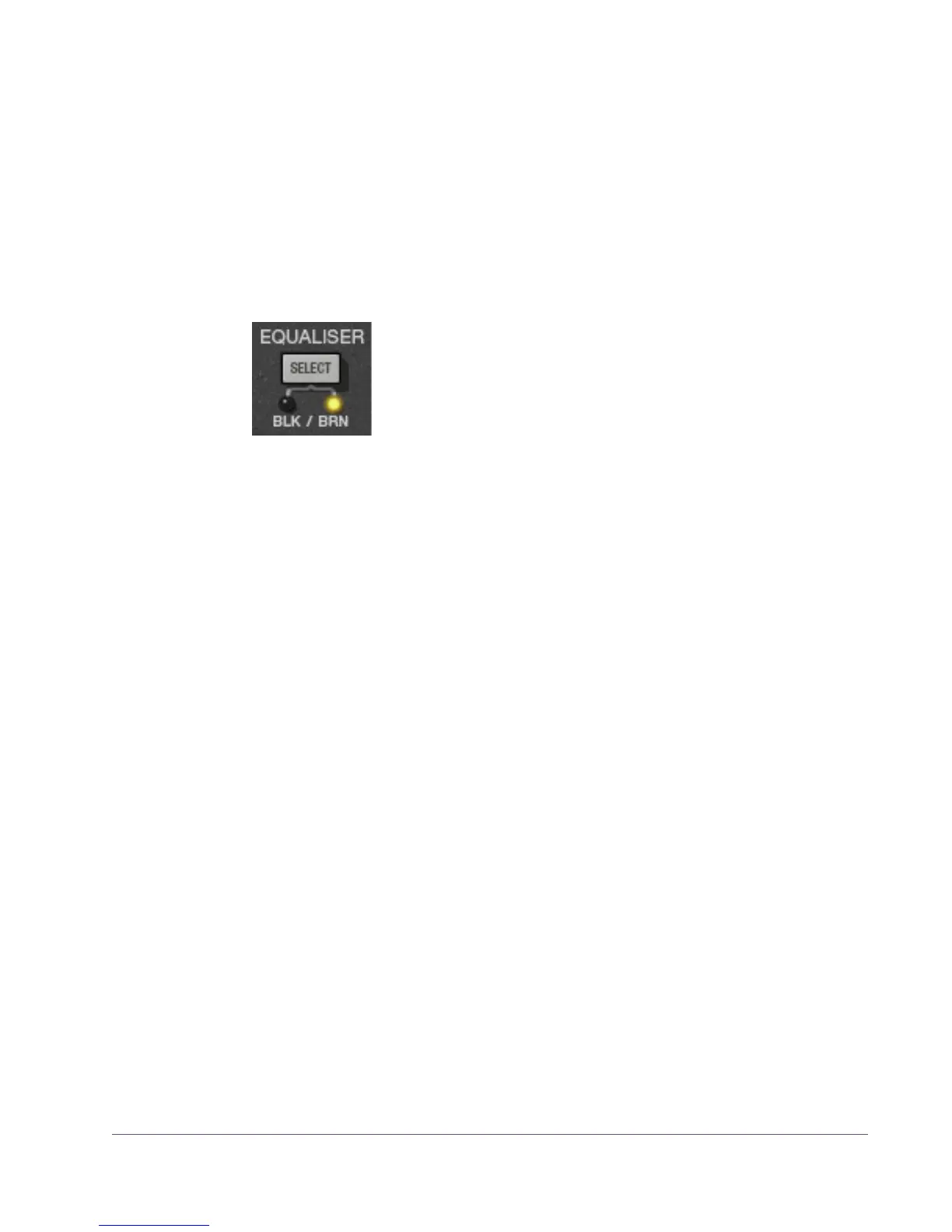
EQ Type Two different types of SSL EQ are available. The EQ Type but-
ton selects between the two types, either Black or Brown. The
knob color of the LF band controls changes to reflect the cur-
rent setting.
The Black and Brown EQs sound different. Black is a bit
deeper due to its higher gain values, while Brown is more gentle at extreme
settings.
EQ Type Background
The original E series equaliser section was the ‘Brown Knob’ circuit. This was
standard on all early production E Series consoles. The two parametric
mid-band sections feature a classic logarithmically symmetric design that en-
sures that the ±3 dB up/down points retain the same musical interval from the
centre frequency regardless of frequency and amplitude settings. The two
shelving sections are traditional 6 dB/octave designs with an option for a
fixed Q parametric response (Bell). The ‘02’ EQ, to give it its correct name
(the last two digits of the card’s part number), was used on countless record-
ings and mixes in the early eighties.
In 1983 a new ‘242’ EQ circuit was developed in conjunction with the leg-
endary George Martin for the first SSL console to be installed in AIR studios.
The ‘Black Knob’ EQ, as it became known, featured enhanced cut and boost
ranges (±18 dB instead of ±15 dB) together with a different control law and
a steeper 18dB/octave high pass filter for tighter control of low frequencies.
It is this design which is retained today as the ‘E-Series’ EQ option of the
X-Rack, Duality and AWS consoles.



 To Next Page