8 Start-up
126 Installation and maintenance instructions aroTHERM plus 0020297937_01
Checking the filling and supplementary water
▶ Before filling the installation, measure the hardness of the
filling and supplementary water.
Treating the filling and supplementary water
▶ Observe all applicable national regulations and technical
rules when treating the filling and supplementary water.
Provided the national regulations and technical rules do not
stipulate more stringent requirements, the following applies:
You must treat the heating water in the following cases
– If the entire filling and supplementary water quantity dur-
ing the operating life of the system exceeds three times
the nominal volume of the heating installation, or
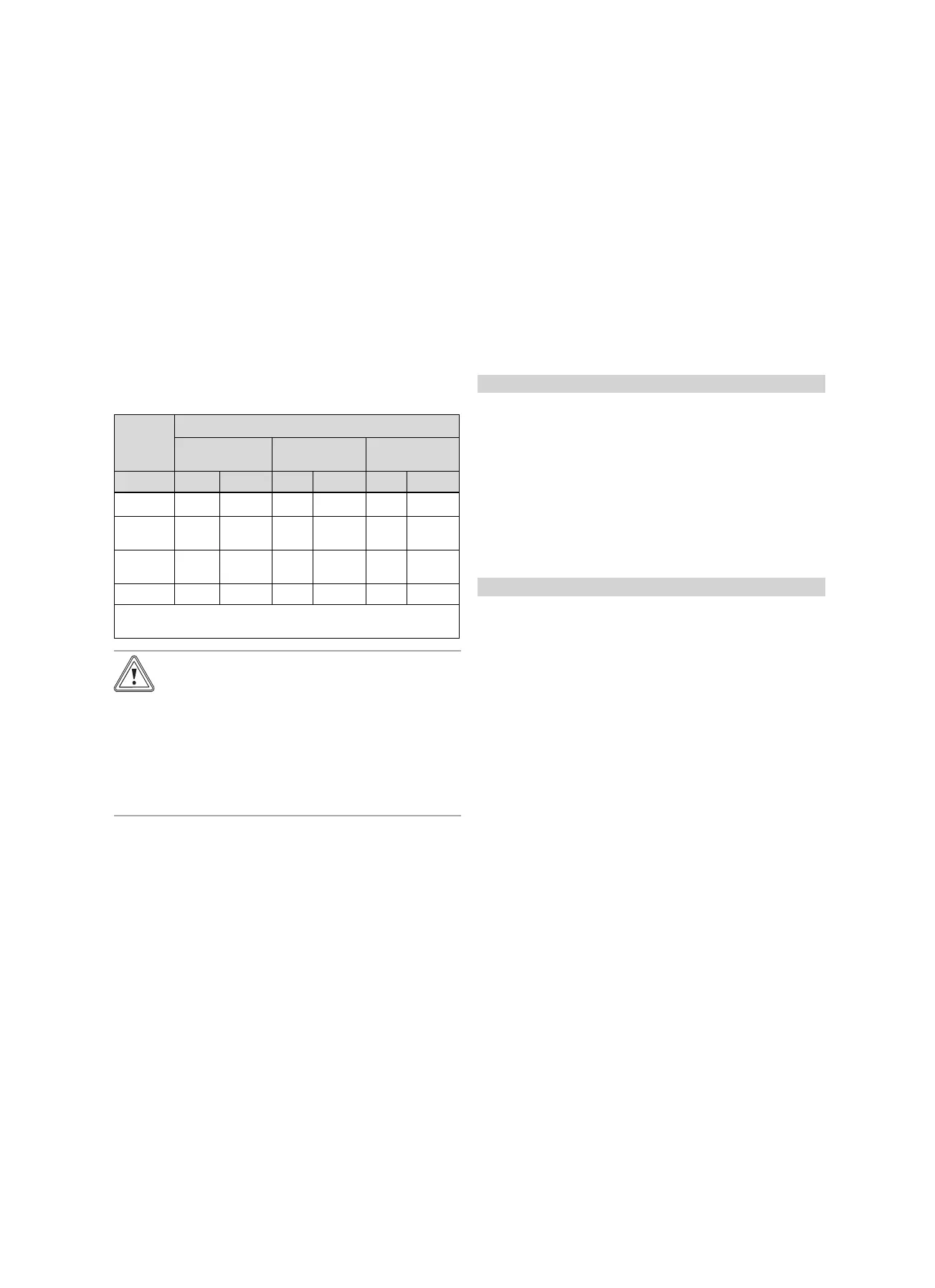
– If the guideline values listed in the following table are not
met, or
– If the pH value of the heating water is less than 8.2 or
more than 10.0.
Total
heating
output
Water hardness at specific system volume
1)
≤ 20 l/kW
> 20 l/kW
≤ 50 l/kW
> 50 l/kW
kW °dH mol/m³ °dH mol/m³ °dH mol/m³
< 50
< 16.8
< 3 11.2 2 0.11 0.02
> 50
to ≤ 200
11.2 2 8.4 1.5 0.11 0.02
> 200
to ≤ 600
8.4 1.5 0.11 0.02 0.11 0.02
> 600 0.11 0.02 0.11 0.02 0.11 0.02
1) Nominal capacity in litres/heating output; in the case of multi-
boiler systems, the smallest single heating output is to be used.
Caution.
Risk of material damage if the heating
water is treated with unsuitable additives.
Unsuitable additives may cause changes in
the components, noises in heating mode and
possibly subsequent damage.
▶ Do not use any unsuitable antifreeze and
corrosion inhibitors, biocides or sealants.
No incompatibility with our products has been detected to
date with proper use of the following additives.
▶ When using additives, follow the manufacturer's instruc-
tions without exception.
We accept no liability for the compatibility of any additive or
its effectiveness in the rest of the heating system.
Additives for cleaning measures (subsequent
flushing required)
– Adey MC3+
– Adey MC5
– Fernox F3
– Sentinel X 300
– Sentinel X 400
Additives intended to remain permanently in the
installation
– Adey MC1+
– Fernox F1
– Fernox F2
– Sentinel X 100
– Sentinel X 200
Additives for frost protection intended to remain
permanently in the installation
– Adey MC ZERO
– Fernox Antifreeze Alphi 11
– Sentinel X 500
▶ If you have used the above-mentioned additives, inform
the end user about the measures that are required.
▶ Inform the end user about the measures required for frost
protection.
8.4 Filling and purging the heating circuit
Validity: Direct connection
▶ Fill the product with heating water via the return.
Slowly increase the filling pressure until the required
operating pressure is reached.
– Operating pressure: 0.15 to 0.2 MPa (1.5 to 2.0
bar)
▶ Activate the purge programme on the indoor unit's
control.
▶ Check the system pressure during the purging pro-
cess. If the pressure falls, top up the heating water un-
til the required operating pressure is reached again.
Validity: System separation
▶ Fill the product and the primary heating circuit with
a frost protection/water mixture (44% vol. propylene
glycol and 56% vol. water) via the return. Slowly in-
crease the filling pressure until the required operating
pressure is reached.
– Operating pressure: 0.15 to 0.2 MPa (1.5 to 2.0
bar)
▶
Activate the purge programme on the indoor unit's
control.
▶ Check the system pressure during the purging
process. If the pressure falls, top up the frost pro-
tection/water mixture until the required operating
pressure is reached again.
▶ Fill the secondary heating circuit with heating water.
Slowly increase the filling pressure until the required
operating pressure is reached.
– Operating pressure: 0.15 to 0.2 MPa (1.5 to 2.0
bar)
▶ Activate the heating pump on the indoor unit's control.
▶ Check the system pressure during the purging pro-
cess. If the pressure falls, top up the heating water un-
til the required operating pressure is reached again.




 To Next Page