Ventis™ MX4 Product Manual
© 2014 Industrial Scientific Corporation
26
Instructions
Calibration and Bump Testing with Calibration Cup and/or Tubing
Read all instructions before beginning: notices, supply check-list, gas cylinder preparation, and the complete screen-
by-screen walk-through of the zero, calibrate, and bump test processes. Each process is presented in the order in
which it is accessible from gas monitoring mode.
NOTICES
Industrial Scientific recommends that full monitor calibration be performed, using a known certified
concentration(s) of Industrial Scientific calibration gas(es), to prepare the monitor for first time use, and
monthly (at a minimum) thereafter, to help ensure monitor accuracy.
Industrial Scientific also recommends that each monitor be zeroed and bump tested before each use with a
known certified concentration(s) of Industrial Scientific calibration gas(es).
Read ALL requirements and instructions outlined below, including the screen-by-screen process description,
before beginning the zero, calibration, or bump testing processes.
Only qualified personnel should zero, calibrate, or bump test a monitor.
Zero, calibration, and bump testing functions should be performed in a fresh air environment known to be
nonhazardous.
After calibration or bump testing, or after terminating either process, stop the flow of gas.
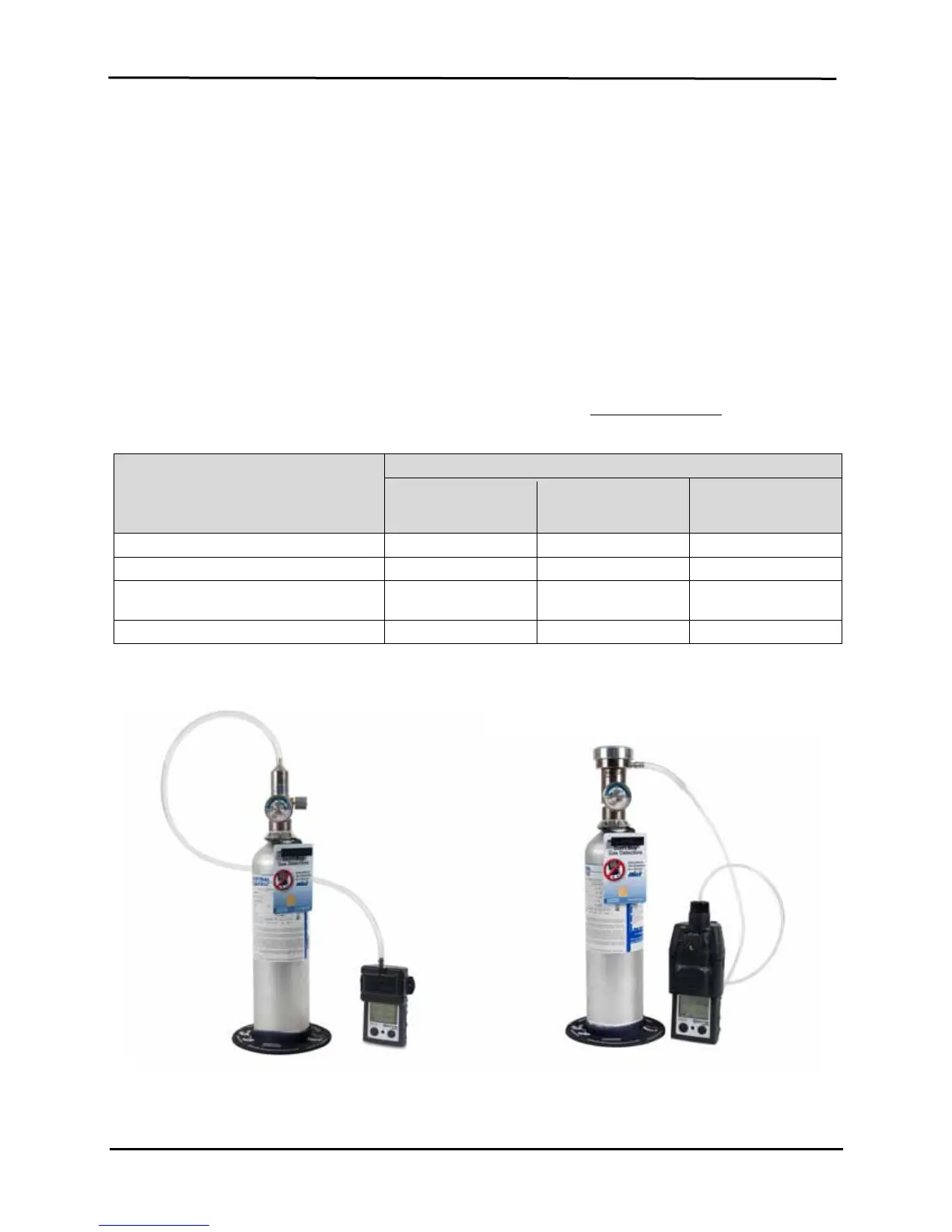
Supplies
Item Monitor/Regulator**
spirated monitor
with Demand Flow
Regulator**
spirated monitor
with Positive Flow
Regulator**
Diffusion monitor
with Positive Flow
Regulator**
Calibration cup* No No Yes
Calibration tubing 2 feet in length* Yes No Yes
Calibration tubing 2 feet in length with
integrated “t” fitting
No Yes No
Calibration gas cylinder Yes Yes Yes
*Shipped with monitor.
**Industrial Scientific recommends 1) the use of positive flow regulators with a flow rate of .5 LPM, and 2) the diffusion monitor be calibrated or bump
tested using a positive flow regulator, NOT a demand flow regulator.
Diffusion monitor with positive flow regulator. Aspirated monitor with demand flow regulator.


 To Next Page