This document is an operator's manual for the Vicon EXTRA 628 FT, 632 FT, and 635 FT swathers, manufactured by Kverneland Group Kerteminde AS. It provides instructions for trained farmers and qualified agricultural workers on assembling, operating, and maintaining the machinery.
Function Description
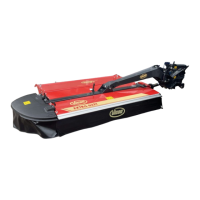
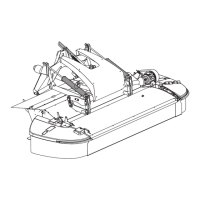
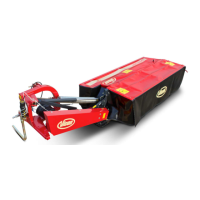
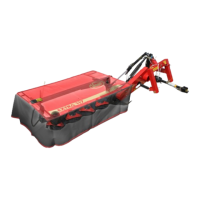
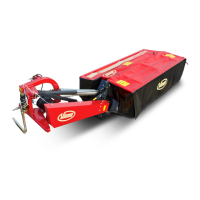
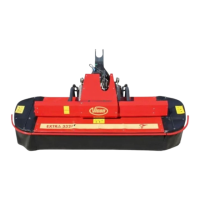
The EXTRA 628 FT, 632 FT, and 635 FT are front-mounted swathers designed to lay common grass and cereal crops in swaths. The machine's cutting unit is hydraulically connected to the main frame and can be raised and lowered using the tractor's hydraulic system. It is balanced by strong springs, ensuring precise ground following and uniform crop cutting. The cutting unit is equipped with a powerful rotor for effective crop conditioning.
Important Technical Specifications
The manual provides detailed technical data for each model:
| Specification |
Unit |
628 FT |
632 FT |
635 FT |
| Net weight |
KG |
1147 |
1165 |
1286 |
| P.T.O. Power take off |
rpm |
1000 |
1000 |
1000 |
| Power requirement |
kW/HK |
50 / 70 |
60 / 80 |
70 / 90 |
| Number of discs |
Qty |
8 |
8 |
10 |
| Number of knives |
Qty |
24 |
24 |
30 |
| RPM, cutting discs |
rpm |
3000 |
3000 |
3000 |
| RPM, rotors |
rpm |
900 / 600 |
900 / 600 |
900 / 600 |
| Hydraulic flow (max) |
L/min |
50 |
50 |
50 |
| Hydraulic pressure (max) |
bar |
210 |
210 |
210 |
| Working width |
m |
2.8 |
3.2 |
3.5 |
| Speed during operation |
kph |
8 - 16 |
8 - 16 |
8 - 16 |
| Noise level |
dB(A) |
85 |
85 |
85 |
| Clearance under the machine in the raised position |
cm |
40 |
40 |
40 |
| Transport width |
m |
2.6 |
3.0 |
3.4 |
The tractor must be equipped with a front lift device designed for a three-point hitch (DS/ISO 8759/2 compliant) and an A-frame (DS 6044 compliant, category 2 fasteners). The tractor's PTO shaft must be 1 3/8" with 6 splines and capable of running at 1000 rpm. The hydraulic system should provide a minimum flow of 25 L/min at 150 bar.
Usage Features
The swather is suitable for mowing various crops including all types of grass, clover, whole crop, alfalfa, and sorghum. It is not intended for cutting grass in park facilities, lawns, public road verges, harvesting corn, or clearing forest floors.
Key operational adjustments include:
- Conditioner Plate: Can be set in 3 positions (light, moderate, heavy) to adjust crop conditioning and throwing distance.
- Rotor Speed: Can be set to 600 rpm or 900 rpm by swapping pulleys on the transmission and rotor. This influences crop conditioning and length.
- Deflector Plates: Used to collect crop into a compact swath. They can be removed to spread crop across the full breadth of the machine. Extension pieces are available for a particularly compact swath. Users with large front wheels and short lift arms should be aware of potential contact with deflector plates when turning.
- Stubble Height: Adjusted by changing the length of the top link on the front lift device. Reducing length increases stubble height, extending it reduces stubble height.
- Suspension: The cutting unit's downward pressure (recommended 40-60 kg) can be adjusted by screwing a bolt. Taut springs cause instability, slack springs cause heavy dragging.
- Headland Turning: Involves activating and holding the tractor's hydraulic outlet to raise the cutting unit, then releasing the handle to turn.
Maintenance Features
The manual emphasizes regular maintenance to ensure safe and efficient operation. Key maintenance points include:
- Safety First: Always stop the tractor, remove the ignition key, disconnect the PTO shaft and hydraulic system, and apply the handbrake before any maintenance. Use proper support when working under the machine.
- Original Spare Parts: Only original spare parts should be used to maintain warranty and safety.
- Hydraulic Hoses: Should be replaced at least every 4 years and checked regularly for damage. Hydraulic systems must be depressurized before connecting/disconnecting hoses.
- Cleaning: Use PH neutral cleaning agents. High-pressure cleaners should be used with low water pressure around bearings, hydraulic hoses, plastic components, and electrical equipment. All guards should be opened, and loose material removed before cleaning.
- Storage: Before winter storage, check and tighten all bolts, repair damaged components, lubricate the machine, cover hydraulic quick couplings, clean and oil the PTO shaft, and ensure safety equipment is not worn. The machine should be parked on a stable, horizontal surface and secured against overturning.
- Lubrication: Regular lubrication is crucial. PTO shaft, cutting unit, cones, and mechanical connections require specific grease gun pumps (1-2 pumps, max 2 times) at intervals ranging from daily to every season.
- Oil Checks and Changes:
- Cutterbar: Check oil level daily. Oil change every 200 hours or once a year. Fill with new oil until the correct level is reached (3.6 L for 628 FT, 4.1 L for 632 FT, 4.6 L for 635 FT).
- Main Gear: Check oil level every 80 hours. Oil change every season (1.9 L).
- Bevel Gear - Cutting Unit: Check oil level every 40 hours. Oil change every 200 hours or once a year (0.25 L).
- Knives: Inspect regularly (after 1 hour of use, then daily) for wear and damage. Replace if worn or damaged. Bolts must be tightened to 95 Nm. Quick-release knives are an optional feature.
- Cutting Discs: Inspect regularly (after 1 hour of use, then daily) for deformation and cracks. Tighten to 80 Nm.
- Cones: External inspection daily for dirt. Internal inspection every season, cleaning inside the cone.
- Universal Joint: Inspect monthly for wear. Check bolts for looseness or breakage. Replace broken bolts and tighten to 79 Nm with Loctite 242.
- Stone Guard and Counter Knife: Inspect every 40 hours for wear. Replace immediately if visible holes appear.
- Y-fingers on the Rotor: Inspect daily for loose fingers, damage, or wear. Replace if damaged or worn. Bolts must be tightened fully, and Y-fingers should move freely.
- Friction Clutch: Bleed after prolonged periods without use. This involves blocking the cutter bar, removing the PTO shaft, tightening screws on the clutch, mounting it, and running the tractor's PTO at lowest speed for approx. 5 seconds. If the clutch still slips, it must be disassembled and cleaned. Replace friction discs if torque is too low.
- V-belt: Check regularly (after 10 working hours, then every 40 hours) for proper tension. A new machine or V-belt should be checked after a few hours of use.
The manual also includes a troubleshooting section for common issues related to hydraulic system, cutterbar, and PTO shaft, offering possible causes and remedies.

 Need help?
 General

 To Next Page