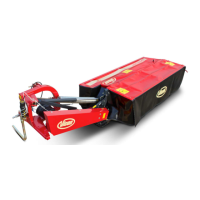
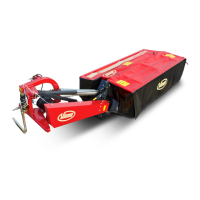
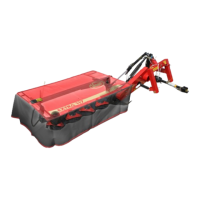
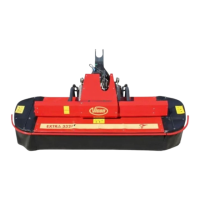
The device described in the manual is the EXTRΔ 632 FR, a swather designed for agricultural use.
Function Description
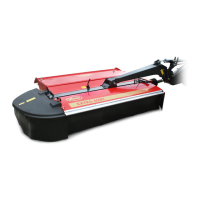
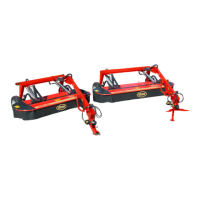
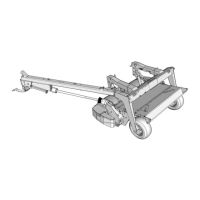
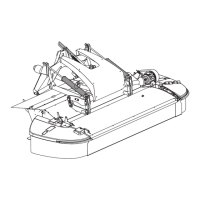
The EXTRΔ 632 FR is a front-mounted swather that couples to the lift arms of a tractor's front lift device. Its primary function is to lay common grass and cereal crops in swathes. The machine's cutting unit is hydraulically connected to the main frame, allowing it to be raised and lowered using the tractor's hydraulic system. Strong springs balance the cutting unit, ensuring the cutterbar precisely follows the ground contours for uniform crop cutting. The cutting discs are equipped with durable, reversible knives, designed for high capacity even at high mowing speeds and for difficult crops. The cutting unit also features powerful rollers for effective crop conditioning. A guard protects the cutting unit from moving objects, and this guard, or its parts, must never be removed and must always be kept in good condition. The machine is designed for quick and easy lifting of the cutterbar hydraulically when turning on the headland, without the need for tools.
Important Technical Specifications
The EXTRΔ 632 FR has the following key technical specifications:
- Net weight: 1267 kg
- P.T.O. Power take off: 1000 rpm
- Power requirement: 60 / 80 kW/HK
- Number of discs: 8
- Number of knives: 16
- RPM, cutting discs: 3000 rpm
- RPM, rollers: 900 rpm
- Hydraulic flow (max): 50 L/min
- Hydraulic pressure (max): 210 bar
- Working width: 3.2 m
- Speed during operation: 8 - 16 kph
- Noise level: 85 dB(A)
- Clearance under the machine in the raised position: 40 cm
- Transport width: 3.0 m
Machine Dimensions:
- A: 2000 mm
- B: 1450 mm
- C: 1400 mm
- D: 3200 mm
- E: 2980 mm
- F: 1700 mm
- G: 4215 mm
The tractor connecting to the swather must have a proper weight, and local regulations governing this relationship must be observed to ensure proper braking and maneuverability. The front lift device must comply with DS/ISO 8759/2 and be fitted with an A-frame complying with DS 6044. The A-frame may be supplied with category 2 fasteners, but is not supplied with new machines. The tractor's PTO shaft must be 1" 3/8 with 6 splines and capable of running at 1000 rpm.
Usage Features
The EXTRΔ 632 FR is intended for mowing various crops in fields, including all types of grass, clover, whole crop, alfalfa, and sorghum. It is explicitly not to be used for cutting grass in park facilities and lawns, on public road verges, harvesting corn, or clearing forest floors or densely wooded areas.
Preparation and Connection:
- The machine is delivered in main components and requires assembly according to specific instructions.
- The transmission's direction of rotation can be changed to suit tractors with either clockwise or anti-clockwise PTO outlets. The transmission is factory-fitted for clockwise rotation.
- When connecting the machine, ensure the tractor cannot roll, the tractor and machine belong to the same category, and never stand between them during attachment.
- The hydraulic three-point suspension should be used slowly and carefully.
- The machine's support legs must be fully lowered during initial fitting.
- The A-frame is fitted to the tractor's front lift device and locked into the machine.
- The top link on the front lift device should be adjusted so the A-frame is vertical.
- Hydraulic connections should only be made when the system is depressurized to prevent unintentional movement.
- The tractor's hydraulic outlet should be set to the floating position to allow the machine to follow ground contours. Downward pressure must not be applied.
- The PTO shaft must overlap by a minimum of 200 mm when fitted and its length checked with the machine in the raised position.
- The cutting unit's suspension should be adjusted to about 40-60 kg downward pressure, checked by lifting manually.
- The friction clutch needs to be bled when first started or after a long period of disuse by blocking the cutterbar and rotating the clutch at the lowest possible speed for approx. 5 seconds.
Operation:
- Before use, the operator must be thoroughly instructed and all safety instructions complied with.
- All protection guards must be in place.
- Tyre pressure should be regularly controlled.
- The surrounding area must be checked for persons and animals before use.
- The hydraulic flow of the tractor should be limited to 50 l/min to avoid overheating and overloading.
- Roller pressure is adjusted via strong springs on both sides of the machine, with a standard setting of approximately 2 mm between spring coils. Increased pressure for grassy crops, reduced for clover and leafy crops.
- The distance between rollers can be reduced or increased by adjusting nuts, with a recommended distance of 3 mm.
- Deflector plates can be adjusted or removed to control swath compactness. Extension pieces can be added for a more compact swath.
- When turning at headlands, the cutting unit is raised hydraulically.
Maintenance Features
Regular maintenance is crucial for safety and longevity.
- General Instructions: Maintenance work should only be performed by trained personnel using proper tools. The PTO shaft must be disconnected, the tractor engine stopped, ignition key removed, handbrake applied, and hydraulic system depressurized. The machine must be safely parked and supported.
- Lubrication: Follow the lubrication scheme provided in the manual. Use authorized products. Grease gun application should be 1-2 pumps, avoiding over-greasing.
- Oil Change: Use authorized oil products. Used oil must be disposed of properly.
- PTO Shaft Check: Refer to the manufacturer's instructions for the PTO shaft. Lubricate grease nipples daily.
- Cutting Unit (Every 40 hours): Lubricate grease nipples on the cutting unit and turn the cone 180 degrees to lubricate the other side.
- Cones (Every season): Inspect cones for dirt and clean them. Remove top covers for internal inspection and cleaning.
- Universal Joint (Every month): Inspect for wear. Check bolts for looseness or damage, replace if necessary, and tighten to 79 Nm using Loctite 242.
- Knives (After 1 hour, then daily): Inspect knives for wear and damage. Replace worn or damaged bolts (minimum diameter 16 mm). Tighten bolts to 95 Nm. If fitted with quick release, the same bolt wear requirements apply.
- Cutting Disc (After 1 hour, then daily): Inspect for deformation and cracks. Tighten to 80 Nm using Loctite 242.
- Stone Guard and Counter Knife (Every 40 hours): Inspect for wear. Replace immediately if visible holes are present.
- Rollers (Daily): Inspect for lodged foreign bodies.
- Friction Clutch (After prolonged disuse): Bleed the clutch by blocking the cutterbar and rotating for approx. 5 seconds at lowest speed. If slipping persists, clean contact surfaces.
- V-belt (After 10 hours, then every 40 hours): Check V-belts on rollers. Tighten springs with a bolt to 80 mm measurement.
- Oil Changes:
- Cutterbar (After 10 hours, then every 200 hours or once a year): Drain old oil (approx. 10-15 minutes), refill with 4.1 litres of new oil (632 FR model).
- Main Gear (After 10 hours, then every season): Drain old oil (approx. 10-15 minutes), refill with 1.9 litres of new oil.
- Bevel Gear - Cutting Unit (After 10 hours, then every 200 hours or once a year): Drain old oil (approx. 10-15 minutes), refill with 0.25 litres of new oil.
- Main Gear - Rollers (After 10 hours, then every season): Drain old oil (approx. 10-15 minutes), refill with 0.8 litres of new oil.
- Arm - Rollers (After 10 hours, then every season): Drain old oil (approx. 10-15 minutes), refill with 0.75 litres of new oil.
- Storage: At the end of the season, clean the machine thoroughly, change transmission oils, cover hydraulic quick couplings, clean and oil the PTO shaft, check safety equipment, bleed excess hydraulic pressure, and store in a ventilated machine room on a stable, horizontal surface, secured against overturning.
The machine is CE marked, complying with EC regulations, specifically EU Directive 2006/42/EC and standards such as DIN EN ISO 12100-1:2003, DIN EN ISO 12100-2:2003, DIN EN ISO 4254-1:2005, and DIN 11001-3:1998.

 Need help?
 General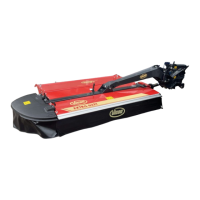

 To Next Page