Maintenance
Tires 61
Check the air pressure of the tires every 50 hours and correct
it if necessary.
– When checking the tire pressure the machine must be without
load.
– When inflating a tire with a multi-part rim you must make sure
whether the loose ring sections are correctly positioned to each
other, because a flying off ring can cause life threatening injury.
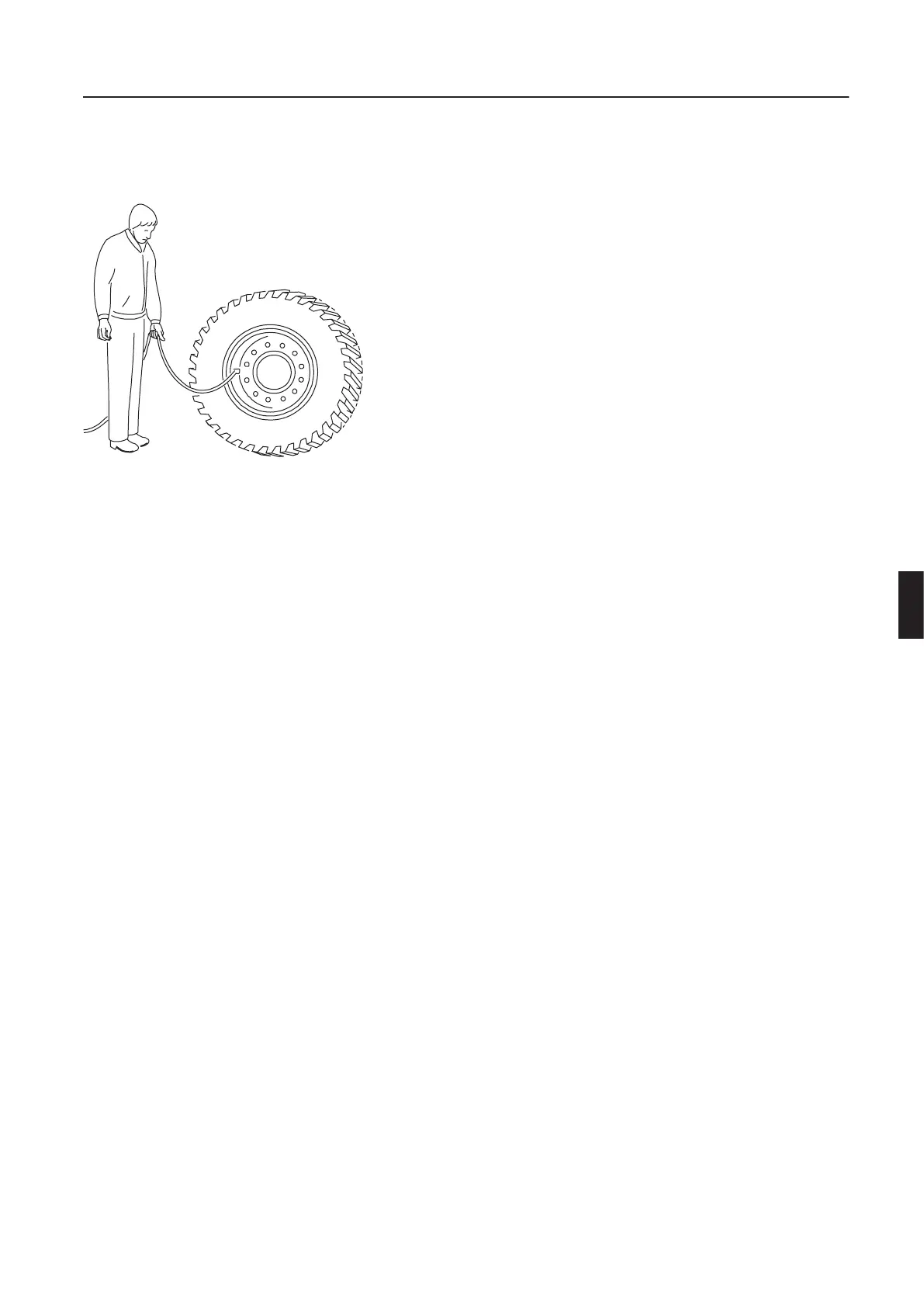
– An self-locking nozzle with hose of sufficient length should be
used, so that the person perf orming the work can stand outside
the danger zone. (See illustration)
– Donotcutorweldontherimofaninflatedtire.
– Do not combine rim parts of different dimensions and do not
use damaged or defective parts.
– Alwaysrelievethetirepressurebeforeremovingforeign
obstacles from the tread of a tire.
– After checking and filling screw the v alve cap back on.
– For special applications (e.g. on sand) the air pressure ma y be
changed after consulting the customer service department or
the tire manufacturer.
– The adherence to the specified air pressure has a decisive
influence on the lifetime of the tires.
– For the tires driving with a too low air pressure means:
– higher kneading work,
– higher temperature,
– excessive straining of the fabric,
– more bulging of the side walls.
– This results in:
– Loosening of individual fabric fibres,
– cuts and damage to the side walls.
– High ai r pressure is dangerous:
– It causes excessive tensile loads in the fabric: this makes the
tire more susceptible for punctures and cuts.
– During the first week all wheel nuts must be tightened
every day, after this ever y 50 operating hours - tightening
torque 290 Nm / 213 lbf ft.
– After a wheel chang e the wheel nuts must also be
tightened every day during the first week.
M300056A



 To Next Page